
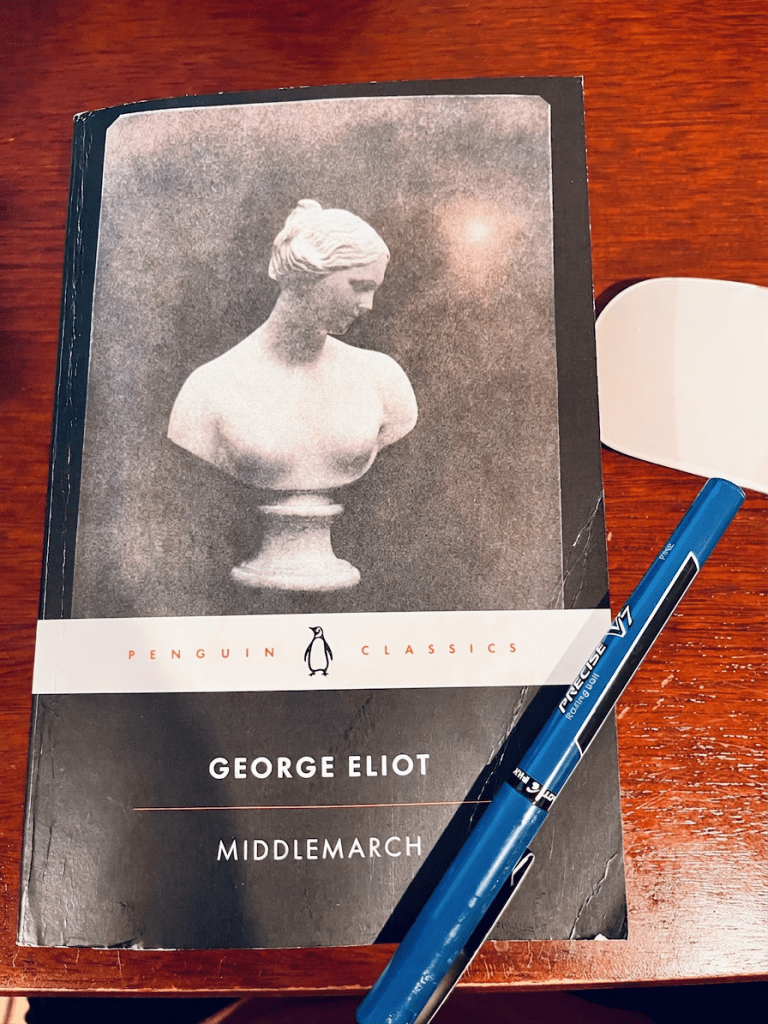
How Middlemarch Shaped My Perspective as a Mother

I am 38 and only just discovered Middlemarch by George Eliot, and now it’s in my top 5 favorite novels of all time, and I thank God I didn’t wait another 30 years before I opened this book, because not only is it a classic for a reason– timeless, universal, exceptionally written– but it hit me just at the right season of my life as a 38-year-old wife and stay-at-home mother who wrestle with this need to feel “fulfilled” and “accomplished” in my life.

When I picked up Middlemarch, I expected to read a great Victorian classic. I didn’t expect it to tug at my soul and expose its contents and re-narrate the story I had scripted about my own life. Middlemarch spoke poignantly to some of my deepest longings and questions and fears, the way no self-help book or therapy can, by expressing humanity through deep and complex characters going through ordinary life.

This post is not a review, though it does contain elements of it, and will include spoilers. This post is about how Middlemarch helped me see myself in this season more clearly and empathetically, how it defined the image I had for myself through a pretty annoying character, and how it helped me feel more content and fulfilled in my life.

First of, George Eliot writes beautifully. Her prose is just unrivaled, and I was copying down sentence after sentence that were so beautifully and gracefully crafted that I wept at how my own writing paled in comparison. Her characters have flesh, blood, movement, tears, sweat, creaking joints, excrements. They are alive. They are not satirical or angelic like most of Charles Dickens’ characters. They are not melodramatic and overwrought like some of Fyodor Dostoevsky’s characters. They are noble and egoistic; earnest and foolish; generous and selfish– all the dimensions that make up the complex nature of a human being who’s both made in the image of God yet is also fallen and depraved.

And you can really tell that Eliot loves her characters. She’s got such tenderness towards them, the way God does to His image-bearers. She exposes their shortcomings, yet covers them with grace and mercy and compassion. None of her characters are pure villains or angels. They are so richly complex, so vibrantly flawed, yet uniquely sympathetic and whole and…well, dignified in their own right. Many writers do this well, but Eliot is next level. As a narrator, she flows naturally from counselor to pastor to philosopher to a fellow human being in the way she illustrates and analyzes what’s happening. She’s no postmodernist— she’s got a strong moral core, but without being sanctimonious.

Middlemarch is set in a small early 19th-century town called Middlemarch in England, at a time when Britain was globally powerful and prosperous, when society was still rigidly divided into social status and gender, when women were expected to be naturally more virtuous than men yet stay dependent, private, powerless, and fragile, and when the Industrial Revolution was gearing up, causing new and inextricable issues regarding class, labor, human rights, politics, education, democracy.

At its core, the book is about unmet idealism. It follows the ambitions, limitations, and disappointments of two main characters, Dorothea Brooke and Tertius Lydgate. (By the way, who’s named Dorothea or Tertius these days?)

We meet Dorothea as a “handsome” and “remarkably clever” 19-year-old orphaned woman who intentionally wears such plain garments in contrast to her beauty that she’s compared to the “Blessed Virgin appeared to Italian painters.” She’s described as having a mind that’s “theoretic, and yearned by its nature after some lofty conception of the world.” She’s “enamoured of intensity and greatness, and rash in embracing whatever seemed to her to have those aspects; likely to seek martyrdom.” She’s ardently pious with a fierce sense of social justice and compassion, to the point where meeting a sick labourer would cause her to “kneel suddenly down on a brick floor” and pray “fervidly as if she thought herself living in the time of the Apostles.”

In short, she’s tiresome. She’s annoying. She’s the kind of Bible-quoting, moral policing, self-denying, self-righteous social justice warrior who would chastise you for swearing or being apathetic about oppression.

Here’s one early scenario, where her younger sister Celia suggests looking through their dead mother’s jewels. Dorothea is instantly dismissive— Why? Only worldly people wear jewels. Celia argues that they should respect mama’s memory, that necklaces are quite usual these days, not at all extravagant, and “surely there are women in heaven now who wore jewels,” she tries feebly.

Dorothea consents and they admire their mother’s jewels. Dorothea is delighted in Celia’s delight. Then Celia suggests Dorothea keep a beautiful pearl cross, thinking that would suit her religious aesthetic.

“Not for the world, not for the world. A cross is the last thing I would wear as a trinket.” Dorothea shuddered slightly.

“Then you will think it wicked in me to wear it,” said Celia, uneasily.

“No, dear, no,” said Dorothea, stroking her sister’s cheek. “Souls have complexions too: what will suit one will not suit another.”

OK. YOU SEE WHAT I MEAN? She is maddening!

Here, in one passage, Eliot brilliantly captures the paradox of Dorothea. She clearly admires the jewels, but she justifies it with religious speak. It’s OK for her sister to wear a cross necklace, but no, absolutely not her, because she’s different, she’s set apart, she’s extraordinary. This is Dorothea’s contradiction: She’s genuinely humble and good…but she’s also freaking full of herself, and she’s completely unaware of it. She believes she’s called to an unconventional vocation, a heavenly mission.

Trouble is, she’s a woman in the early 1800s in England. The best permitted ambition for her is to marry up. So she decides she’s going to marry someone extraordinary– an exceptional husband for a woman who seeks the exceptional things in life. When Sir James Chettam, a wealthy, good-natured, handsome young landowner expresses interest in Dorothea, she shuts that down real quick. Sir James might be the ideal catch for many a women, but not Dorothea, oh no. No, she decides to marry Edward Casaubon.

Let Eliot describe Casaubon to you: “the set of his iron-grey hair and his deep eye-sockets made him resemble the portrait of Locke. He had the spare form and the pale complexion which became a student; as different as possible from the blooming Englishman of the red-whiskered type represented by Sir James Chettam.”

Eliot is being charitable by describing him through the eyes of Dorothea. Celia describes Casaubon more candidly: “How very ugly Mr Casaubon is!”

When Dorothea rebukes her sister, saying Casaubon is as distinguished-looking as Locke, Celia retorts, “Had Locke those two white moles with hairs on them?”

Oh man. I DIE. Do you know what John Locke looks like? This is a portrait of Locke:

Dashing, he is not. His nose is large enough to hang a coat. Add two white moles with hairs, and that’s Casaubon. Also, Casaubon is 45 years old to Dorothea’s 19.

Besides, he is just…that kind of self-important, self-serious, mansplainer who talks “as if he had been called upon to make a public statement.” He is not just old enough to be Dorothea’s father; he is also physically ailing. He’s spent too much time indoors poring over his tomes, working on a scholarly masterpiece that have yet to materialize, and his sallow skin and weak frame reveal it.

And THEN! The proposal he writes Dorothea! I won’t quote it, because it’s incomprehensible with all its stylized, obtuse garble (even by Victorian standards), but basically, he tells her that he’s a Very Important Man, working on a Very Important Work that demands all his energy and attention (basically, he’s trying to compile the world’s mythologies into one scholarly religious text), but he senses another need that he once feared would interrupt that Very Important Work, and that is a female helpmate. But hark! He’s finally found a companion worthy of assisting him in this Very Important Work: Dorothea! How amazing is he– uh, she? Would she marry him?

And Dorothea’s reaction? She “trembled while she read this letter; then she fell on her knees, buried her face, and sobbed.” Not out of outrage and indignation, as any sensible woman should have, but out of overwhelming gratitude that she had been chosen. She herself didn’t choose Casaubon out of love: “Her whole soul was possessed by the fact that a fuller life was opening before her: she was neophyte about to enter on a higher grade of initiation.”

So I guess they deserved each other. They married to fulfill their own needs. And their marriage is disastrous. Not only does Casaubon not show much affection or appreciation for who Dorothea is as a person, he starts resenting and belittling her once he realizes that she realizes that Casaubon is indeed a big fat fraud. And worse, he’s a BORE. He can parrot important, serious-sounding intellectual words, but it’s all regurgitation. He’s well-read, but as bland as soggy bread. He’s disciplined, but utterly unoriginal and uninspired. He always does what is right, but there’s a stinginess even to his charity.

Dorothea had expected Casaubon to elevate her spiritual purpose, to stimulate her hunger for intellectual nourishment. Instead, their marriage spirals into a toxic prison of resentment, frigidness, jealousy, bitterness, suspicion, fear, insecurity. For all her high-minded ways, Dorothea is an earnestly joyful person, but he sucks the joy and zest out of her. Finally, Casaubon dies, and Dorothea is a young widow bereft not just of a husband, but her dreams of a fulfilling some deep purpose in life.

And then there’s Tertius Lydgate. Now Lydgate is a middle-class man. He’s got way more power and resources and opportunities than Dorothea. He’s also whip-smart, young, educated, visionary. He’s progressive and scientific in the medical field, at a time when doctors still drew blood to “restore bodily balance” and placated patients with nonsense brews. He arrives in Middlemarch as an ambitious doctor aiming to reform medicine in a conservative rural town suspicious of anything new and progressive. He wants to save lives…and make a name for himself.

His is an even more tragic story. Lydgate had so much potential and worthy goals. But then he marries a beautiful woman with elegant charm and a sweet singing voice and pretty smiles but no moral compass, sensibility, or perspective other than her own. His story is a painfully gradual, downward slide— first financially, then maritally, then socially and idealistically…until he quietly fades into comfortable mediocrity, which quite literally diminishes him.

Dorothea and Lydgate are similar in many ways: They are both idealistic and intelligent. They both marry disastrously and becomes disillusioned. But their ending is different. By the end of the book, one commands admiration. The other evokes pity.

The difference between Dorothea and Lydgate is that Dorothea had moral resilience. When her life didn’t turn out the way she wanted, she learned and evolved. Dorothea faces her disappointments with a strong, principled determination to continue doing what is right and good. She might not feel respect or love for her husband, but she continues to act in love and faithfulness even when he’s cold and bitter towards her. She exchanges bitterness for compassion. She gives up her lofty ideals, but not her values, and in the process, she gains empathy, wisdom, resilience, strength, discipline. She is still passionate and high-minded, but her passion and orientation become refined, grounded, and authentic. Eventually she marries again, this time giving up status and influence for a life of invisibility and ordinariness, but one that’s also rich in love and relationships. This is someone who redirects her passion to what truly matters.

Lydgate is not like Dorothea. He diminishes. He gets smaller and smaller. He compromises, shrinks, and eventually, succumbs to defeat. He gives up relationships and purpose. He becomes passive. And he stops striving for what is good and true, and simply…lives on because he’s still breathing, and bills need to be paid. This is someone who loses his passion.

There is so much to unpack here.

As much as Dorothea irritated me with her youthful delusions of grandeur and martyrdom, even more irritatingly, I saw myself in her. I have those delusions of grandeur. I always thought it would be quite awesome to die while reporting in a war zone, or to get entangled in danger because I’m exposing corruption in powerful authorities. I had so much passion in me to make the most of life, to make it matter, to do something that matters. I also deeply identified with Lydgate’s ambitions and potential, and his sometimes awkward inability to fit neatly into societal conventions and expectations.

It’s in my nature to be idealistic, but I think it was also nurture. I was raised by a very idealistic, passionate, intense father with firm principles on what is right and wrong. He sought righteousness with all his heart and might all his life, and he raised me to be that way. All of those traits are wonderful and good…until it gets twisted with human ego and a fear of failure. I also remember as a kid attending church conferences by Darakbang, a Korean evangelistic denomination that’s…slightly cultish (but not a cult) and super intense about evangelism and discipleship. Through Darakbang, I heard so many exhortations to be this era’s “Daniel” and “David” and “Moses”– highly educated, highly accomplished, powerful “elites” (they actually used that term “elite”) who will shake society and heaven.

I strived to be a Daniel and Moses. I wanted to be an elite. Someone who does great things. A transformer. A mover and shaker. A legacy.

And what do I do now? I read Middlemarch after the kids go to bed, and that’s the main intellectual exercise I get for the entire day.

I wake up with two little kids clinging onto me like little koalas. I pick up toys and shoes and underwear as I strut around the house, changing diapers, washing poopy hands, wiping apple sauce off counters and floors, wiping snot on my sweatpants (my daily attire), holding a tantrumy toddler in one arm while stir-frying dinner with the other, telling a high-energy preschooler for the twelfth time to sit his butt on the chair instead of rolling underneath the dining table, and teaching a highly unmotivated 4-year-old to sound out the word “CAT.”

I do not feel like a Daniel or a Moses or a David. I feel…like a Martha. Constantly doing, rushing, repeating chores and duties that are invisible only because someone is doing them, day in day out. Someone who’s quietly resentful of the countless things she does all day but has nothing to show for at the end of the day.

By the time I read Middlemarch, I had accepted that this is my life, a life I’ve chosen. I chose to stay at home. I chose to homeschool. I mentally closed the door to a career, likely forever. I stopped seeing myself as a former journalist, and more as a mother.

But it didn’t mean I felt good about it. Not that I felt bad about it— I was truly grateful to have this privilege to spend time intentionally raising my children. But I did feel like my original ambitions, my desire to do great things, had shriveled away for the sake of this life. I felt like a flower with a few petals ripped off. When I saw other former colleagues travel overseas to report on important issues, producing fantastic work, getting promoted to more distinguished journalistic positions, my heart ached with a sense of loss. And I would console myself by saying, “Well, I had my fair run. Now I’m a mother, and that’s important work, too.” It was more placating than true contentment and pride in where I am right now. I didn’t feel…well, great.

The problem is not that I sought greatness. It was that my idea of “greatness” didn’t mature all that much with my age. I still had that image of an “elite” as my vision of greatness. Doing great things was large, visible, measurable, extraordinary. But motherhood is one of the most ordinary vocation.

And then I finished Middlemarch, and contemplated the lives of Dorothea and Lydgate. And I read and re-read the ending. Here, Eliot is honest about Dorothea’s life. She re-marries someone who’s deemed far lower than herself, giving up her inheritance, and everyone proclaimed it a mistake. She was known in town as that

fine girl who married a sickly clergyman, old enough to be her father, and in little more than a year after his death gave up her estate to marry his cousin– young enough to have been his son, and with no property, and not well-born. Those who have no seen anything of Dorothea usually observed that she could not have been ‘a nice woman’, else she would not have married either the one or the other.

She was once seen as beautiful, clever, a bright and morning star. Now she’s considered a failure, a disappointment— that is, if anyone considers her at all. Meanwhile, as a modern-day feminist reader, I applaud Dorothea for following her heart this time, but there’s a sense in me that’s disappointed that she became “just” a wife and mother. But Eliot redeems her by famously ending with:

But the effect of her being on those around her was incalculably diffusive: for the growing good of the world is partly dependent on unhistoric acts; and that things are not so ill with you and me as they might have been, is half owing to the number who live faithfully a hidden life, and rest in unvisited tombs.

Dorothea didn’t lose herself– at least, not the parts that were essential to how God created her. She still chose the unconventional by marrying her second husband, who later became a social reformer, while nothing much is said about Dorothea marking her impact in the public sphere. It’s implied that she was still influential within her realm, albeit invisibly, and earning zero credit or recognition for it. And Eliot dignifies and redeems that in her.

In the season I’m in right now, I have a conscious choice to make: Dorothea, or Lydgate?

I am still the same person I was before I gave up my career to be a stay-at-home mother. I still have passions, ideals, curiosity, and desires for an intellectually and spiritually fulfilling, rich life— things that drew me to my career as a journalist in the first place. I think those are natural traits that God formed in me. It’s what makes me me, and I believe God honors that.

Reading Middlemarch awakened those things in me, while reminding me that just as Dorothea had to refine and temper those natural instincts in her as she grew from a 19-year-old girl to a mature, time-tested, experienced woman, I too am in the process of fine-tuning my passions and ideals and dreams, from youthful impulsion and selfish ambitions into something more real, more true, more pure…and it’s not just motherhood.

It’s being a whole person. A fuller person. A person who seeks goodness and does good even when no one is watching, when no one recognizes me, when there’s no accolades or promotions. A person who doesn’t long to be seen, but sees others. A person who doesn’t just plan and dream, but acts and lives out my values. That’s what it means to be fulfilled in life– to fill my life with faithfulness, goodness, and contentment. I don’t need to seek purpose; there’s purpose already in the life I’ve been given.

Dorothea was an irritating girl when I first met her. But by the last page of Middlemarch, she earned my respect and admiration. She’s not a typical role model exemplified in society, whether in the 1800s or today. But she is mine.

Rethinking my political journey

I’ve been wanting to process and write about this topic for a long time, but I had pushed it off because 1) the only time I have to blog is usually after 9 pm when the kids are in bed and 2) my brain is musty from full-time childcare, and it’s even mustier at night when all I want to do is snack and read fiction.

But now with the shocking murder of Charlie Kirk, and the conversations that have swarmed out like ants from a smoking ant hill, I feel like this is the time to seriously, carefully rethink my political journey, especially as a parent raising young children in this divisive and politically violent age. I’ve been feeling twinges of conviction from time to time, but I have yet to sit down and parse through them on my knees before God. So here’s that time.

I remember my first encounter with Charlie Kirk.

It was some time in 2017 or 2018, I don’t remember exactly. I was attending a bipartisan political convention, partly for work as a journalist, and partly out of personal curiosity. At the time I had been only just developing my own political conscience, and marking “TBD” on many key issues on which the Bible isn’t clear. One of the panels I sat in on was a debate between Charlie Kirk and a young progressive whose name I cannot remember. The conference room was packed, and from the noises in the crowd, I guessed that the audience– most of them young white men– were majority Charlie Kirk fans.

That debate seared an impression on me because it left a bitter distaste in my mouth. The debate itself was civil, but it was the spirit of the audience that bothered me. I felt like I was watching a pro-wrestling match, with two ridiculously-costumed performers on stage pretend-punching each other for the sake of entertaining pubescent males. The audience jeered, hooted, laughed, and clapped as though watching a slapstick show. At one point Charlie jumped to his feet to point his finger and yell at the founder of The Young Turks, a leftwing news and commentary group, and the audience went nuts.

I remember glancing around at the expressions on these young people’s faces, and the looks of tittering delight, scorn, and thrill made my stomach squish with uneasiness. I thought of that one famous line from Gladiator, when Maximus roars at the bloodthirsty Roman crowd, “Are you not entertained?!”

This is not it, I remember thinking. This is base. This kind of political theater appeals to the basest, animal-like instincts of human nature.

But also… I, too, was entertained. You cannot help but be entertained when two articulate guys verbally spar each other on stage. You cannot help but feel a collective thrill when people around you are howling and stomping in response to a snarky “gotcha!” moment.

And I think that’s what disturbed me the most. How easily I, then an apolitical, open-minded journalist, could also get swept into the current of political fervor. None of us are immune. I am not immune.

Now it’s 2025. I am no longer apolitical. I am not politically active, but I am most certainly politically jaded. The danger with forming a political consciousness is that I’ve solidified where I land on certain issues, and the stronger I feel about it, the stronger I feel about opinions of people with whom I disagree. What used to be curiosity turned into polite disagreement and then stiffened into vehement disagreement. I could not listen to people talk about an issue I felt passionately about without viscerally feeling a rush of negative emotions, which like gush of red dye colored my image of that person.

I didn’t used to be like this. What happened?

One thing I’m really thankful to my parents is that they never raised me in a political environment. My parents didn’t have Fox News and Rush Limbaugh constantly blaring in the house like some did, and I didn’t even know what political party my parents identified with until the 2016 election. They focused on raising me in God’s Word; emphasized that we are exiles belonging to a heavenly kingdom, not an earthly one; and taught me values and virtues without sticking them onto a political ideology. Growing up in public schools in Singapore and Northern Virginia, I was exposed to diverse cultures and viewpoints, and actually enjoyed getting to know people who were different, but also had the confidence to speak my own views, which helped me identify and correct mistakes in my delivery and tone.

And then the 2016 election happened. That was a landmark election in so many ways, and for me, it was the moment when I observed with shock how many Christians so enthusiastically support Donald Trump. And then when the shock finally faded, disgust replaced it. How did the values that we preach fit in with that man?

That was also when I started listening to The Ben Shapiro Show for an article I was working on. His was the first political podcast I’d ever listened to, and what started as reporting research turned into a daily habit. He released content daily, so there was barely a day in which I didn’t have Ben Shapiro’s glib tongue waggling his free-flowing thoughts and opinions in my ear. I was first drawn to him because he originally came out as a Never Trumper, and he was an Orthodox Jew who shared my belief in a God and respect for the Bible, and I found his views interesting. He was also entertaining…but I was foolishly oblivious to why he was so entertaining, because I listened to him while distracted with other things such as grocery-shopping and washing dishes, and because I had naively trusted him simply because he seemed to hold fast to his convictions as a conservative who refused to kowtow to the Trump mania.

I don’t know when it started…but the more I listened to him, the more I absorbed his tone and attitude. A lot of his content was mocking the left. I learned terms such as “liberal tears” from him, and without even being conscious of it, began to see people in categories of left and right. There was little nuance in Ben Shapiro’s portrayal of the left– he handpicked the more radical and extreme views of the left, and trumpeted them often with contempt and derisive humor. He’s a very intelligent, eloquent man, but I wonder how good it is for him to sit in front of a mic daily for an hour with nothing but headlines on a sheet of paper as a launchpad to spew off his instinctive reactions. I know that’s how he works because I visited him in his studio for an interview, and even then, I remember feeling concerned: Where is the time and space to sit with a thought and work through them with humility, empathy, and wisdom? How many of us can speak with nuance when we look at a headline designed by clickbait-hungry editors to enrage and alarm? We would get into trouble if we all ejaculated our first thoughts without a second and third draft, yet political commentators gain fame and funds for doing that for a living.

At some point, I deleted Ben Shapiro from the Apple Podcast app after realizing that my on-the-ground reporting on immigration didn’t line up with his offhand remarks on the show, but by then, the damage had been done. My curiosity had hardened into emotional triggers and mental rebuttals. I couldn’t listen to people’s opinions without an immediate checklist of “why you’re wrongs” unfurling in my mind.

Meanwhile, vicious political disagreements also entered my workplace, particularly during 2020. I also made the absolutely stupid decision to lurk on Twitter whenever I had a spare moment. My disappointment in Christians deepened. I hated how politics became so intertwined with the Christian witness, how much muck politically active Christians raked into the gospel until their testimony was fruitless and powerless. The Bible is offensive enough, but often, Christian clothes and painted it with so much political ideology and cultural niche that it became a clown, a slogan, a monster. What offended people wasn’t what the Bible said but how Christians used it to justify their ideology.

But here’s where I need to owe up to personal responsibility. My anger and distaste about this phenomenon of Christian nationalism is, I think, right, but I also allowed a lot of self-righteousness and cynicism to rule over it. Plus, I had already ingrained the habit of categorizing human beings into political labels after at least two years of listening to political podcasts and even more years of being addicted to Twitter. What that meant was I was getting constantly triggered, but did not know how to release those negative emotions. So my spirit kept getting chafed, and chafed, and chafed, until its flesh was raw and pulpy, sensitive and twitchy to the lightest touch. It got to the point where I refused to talk current news with my own husband, because my immediate responses were aggressive and argumentative, even though he and I are aligned on a lot of values. I need a detox, I told David. I don’t want to talk about politics anymore. I need to heal.

I thought by avoiding politics, my spirit would heal. But that is not the case. I can’t just leave a gaping wound open to the winds and dust of the environment, because the environment will never ever be kind to untreated sores. I need something more proactive, something more surgical. I knew this subconsciously, but what with all the mental load of parenthood, and my aforementioned musty brain, and my own blend of cynicism and apathy, I pushed it to the side as something I’ll deal with when I feel like it. So my posture with politics have mainly been outward avoidance while internally seething.

Well. I don’t think I can push it off any longer.

When I first heard that Charlie Kirk was shot, God have mercy on me, my immediate thought was, “Oh God, I can’t stand that guy. He’s a horrible person.”

The first image I had of him was his tweets, clips of his most controversial videos, and that debate I attended years ago. I didn’t see his face, his humanity, but his viewpoints and rhetoric about race, women, and immigration. I forgot that he’s a beloved father to a 1-year-old and a 3-year-old– that he’s a beloved husband, son, brother, friend. He’s Charlie, he’s Dada, he’s honey, not a commercialized “The Charlie Kirk Show.”

And then the news came out that he died. It was then that the Lord grabbed ahold of my heart and said, “Stop. Look here. Look at his face, his eyes, his soul. I knitted this guy in his mother’s womb. I stamped him with my image. Do you see me in him?”

Oh, the shame! That bleak, stark, blinding, wretched exposure of my heart! I did not just lose my sense of empathy and humanity to politics; I have lost God’s heart. That’s what is most grievous of all. What did it matter, that I formed all these political convictions out of supposed values of justice, compassion, and righteousness, if I lost God’s heart in seeing what politics addresses in the first place– the working outs of humanity?

So far, social media has reacted to the Charlie Kirk assassination exactly as I anticipated it would. I’ve seen some encouraging responses calling for a national introspection and return to mutual respect and civil discourse, but I’ve also seen responses that disturb and dismay me– from apathy and even cheers from some on the left, to vengeful rage and politicization from some on the right. I see Christians encouraging more political activism, and lionizing Charlie Kirk as a martyr (my former publication even called him “the American Stephen”).

I could call them out– and I suppose in a way I have– but really, it’ll just make me even more cynical, triggered, and upset, because I’ll face my own impotence against a whole society. What weapon can I swing against a formless, invincible social phenomenon?

So I start with what I do have agency over– myself, and my household.

The triggers I have now were formed over years of thoughts that became so habitualized that I think these things without realizing it. That’s what they really are– habits of the mind that I allowed and empowered for way too long. To break this habit, I need to form new habits. Whenever I feel triggered, I can pray, and ask God to protect and guard my heart and mind, instead of letting those triggers infest my soul. I can practice the virtues of silence and charitable thoughts. I can return to my journalistic roots– that open curiosity that attracted me to journalism in the first place, the discipline of objectivity and truth-seeking, the practice of discernment and wisdom.

Forming new habits is hard. It’ll be uncomfortable, but leaning on what felt comfortable has gotten me to this spot. Discomfort is good. Discomfort is refining. Plus, I have no choice. I have to do this, for the sake of my own soul, for the sake of my children, the next generation of thinkers and doers.

Teaching my child to love God

As Tov is now 3, David and I have been discussing more about how to intentionally instill a living faith in our children, and that got me thinking about how I was raised as a Christian.

I grew up as a pastor and missionary’s kid, so my parents were very intentional about developing our faith. We spent about as many hours playing in church as at home. We had family worship time at home, with my father strumming the guitar as we sang Korean hymns from black-leather, zip-up Korean Bibles that included about 500+ classic translated hymns. I engaged in a lot of cat fights with fellow PKs and broke a couple of glasses that way. We were required to sit in the front row while my father preached for two hours, which meant everyone behind me could see my head nodding away, and I knew I’d get a scolding from my father on the way home.

All that intensive training to be a devoted Christian, and by God’s grace, and through my parents’ fervent prayers for us, I am today a committed, Bible-believing Christian. I thank my parents for that, but mostly, I thank God, knowing how much of a child’s faith is out of the parent’s control.

Still, if I have to confess: I don’t always love to pray. I never did, actually. Growing up, I really did not like reading the Bible; I didn’t like going to church; I didn’t like participating in worship; and I especially hated the children’s worship time, absolutely detested those perky Sunday teachers forcing us to stand up and do silly dances and hand motions when I’d rather be tucked in bed reading and sucking on chocolate mints.

I also remember the week-long church retreats in Korea that my parents registered us in. Koreans can be kind of extra, and the prayers there were definitely…dramatic. Korean Christians do a lot of simultaneous prayers, which means everyone prays out loud together. Today I see a lot of value and beauty in that kind of communal prayer setting, but even as a kid with a sensitive BS meter, sometimes all I saw was a bunch of adults competing to one-up each other on passion and zealousness for God. It was mostly a lot of ahjummas with the ubiquitous Korean perm, lifting their arms up, beating their breasts, wailing, hollering, weeping, screaming “Ju-Yeo! Ju-Yeo!” or “Lord! Lord!” in Korean. And I remember watching some littler kids looking around stupefied, and then starting to cry themselves, and nobody paid heed to them, because that was just the kind of response one was supposed to have in the presence of God.

All these religious rituals of prayer and worship and Bible-reading felt onerous to me. At times it felt performative. Mostly it felt burdensome, like doing worksheets after school or eating broccoli because it’s “good” for me and because my parents said so. I still remember the shame I felt when my father glared at me from the pulpit because I couldn’t keep my eyes open, or the family worship that erupted into tears and bellows as my father boxed our ears because we weren’t paying attention and showing proper devotion to God.

Now as a mother of two still very young children, I feel the impendence of this terrible, tremendous, awesome burden of Deuteronomy 6: 5-9:

Love the Lord your God with all your heart and with all your soul and with all your strength. These commandments that I give you today are to be on your hearts. Impress them on your children. Talk about them when you sit at home and when you walk along the road, when you lie down and when you get up. Tie them as symbols on your hands and bind them on your foreheads. Write them on the doorframes of your houses and on your gates.

My parents certainly did this for us, quite literally. They truly loved God with all their heart, mind, and strength. My father in particular also had a lot of zealousness, and the severity of an eldest son of an extremely traditional Korean household. He talked about God all the time. He preached to us from the dinner table, during the drive to church, after church, on family vacations, at random times during the day when he was struck with a conviction to teach us something Very Important, and we better sit up and listen with the respect due to him as our father but especially, to God.

We weren’t allowed to watch a lot of movies and shows. (Beauty and the Beast was evil, my mother told us, because it was too close to bestiality. Thankfully they relaxed on this a little as we got older.) We couldn’t listen to secular music, because Satan was a worship leader, and rock and roll is near satanic. We didn’t have much decor at home, because my parents had no time or aesthetic sense to design our house, but we did have a small wooden cross, a giant painting of (white-looking) Jesus and his disciples, and scripture verses in Chinese printed out on A4 paper and taped onto the bathroom wall at eye level from the toilet. When my parents visited our house, my mother commented with dismay at the lack of religious decor in our home, and I internally shuddered, because I now associate religious decor with the hideous, cheesy, ostentatious artifacts of the 90s and early 2000s. (I do appreciate a simple cross though. We have a small wooden cross in our house– gifted by my parents, of course.)

I don’t want to raise my kids exactly like the way my parents raised me and my brother. But they also did a lot of things well. They taught us that God is to be taken seriously. They taught us to take His Word with reverence, to the point where my father would get upset if we placed the Bible on the floor. They drilled into us spiritual disciplines such as going to church, tithing, and reading the Bible, and they themselves lived that out diligently and faithfully in their own lives. I never once doubted the existence of God, because I saw that God is real to my parents. God is not a political symbol, a cultural expression, a proud heritage of our forefathers– He is a real, living being. They placed this faith– love God and love others– first and foremost in their priority of values, and to this day, this value comes before all other common values such as wealth, comfort, popularity, health, ego, success, and vanity– and for that, I’m eternally thankful, because that shaped my own value system to this day.

My parents modeled what it looks like to be a Christian in real time, and as a missionary kid, I also heard a lot of testimonies from people all over the world whose lives were transformed by God, and I heard lots of biographies of missionaries who sacrificed everything to share the gospel. I had so much knowledge. I had so many examples of how to be a real Christian. I was proud of my parents, and I still am.

As I look back, however, I think something was also lacking. I don’t know if it’s lacking because of something deficient in the way my parents raised us, or if it’s because of my own sins and shortcoming. But what was lacking was joy. There were not enough joy and delight in the way my parents taught us faith. I didn’t find God very enjoyable or delightful. In fact, church services were stressful for me because I knew I would fall asleep and then have to face my father’s disappointment, and I absolutely dreaded family worship because I knew it’ll end with, again, my father’s anger and disappointment.

But what could I do about it? I told myself honestly that I simply did not love God enough, didn’t love Him like my father did, but I did not know how to make myself love someone I couldn’t see, hear, or touch, no matter how much my parents tried to discipline this apathy out of me. God felt like a distant cousin’s uncle, yet His presence was heavy and stifling, like a thick blanket over me, making it hard to breathe or move without feeling its fabric hanging over my face.

It didn’t help that my father was also my pastor, and our family was rather patriarchal and hierarchical, in which my father’s word was the ultimate authority, so it was confusing to me whether my father’s words was God’s Word, or a human father’s words. So much of God was channeled through my parents’ words, actions, and expectations that I couldn’t disentangle the two; it was like trying to hear God through a faulty landline buzzing and hissing with other people’s conversations. I suppose this is a very common issue among second-generation Christians, especially those whose parents are in ministry. There were just too many words, too much knowledge, too much theology, stuck in my mind like an apple core in a gullet, unable to be fully digested and absorbed into the heart.

And so. Now the responsibility of raising our children according to Deuteronomy 6:5-9 falls upon David and me. It’s our turn now, and that means we need to start with Deuteronomyu 6:5: “Love the Lord your God with all your heart and with all your soul and all your strength.”

When I really think about it, really sit and dwell on it in the midst of the chaos of early parenthood, I feel stabs of anxiety. I can go to church every Sunday, tithe a good amount, go to small group and discipleship groups, do my devotions, serve others, all that. But love the Lord with everything I have, to the deepest depths of my soul? Oh, dear. How much of my daily life reflects that? And my goal for our children is pretty lofty: I don’t want to them to just be good Christians; I want them to be better Christians than David and I. I want them to love God– truly, desperately, delightedly, joyfully love God, with all their heart and soul and might.

Now, how do I achieve that?

When Tov turned 3, I decided it’s time to be more intentional about setting healthy spiritual habits for our son. Every morning, during breakfast, we now have Bible time. It’s short and relaxed, especially because Tov has a hard time sitting still, and he’s only just begun being able to sit through a picture book.

Here’s how our Bible time looks like: We begin with a short prayer. Currently we are praying for gentle and kind hands, because Tov can be quite rough with his little sister. Then we read a short story out of a children’s Bible. (We started with The Tiny Truths Bible for Little Ones, which is really more on Tov’s level and he loves the cute pictures of angels in there, and now we’re going through The Jesus Storybook Bible, which I love but the artwork is not as engaging for Tov and the narrative is profound but seems a little over Tov’s head.) Then I read a short passage out of my Be Thou My Vision liturgy book, which is definitely way over Tov’s level, but the purpose of it is just to get Tov habituated with the language and posture of liturgy, and it’s really for me, because I’m part of this Bible time, too. Then depending on the story we read in the Bible, I play a song for him so he can get the wiggles out. For example, when we read about Abraham, I played the song “Father Abraham” for Tov, and he turned on the karaoke mic to sing (scream) along and ran to his room to get his guitar so he can have a proper jam session. We end with a brief lesson on an alphabet letter.

All this is maybe 15 minutes, at most. That’s the longest I can hold his attention at a time, and I don’t want to push it in case Bible time becomes more burdensome than enjoyable. Even within that short 15 minutes, it’s controlled chaos: I’m often telling Tov to sit down instead of climbing onto the table, being interrupted by Woori who’s flinging food everywhere, and reminding Tov to eat his breakfast. For now, at least, I was surprised by how easily Tov adopted Bible time into his daily routine, and even asks for it every morning.

Fifteen minutes of Bible time, but then there’s a long stretch of all the other hours when my children are also learning about God through David and me– and that’s the terrifying part. These kids are always watching you, learning from you, including things that you weren’t even aware of, things you don’t want them to learn. Everything is a teaching moment. And I wonder: Is God real and loving and lovable and awesome to them, based on how David and I live our lives? Sometimes I think they’re just too young to even understand the concept of God. But then, I also wonder at what point they will being to understand, and what they’ll absorb and learn until the day I realize that they do understand. It doesn’t matter when they understand. We have to start living our faith out authentically, today.

Two nights ago, we had a teaching moment come by, and it would have passed us if not for the fact that I lost my cool in front of Tov.

Tov had pooped in his little potty in the bathroom, and as he left the room to ask me to wipe him, he pushed the lock inside and then slammed the door shut. So now there his poop sat, steaming in the little pink plastic Baby Bjorn potty, out there in the open air, and I could not get to it. I could smell it from behind the door as I fiddled with the knob.

David was out for a work dinner, so it was up to me to figure out how to open this door. Google told me to straighten a hair pin and poke it into the lock until I hear a click. I did that and I heard no click. I jammed and rammed and jiggled and wiggled the damn hair clip, hearing the metal scratch at metal, while Tov, in a great state of excitement, tried to “help.”

“I’ve got an idea,” he told me, poking his finger in the air, and ran around the house ransacking drawers and cabinets, bringing me a bandaid, a cheese knife, multiple masking tapes, batteries, a wine opener, even a Covid test. He shoved each item into my face, talking up a storm, while I wrestled with the locked door, the fumes of his stool bruising my nostrils. It was just too much sensory overload for me, and I let out a frustrated roar as I violently shook the door knob.

Tov immediately burst into tears. “I don’t like that!” he cried, fat tears running down his red cheeks. He grabbed my face and held it. “Don’t do that! I don’t like that!”

I felt ashamed of my behavior. It wasn’t Tov’s fault. He had shut the door because I had previously told him to do so, as I didn’t want Woori climbing into the toilet and licking his potty.

“Hold you, hold you,” Tov cried, trying to climb onto my lap. I hugged him and apologized. “Omma isn’t angry at you,” I told him. “I’m just frustrated. I don’t know how to fix this. I’m trying, but it’s not working.”

He understood what this means, but he was also puzzled, because every time his toy stopped working or something broke or his Yoto went out of juice, we knew how to “fix” it. What did it mean that his mother couldn’t fix this door?

And then God convicted me: This was a great teachable moment. An opportunity to make faith come alive, in ways that Tov can understand.

“Let’s pray,” I told Tov. “I can’t fix this. But you know who can? God! Can you pray to God?”

Tov bowed his head, put his hands together, and mumbled something with God and Jesus in it and declared, “Amen!”

“Amen,” I echoed. “OK! God is going to fix this!”

OK, God, you heard him, I prayed silently. It’s all up to you now. You’re not going to let a little boy down, will you?

So I continued wiggling with that hair pin in the lock, trying to conjure up that magical “click,” but to no avail. I was losing faith. I mean, did God really care about a stupid locked door? Does Tov even understand what he prayed about, who he prayed to? This lock is probably faulty. Maybe I’ll just wait till David gets home and he’ll either figure it out or we’ll have to break the door. And then I reminded myself that I needed faith, even just for the sake of my child’s faith. Surely God cares about Tov. Surely He’s listened to this prayer, however trivial it is.

“Your omma has less faith than you,” I remarked to Tov. And then I prayed, Come on, God. I may have little faith, but a young boy’s faith is on the line. Please please don’t fail him!

Woori began to whine. It was past her bedtime. I nursed her and put her down. Then David reminded me via text that we may have some tools in the toolbox that’s small enough to fit the lock.

I dragged the toolbox out. I tried with a small screwdriver that fit into the lock, but no matter how much I jabbed, there was no click. I tried another. Nope. Then another. And there it was– that gorgeous sound, click! And the door swung open to a gentle whoosh of poop fumes.

“Oh my God! Tov! Tov!” I exclaimed to my son. He came sprinting over. “What, what omma, what?”

“Look!” I yelled. I almost said I fixed it, and then caught myself– “I– God fixed it! Look!”

Tov opened the door and entered the bathroom with open-mouthed amazement and wonder. We high-fived in glee. Then I went in to clean his poop.

“Who fixed the door?” I asked him later, as we got ready for his bedtime routine.

“God!” he beamed.

Oh, I never felt prouder of our son.

It was a pretty silly, insignificant event. People unlock locked doors all the time. It doesn’t take a genius. But that event transcended into something that fed into the eternal soul of a child who learned that nothing is too small or silly for God’s attention. And that child was me.

That’s it, though. So much of parenting is reminding ourselves that we are daughters and sons of God first, omma and abba second. God commands us to talk to our children about Him when we’re sitting at home or walking on the road or lying down or getting up, because we also–especially so– need to hear it, as guardians of young, impressionable, moldable, wonderfully and fearfully made souls.

When I think back to how I was raised as a Christian, I have a lot of gratitude and compassion for my parents. They were both the first Christians in their family. They were first-time parents and first-time Christian parents. They discipled us the way they knew how, which was very traditional, formal, and rigid. But they did it out of genuine love, love for both God and their children. That love set the foundation from which God added brick and mortar, curtain rods and wallpaper. God honored their love and prayers, and sprinkled so much grace over their mistakes. And over the years, my parents grew, too. They are not the same people they were when they were raising toddlers. They too were son and daughter of God first, parents second, and they are continuing to grow and change to this day.

I felt immense peace that night. It’s not that my sense of duty and responsibility to raise my kids in the Lord has in any way diminished. It’s just that I felt a little wind in my sails. Oh, so this is what it’s like: I invite my children into my growth process as a Christian, as a daughter of God. We don’t have to have it all figured out right now. We just need to have our sails up and ready, so that when that gentle wind of the Holy Spirit blows, we take off in the right direction, with our kids aboard us. And putting our sails up can start as simple as a 15-minute Bible time in the morning, with Tov hopping up and down on his seat, while Woori spread banana paste on her hair.