
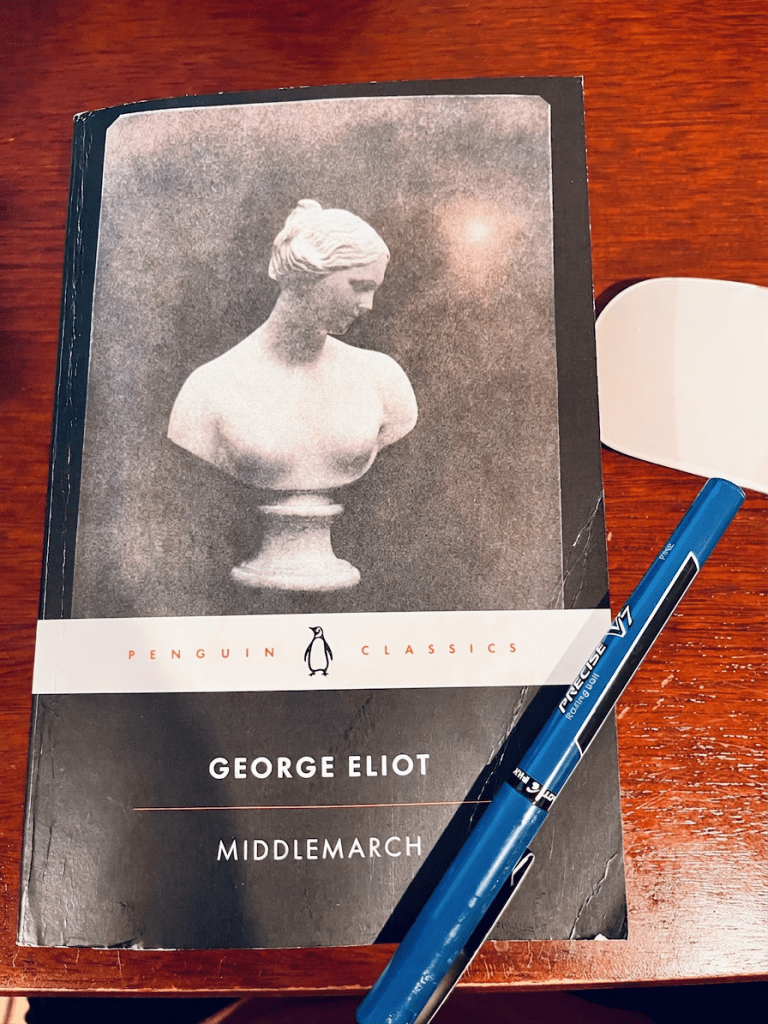
I am 38 and only just discovered Middlemarch by George Eliot, and now it’s in my top 5 favorite novels of all time, and I thank God I didn’t wait another 30 years before I opened this book, because not only is it a classic for a reason– timeless, universal, exceptionally written– but it hit me just at the right season of my life as a 38-year-old wife and stay-at-home mother who wrestle with this need to feel “fulfilled” and “accomplished” in my life.
When I picked up Middlemarch, I expected to read a great Victorian classic. I didn’t expect it to tug at my soul and expose its contents and re-narrate the story I had scripted about my own life. Middlemarch spoke poignantly to some of my deepest longings and questions and fears, the way no self-help book or therapy can, by expressing humanity through deep and complex characters going through ordinary life.
This post is not a review, though it does contain elements of it, and will include spoilers. This post is about how Middlemarch helped me see myself in this season more clearly and empathetically, how it defined the image I had for myself through a pretty annoying character, and how it helped me feel more content and fulfilled in my life.
First of, George Eliot writes beautifully. Her prose is just unrivaled, and I was copying down sentence after sentence that were so beautifully and gracefully crafted that I wept at how my own writing paled in comparison. Her characters have flesh, blood, movement, tears, sweat, creaking joints, excrements. They are alive. They are not satirical or angelic like most of Charles Dickens’ characters. They are not melodramatic and overwrought like some of Fyodor Dostoevsky’s characters. They are noble and egoistic; earnest and foolish; generous and selfish– all the dimensions that make up the complex nature of a human being who’s both made in the image of God yet is also fallen and depraved.
And you can really tell that Eliot loves her characters. She’s got such tenderness towards them, the way God does to His image-bearers. She exposes their shortcomings, yet covers them with grace and mercy and compassion. None of her characters are pure villains or angels. They are so richly complex, so vibrantly flawed, yet uniquely sympathetic and whole and…well, dignified in their own right. Many writers do this well, but Eliot is next level. As a narrator, she flows naturally from counselor to pastor to philosopher to a fellow human being in the way she illustrates and analyzes what’s happening. She’s no postmodernist— she’s got a strong moral core, but without being sanctimonious.
Middlemarch is set in a small early 19th-century town called Middlemarch in England, at a time when Britain was globally powerful and prosperous, when society was still rigidly divided into social status and gender, when women were expected to be naturally more virtuous than men yet stay dependent, private, powerless, and fragile, and when the Industrial Revolution was gearing up, causing new and inextricable issues regarding class, labor, human rights, politics, education, democracy.
At its core, the book is about unmet idealism. It follows the ambitions, limitations, and disappointments of two main characters, Dorothea Brooke and Tertius Lydgate. (By the way, who’s named Dorothea or Tertius these days?)
We meet Dorothea as a “handsome” and “remarkably clever” 19-year-old orphaned woman who intentionally wears such plain garments in contrast to her beauty that she’s compared to the “Blessed Virgin appeared to Italian painters.” She’s described as having a mind that’s “theoretic, and yearned by its nature after some lofty conception of the world.” She’s “enamoured of intensity and greatness, and rash in embracing whatever seemed to her to have those aspects; likely to seek martyrdom.” She’s ardently pious with a fierce sense of social justice and compassion, to the point where meeting a sick labourer would cause her to “kneel suddenly down on a brick floor” and pray “fervidly as if she thought herself living in the time of the Apostles.”
In short, she’s tiresome. She’s annoying. She’s the kind of Bible-quoting, moral policing, self-denying, self-righteous social justice warrior who would chastise you for swearing or being apathetic about oppression.
Here’s one early scenario, where her younger sister Celia suggests looking through their dead mother’s jewels. Dorothea is instantly dismissive— Why? Only worldly people wear jewels. Celia argues that they should respect mama’s memory, that necklaces are quite usual these days, not at all extravagant, and “surely there are women in heaven now who wore jewels,” she tries feebly.
Dorothea consents and they admire their mother’s jewels. Dorothea is delighted in Celia’s delight. Then Celia suggests Dorothea keep a beautiful pearl cross, thinking that would suit her religious aesthetic.
“Not for the world, not for the world. A cross is the last thing I would wear as a trinket.” Dorothea shuddered slightly.
“Then you will think it wicked in me to wear it,” said Celia, uneasily.
“No, dear, no,” said Dorothea, stroking her sister’s cheek. “Souls have complexions too: what will suit one will not suit another.”
OK. YOU SEE WHAT I MEAN? She is maddening!
Here, in one passage, Eliot brilliantly captures the paradox of Dorothea. She clearly admires the jewels, but she justifies it with religious speak. It’s OK for her sister to wear a cross necklace, but no, absolutely not her, because she’s different, she’s set apart, she’s extraordinary. This is Dorothea’s contradiction: She’s genuinely humble and good…but she’s also freaking full of herself, and she’s completely unaware of it. She believes she’s called to an unconventional vocation, a heavenly mission.
Trouble is, she’s a woman in the early 1800s in England. The best permitted ambition for her is to marry up. So she decides she’s going to marry someone extraordinary– an exceptional husband for a woman who seeks the exceptional things in life. When Sir James Chettam, a wealthy, good-natured, handsome young landowner expresses interest in Dorothea, she shuts that down real quick. Sir James might be the ideal catch for many a women, but not Dorothea, oh no. No, she decides to marry Edward Casaubon.
Let Eliot describe Casaubon to you: “the set of his iron-grey hair and his deep eye-sockets made him resemble the portrait of Locke. He had the spare form and the pale complexion which became a student; as different as possible from the blooming Englishman of the red-whiskered type represented by Sir James Chettam.”
Eliot is being charitable by describing him through the eyes of Dorothea. Celia describes Casaubon more candidly: “How very ugly Mr Casaubon is!”
When Dorothea rebukes her sister, saying Casaubon is as distinguished-looking as Locke, Celia retorts, “Had Locke those two white moles with hairs on them?”
Oh man. I DIE. Do you know what John Locke looks like? This is a portrait of Locke:
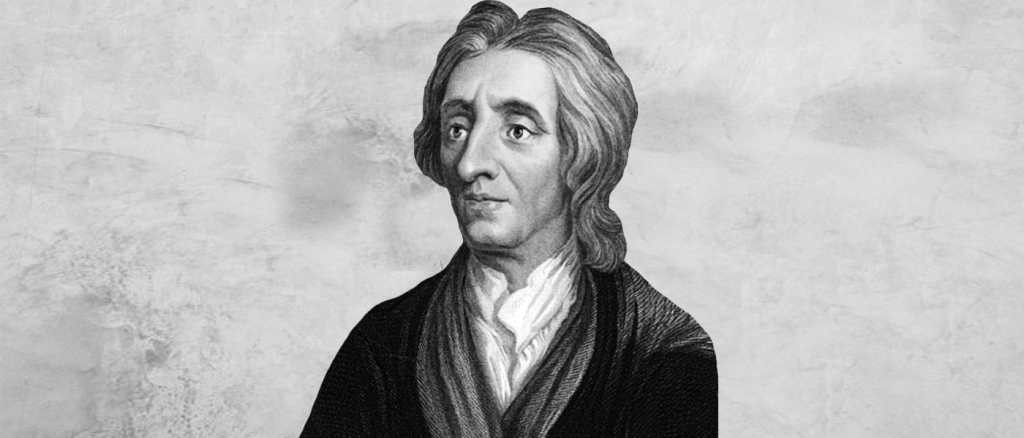
Dashing, he is not. His nose is large enough to hang a coat. Add two white moles with hairs, and that’s Casaubon. Also, Casaubon is 45 years old to Dorothea’s 19.
Besides, he is just…that kind of self-important, self-serious, mansplainer who talks “as if he had been called upon to make a public statement.” He is not just old enough to be Dorothea’s father; he is also physically ailing. He’s spent too much time indoors poring over his tomes, working on a scholarly masterpiece that have yet to materialize, and his sallow skin and weak frame reveal it.
And THEN! The proposal he writes Dorothea! I won’t quote it, because it’s incomprehensible with all its stylized, obtuse garble (even by Victorian standards), but basically, he tells her that he’s a Very Important Man, working on a Very Important Work that demands all his energy and attention (basically, he’s trying to compile the world’s mythologies into one scholarly religious text), but he senses another need that he once feared would interrupt that Very Important Work, and that is a female helpmate. But hark! He’s finally found a companion worthy of assisting him in this Very Important Work: Dorothea! How amazing is he– uh, she? Would she marry him?
And Dorothea’s reaction? She “trembled while she read this letter; then she fell on her knees, buried her face, and sobbed.” Not out of outrage and indignation, as any sensible woman should have, but out of overwhelming gratitude that she had been chosen. She herself didn’t choose Casaubon out of love: “Her whole soul was possessed by the fact that a fuller life was opening before her: she was neophyte about to enter on a higher grade of initiation.”
So I guess they deserved each other. They married to fulfill their own needs. And their marriage is disastrous. Not only does Casaubon not show much affection or appreciation for who Dorothea is as a person, he starts resenting and belittling her once he realizes that she realizes that Casaubon is indeed a big fat fraud. And worse, he’s a BORE. He can parrot important, serious-sounding intellectual words, but it’s all regurgitation. He’s well-read, but as bland as soggy bread. He’s disciplined, but utterly unoriginal and uninspired. He always does what is right, but there’s a stinginess even to his charity.
Dorothea had expected Casaubon to elevate her spiritual purpose, to stimulate her hunger for intellectual nourishment. Instead, their marriage spirals into a toxic prison of resentment, frigidness, jealousy, bitterness, suspicion, fear, insecurity. For all her high-minded ways, Dorothea is an earnestly joyful person, but he sucks the joy and zest out of her. Finally, Casaubon dies, and Dorothea is a young widow bereft not just of a husband, but her dreams of a fulfilling some deep purpose in life.
And then there’s Tertius Lydgate. Now Lydgate is a middle-class man. He’s got way more power and resources and opportunities than Dorothea. He’s also whip-smart, young, educated, visionary. He’s progressive and scientific in the medical field, at a time when doctors still drew blood to “restore bodily balance” and placated patients with nonsense brews. He arrives in Middlemarch as an ambitious doctor aiming to reform medicine in a conservative rural town suspicious of anything new and progressive. He wants to save lives…and make a name for himself.
His is an even more tragic story. Lydgate had so much potential and worthy goals. But then he marries a beautiful woman with elegant charm and a sweet singing voice and pretty smiles but no moral compass, sensibility, or perspective other than her own. His story is a painfully gradual, downward slide— first financially, then maritally, then socially and idealistically…until he quietly fades into comfortable mediocrity, which quite literally diminishes him.
Dorothea and Lydgate are similar in many ways: They are both idealistic and intelligent. They both marry disastrously and becomes disillusioned. But their ending is different. By the end of the book, one commands admiration. The other evokes pity.
The difference between Dorothea and Lydgate is that Dorothea had moral resilience. When her life didn’t turn out the way she wanted, she learned and evolved. Dorothea faces her disappointments with a strong, principled determination to continue doing what is right and good. She might not feel respect or love for her husband, but she continues to act in love and faithfulness even when he’s cold and bitter towards her. She exchanges bitterness for compassion. She gives up her lofty ideals, but not her values, and in the process, she gains empathy, wisdom, resilience, strength, discipline. She is still passionate and high-minded, but her passion and orientation become refined, grounded, and authentic. Eventually she marries again, this time giving up status and influence for a life of invisibility and ordinariness, but one that’s also rich in love and relationships. This is someone who redirects her passion to what truly matters.
Lydgate is not like Dorothea. He diminishes. He gets smaller and smaller. He compromises, shrinks, and eventually, succumbs to defeat. He gives up relationships and purpose. He becomes passive. And he stops striving for what is good and true, and simply…lives on because he’s still breathing, and bills need to be paid. This is someone who loses his passion.
There is so much to unpack here.
As much as Dorothea irritated me with her youthful delusions of grandeur and martyrdom, even more irritatingly, I saw myself in her. I have those delusions of grandeur. I always thought it would be quite awesome to die while reporting in a war zone, or to get entangled in danger because I’m exposing corruption in powerful authorities. I had so much passion in me to make the most of life, to make it matter, to do something that matters. I also deeply identified with Lydgate’s ambitions and potential, and his sometimes awkward inability to fit neatly into societal conventions and expectations.
It’s in my nature to be idealistic, but I think it was also nurture. I was raised by a very idealistic, passionate, intense father with firm principles on what is right and wrong. He sought righteousness with all his heart and might all his life, and he raised me to be that way. All of those traits are wonderful and good…until it gets twisted with human ego and a fear of failure. I also remember as a kid attending church conferences by Darakbang, a Korean evangelistic denomination that’s…slightly cultish (but not a cult) and super intense about evangelism and discipleship. Through Darakbang, I heard so many exhortations to be this era’s “Daniel” and “David” and “Moses”– highly educated, highly accomplished, powerful “elites” (they actually used that term “elite”) who will shake society and heaven.
I strived to be a Daniel and Moses. I wanted to be an elite. Someone who does great things. A transformer. A mover and shaker. A legacy.
And what do I do now? I read Middlemarch after the kids go to bed, and that’s the main intellectual exercise I get for the entire day.
I wake up with two little kids clinging onto me like little koalas. I pick up toys and shoes and underwear as I strut around the house, changing diapers, washing poopy hands, wiping apple sauce off counters and floors, wiping snot on my sweatpants (my daily attire), holding a tantrumy toddler in one arm while stir-frying dinner with the other, telling a high-energy preschooler for the twelfth time to sit his butt on the chair instead of rolling underneath the dining table, and teaching a highly unmotivated 4-year-old to sound out the word “CAT.”
I do not feel like a Daniel or a Moses or a David. I feel…like a Martha. Constantly doing, rushing, repeating chores and duties that are invisible only because someone is doing them, day in day out. Someone who’s quietly resentful of the countless things she does all day but has nothing to show for at the end of the day.
By the time I read Middlemarch, I had accepted that this is my life, a life I’ve chosen. I chose to stay at home. I chose to homeschool. I mentally closed the door to a career, likely forever. I stopped seeing myself as a former journalist, and more as a mother.
But it didn’t mean I felt good about it. Not that I felt bad about it— I was truly grateful to have this privilege to spend time intentionally raising my children. But I did feel like my original ambitions, my desire to do great things, had shriveled away for the sake of this life. I felt like a flower with a few petals ripped off. When I saw other former colleagues travel overseas to report on important issues, producing fantastic work, getting promoted to more distinguished journalistic positions, my heart ached with a sense of loss. And I would console myself by saying, “Well, I had my fair run. Now I’m a mother, and that’s important work, too.” It was more placating than true contentment and pride in where I am right now. I didn’t feel…well, great.
The problem is not that I sought greatness. It was that my idea of “greatness” didn’t mature all that much with my age. I still had that image of an “elite” as my vision of greatness. Doing great things was large, visible, measurable, extraordinary. But motherhood is one of the most ordinary vocation.
And then I finished Middlemarch, and contemplated the lives of Dorothea and Lydgate. And I read and re-read the ending. Here, Eliot is honest about Dorothea’s life. She re-marries someone who’s deemed far lower than herself, giving up her inheritance, and everyone proclaimed it a mistake. She was known in town as that
fine girl who married a sickly clergyman, old enough to be her father, and in little more than a year after his death gave up her estate to marry his cousin– young enough to have been his son, and with no property, and not well-born. Those who have no seen anything of Dorothea usually observed that she could not have been ‘a nice woman’, else she would not have married either the one or the other.
She was once seen as beautiful, clever, a bright and morning star. Now she’s considered a failure, a disappointment— that is, if anyone considers her at all. Meanwhile, as a modern-day feminist reader, I applaud Dorothea for following her heart this time, but there’s a sense in me that’s disappointed that she became “just” a wife and mother. But Eliot redeems her by famously ending with:
But the effect of her being on those around her was incalculably diffusive: for the growing good of the world is partly dependent on unhistoric acts; and that things are not so ill with you and me as they might have been, is half owing to the number who live faithfully a hidden life, and rest in unvisited tombs.
Dorothea didn’t lose herself– at least, not the parts that were essential to how God created her. She still chose the unconventional by marrying her second husband, who later became a social reformer, while nothing much is said about Dorothea marking her impact in the public sphere. It’s implied that she was still influential within her realm, albeit invisibly, and earning zero credit or recognition for it. And Eliot dignifies and redeems that in her.
In the season I’m in right now, I have a conscious choice to make: Dorothea, or Lydgate?
I am still the same person I was before I gave up my career to be a stay-at-home mother. I still have passions, ideals, curiosity, and desires for an intellectually and spiritually fulfilling, rich life— things that drew me to my career as a journalist in the first place. I think those are natural traits that God formed in me. It’s what makes me me, and I believe God honors that.
Reading Middlemarch awakened those things in me, while reminding me that just as Dorothea had to refine and temper those natural instincts in her as she grew from a 19-year-old girl to a mature, time-tested, experienced woman, I too am in the process of fine-tuning my passions and ideals and dreams, from youthful impulsion and selfish ambitions into something more real, more true, more pure…and it’s not just motherhood.
It’s being a whole person. A fuller person. A person who seeks goodness and does good even when no one is watching, when no one recognizes me, when there’s no accolades or promotions. A person who doesn’t long to be seen, but sees others. A person who doesn’t just plan and dream, but acts and lives out my values. That’s what it means to be fulfilled in life– to fill my life with faithfulness, goodness, and contentment. I don’t need to seek purpose; there’s purpose already in the life I’ve been given.
Dorothea was an irritating girl when I first met her. But by the last page of Middlemarch, she earned my respect and admiration. She’s not a typical role model exemplified in society, whether in the 1800s or today. But she is mine.

