
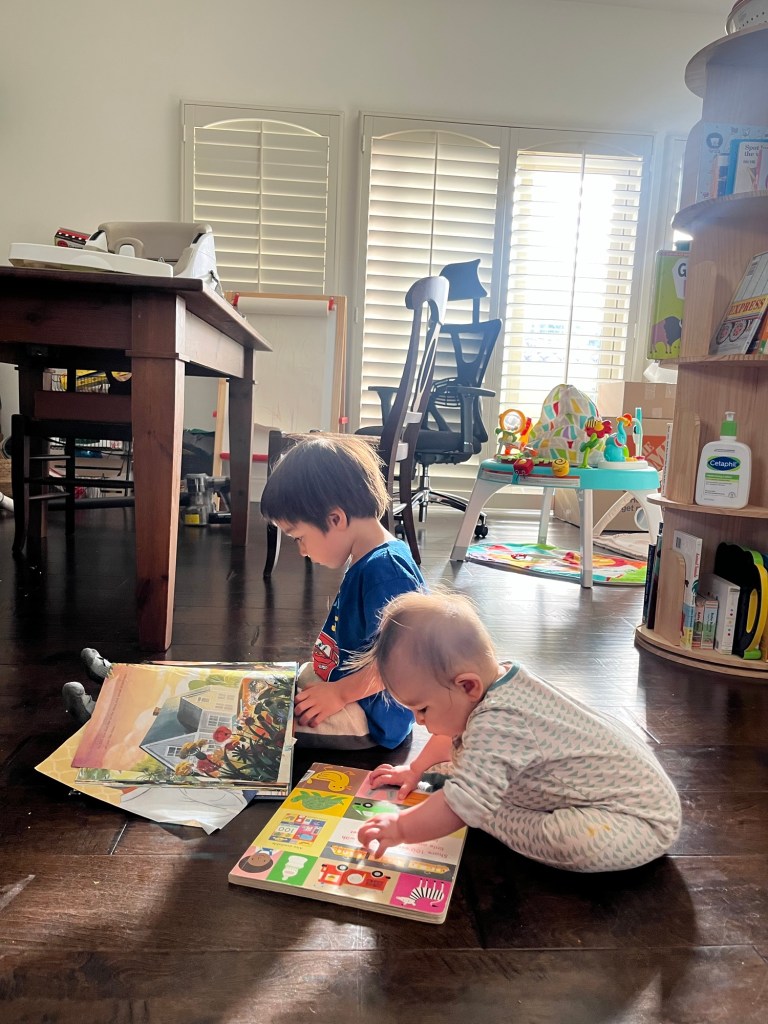
A son made in my image

When Tov was first born, I started imagining.

I imagined how our son will grow up, what his personality will be like, what interests and passions will drive him, who he’ll hang out with. Would he be into sports? Music? Art?

That’s what makes the Korean tradition of doljabi so fun, but also laced with anticipation: What destiny will my 1-year-old pick? As parents of young, not-yet-formed human beings, we have the power to present to our children certain life opportunities, but absolutely no control over which path they will pick, and that’s what makes doljabi a fun, light-hearted way to play-pretend. We lay out only the desirable options for our children’s doljabi, but ultimately, our 1-year-old babies will grab whatever their heart fancies.

I remember for my niece’s doljabi, my sister-in-law refused to include a ball because she didn’t want her daughter to go into sports. I didn’t want to offer sports as an option either, but David would be apoplectic if Tov didn’t like baseball, so I reluctantly allowed him to include a baseball, comforted by the fact that neither of us has athletic talents, so most likely, neither will our children. Our doljabi was not very traditional. Because I would love for Tov to become a journalist like me, I added a reporter’s notebook into his doljabi options, and I also included a globe because I wanted him to be well-traveled and globalized in his worldview.

Tov chose the globe. I rejoiced, even as I knew all this is just a game designed to please the parents’ ambitions for their child, nothing more. Even then, I thought, “I don’t care what Tov chooses to be when he grows up, as long as he’s just like his name– a good person, full of God’s goodness. I will be content with whatever he chooses.”

That was then, when Tov was still very young and malleable. Now that Tov is 3, I realize I might be more ambitious than my professed noble goal for my son. I know it, because I have been fighting some rather strong disappointment that my son– my wonderful, adorable, good son, who is indeed so much like his name– does not seem to be much literary-inclined.

Often with firstborns, there are childhood stories that parents repeat to prove their firstborn is special (these kinds of stories seem to diminish with the younger siblings, interestingly enough). For me, apparently I was about 2 when my parents searched all over the house for me until they finally found me hidden behind a pile of books. I had been “reading” for hours, completely engrossed. There’s another story that apparently prove my unique brightness. According to my parents’ folklore, as a child I had very curious, observant eyes. I would stare at things and people with intensity, as though analyzing them in deep thought, and I remember my parents constantly admonishing me to stop staring at strangers.

Now that I think about this, I don’t think it proves anything about my specialness or intelligence; it sounds like I was a pretty creepy child indeed. But all that to say, my parents told these stories proudly to anyone who would listen, which showed a value they upheld and instilled in me: Intellect.

I too uphold this value. I value minds that think and read and create. I admire people who are well-read, who can quote literary giants, who can discuss Dostoevsky and Kierkegaard and C.S. Lewis. If I’m completely honest, I probably uphold that value higher than any other virtues such as goodness, gentleness, self-control. And that value system is becoming more blatantly obvious as I watch Tov grow from a baby to a boy, as I take him to the library and offer to read him books, but he’d rather just run and climb between the bookshelves. Or when five seconds after I pointed out the letter “A” to Tov, he’s already forgotten what it is. My literary ambitions for my child is even more abundantly clear when I meet other kids similar to his age who love reading, have a strong grasp of language, and can recite entire books front to back. I can’t stand those kids. I hate them, really.

One evening, I was trying to read a book with Tov, when as always, he kept grabbing the page from me and interrupting me, fixating on that one page with the picture he likes. “What’s that?” he asked, for the fifteenth time.

“Oh my God, Tov, can I just finish this book!” I cried, losing my patience, yanking the book away and startling the poor little boy, who just wanted to look at the orange ball again and again.

At that moment, so many thoughts were flicking through my head, all poking at perceived flaws in my son: Why can’t Tov just sit through a book? Why does he only want to read this one stupid book? Why doesn’t he like books? Are we letting him watch too many stupid firetruck shows on YouTube? Why hasn’t he learned his letters yet? I’ve been trying to teach him his ABCs for months now! Is it the screen time? My niece could memorize the entire Brown Bear book by his age; why can’t he? God, we need to stop letting him watch shows, it must be rotting his attention span!

Oh, the slash of terror: What if…God forbid, my son never likes to read? What if my son is not very intelligent? What if…Good God!– my son becomes an atrocious writer? And, to my self-dismay, what I felt then was shame. Shame, that my flesh-and-blood might not carry this value that I hold so dear. Shame, at the thought of my son struggling with math and spelling and grammar.

And then, of course, I felt instant shame at my shame. Is this what I’m really all about? I, a professed Christian, called to set apart from the world, has allowed secular standards to infiltrate my value system, and it’s going to impact my parenting and shape my children. But is it not an instinctual, parental desire to create my child to my own likeness?

I wrestled with this thought for months.

I don’t think that wanting my children to love and read books, to have deep critical thinking skills, and to cultivate a rich intellectual mind is a bad thing. I know it’s a worthy and good goal to try to instill these values into my children’s education, which will serve them well in life, and raise them as solid citizens of the world.

It’s also healthy and natural for me to want to share my passions and interests with my own children. Just like David can’t wait to take our children to their first baseball game, I can’t wait to read the Harry Potter books with my children, and also The Good Earth, Jane Eyre, East of Eden, The Brothers Karamazov, and discuss them together.

What I struggle with is how much I want it. How much it’s insidiously tied to my own ego, ambition, and identity. And how disappointed, frustrated, and mad I fear I’ll get if they fail to meet my standards.

People say Tov looks like me, which pleases me, because I think Tov is a very handsome boy— no bias at all. And maybe, if I’m brutally honest, I’d like people to also say Tov is sharp and intelligent because that too reflects well on me. Because those are values I hold high and dear. Because I want Tov to fit my ideals of a worthy person, and create him according to my image, when he has already been wonderfully and fearfully made in the image of God.

As a parent, I have the responsibility to raise my children to be the best person they can be, to stretch their weak points and cultivate their strong points. But it’s also my responsibility– and joy– to get to know and understand who they already are as a person, and delight in how God created them, just as they are. There’s a fine balance between accepting who my child is, and recognizing that they have more potential, and then pushing them lovingly and firmly towards it. It’s this fine balancing act that make my head twirl and my heart clench. Man, parenting requires so much wisdom and discernment. There’s just so many life-altering decisions and judgments that I feel, at this current moment, so ill-equipped to make. Lord, help me.

Tov is still only 3. I have yet to see all the hidden parts of Tov. He has yet to emerge from his chrysalis, yet to fully spread his wings. He might still learn to love books. Or he might not. My brother was raised the same way I was, with the same parents, and he is still not a reader, but he has many other interests and capabilities that I don’t have.

So what can I do?

I still want to do what I can to foster a rich intellectual life for my children. So I plan to take Tov and Woori to the library once a week. I can keep surrounding them with books, keep reading with them, and let them see me read.

And also: I can just relax and enjoy who they are.

That’s easy enough. Tov truly is a wonderful person. He is kind and empathetic and sweet and resilient and curious and fun. He loves his little sister, loves his umma and abba, loves his teachers and friends, loves laughing and rolling and the color pink and fire trucks and Lightning McQueen and listening to music and collecting rocks.

I adore 3-year-old Tov. He makes my heart so full. And I’m so proud to be his umma.

Saying goodbye to my parents

On February 28, 2025, I dropped my parents off at Hell on Earth, aka LAX, early in the morning. I’ve dropped them off at this airport numerous times. But this time, they weren’t flying back home to Virginia. They flew back to their mother home, South Korea.

They had four luggages and one backpack. For people who had lived so economically and simply, they were shocked by how much stuff they had accumulated over the 24 years they had lived in the United States– mountains and mountains of stuff that they threw out and donated and gave away.

I remember the story my father used to repeat to us, the way patriarchs retell family legends, of them packing all their belongings in Korea into two luggages, and landing in Singapore as fresh missionaries with a 4-year-old and a 2-year-old. My father was filled with ambition; my mother filled with apprehension. Now they return home with twice the luggage, five times the wrinkles, 34 times the lived experience of full-time ministry, and infinite times the joy and gratitude.

Woori was wailing as we drove to the airport that day. She hates being in the car seat, and no matter how many tongue-clucking and funny faces my omma made, she made her displeasure known. So by the time I pulled the Mazda SUV up to the curb of Tom Bradley International Terminal, I was a little frazzled, my overstimulated senses as messy and stuffy as my heart.

We pulled the heavy luggages out to the curb. Then we embraced. Once, twice. I had to let go quickly as I wasn’t technically allowed to park there, but my hugs were also hasty because once I enfolded my arms around my omma and abba, breathing in their familiar scents, touching the bodies that cradled me skin-to-skin from the moment I was born, I didn’t want to let go.

They waved. I waved. Then I hopped into the SUV and pulled out, back into the smoky tunnel of LA morning traffic. And as I drove away, Woori cried, and I too cried.

It is an end to an era.

It is silly, I tell myself, to be this sad. It’s not like my parents are dying, or unreachable. They are simply moving an ocean away, and with technology, I need only tap my screen to see their faces and chat with them. It’s not like I got to see them that often even when they were stateside, since we lived in opposite coasts.

But it does feel, in a way, like death. Or at least, an ending. They have closed down their church of 24 years, the church I grew up in, served in. The church that sent me off to college and then welcomed me back when I dropped out after being hospitalized, and then sent me back off again. The church about which I have complex feelings, the way anyone does with family members squeezed under one roof. The ministry my parents gave more than half their life to is changing. I can no longer go back “home” to Virginia, and that feels sad, even though Virginia hasn’t felt like home in years.

It also feels like a death to my hope that my children will be close to their grandparents. Living overseas, I grew up seeing my own grandparents once every three years, at most, and whenever we visited them, I felt awkward. Each visit was like meeting strangers for the first time. We had almost zero history and shared very little memories and experiences. They didn’t have much to say to me, and I didn’t have much to say to them. I really don’t want that for my own children. The thought of them not knowing their grandparents, not receiving their affection and admonishments and doting, pains me.

But more than anything, this closing of an era is a jolting reminder to me that my parents are aging. During the two weeks they spent with us here in LA before they flew to Korea, I saw my parents get more easily tired. Omma has lost more than 15 pounds and is dealing with health issues, while abba needs a few naps a day to push on. Omma has always been more physically fragile, but Abba to me has always been like an oak tree– thick, strong, unwavering, abounding. Even his voice was like oak– a rich, loud baritone. To see his sparse gray hairs, to hear his cracking voice, I felt fear and anxiety, knowing the thing that most human beings face at some point in their lives– the passing of their parents– is drawing near.

Death was a regular topic while my parents were in LA. For the first time, they told me what they wanted when they died. Both told me they want us to pull the plug should they be in a coma. They want us to scatter their ashes in the mountains. We also talked about what to do if one of them dies before the other. It’s terrible talk, but it needed to be said.

Being a 37-year-old wife and mother is to be sandwiched between two duties– one to the family I’m raising, and the other to the family that raised me. One family is fresh and new, still knobly and plump like buds about to bloom. The other is wilting, the peak season long passed. I myself am in full bloom, but I’m noticing a few petals starting to droop, and I know my peak is over, particularly as I feel the growing aches and creaks of aging. It is a very odd, uncomfortable, conflicting season in life, to be worrying about your kids at the same time you worry about your parents.

I knew my parents would have financial issues. Now that they are no longer receiving an income from the church, they had to figure out a new living situation. They didn’t have anything planned for retirement other than social security. They have no property, no assets. When they applied for a new credit card, the company gave them a $1,000 credit line. They couldn’t even afford to continue staying where they’ve been living for 22 years– a townhouse that’s 40 years outdated, with tiny rooms and laminated kitchen cabinets that are literally falling apart.

That’s how my parents had been living all these years. They tithed about a third of their income to the church. They never considered building wealth, at least not the earthly kind. My mother didn’t once own a designer handbag. My father wore the same suit he bought in Korea decades ago, and his ties were gifted by others. They lived simply and trusted that the Lord will provide.

I have less faith, I suppose. I got a little angry when they refused, several years ago, David’s offer to buy their townhome for them so they didn’t have to worry about housing. I got irritated thinking about this again after they told me they shut down the church. “You should have said yes to David’s offer when you had the chance!” I said to omma.

And that’s when they decided to return to South Korea and apply for dual-citizenship. It was the most practical decision– Korea has great benefits for the elderly so they don’t have to worry about health care; they could comfortably live on their social security there, since housing is cheaper, as long as it’s not in major cities such as Seoul. But they underestimated the cost of housing even in smaller towns. Their budget could only afford old, rundown places in rural villages.

Meanwhile, David and I are renovating our new house. What was originally going to be a bit of a fix-up here and there turned into a full gutting. Basically, we are building a new customized house. Our renovation budget has blown out of proportion and I’m embarrassed to share it. While my parents were here, I was deciding on wall paint colors, and omma accompanied me to get some paint samples, which cost me about $160– for freaking paint SAMPLES! The money we are spending on this house is insane. Three exterior doors cost us $15,000!!!

It just didn’t feel right, that we are building our dream house while my parents look for crappy, bug-infested housing in the countryside. I felt a pang to see how excited my mother was for us. She wanted to know what we’re doing for the kitchen, the bathrooms, the exterior paint, and had plenty of opinions. She told me she enjoys watching home renovation videos on YouTube, something I learned for the first time, and it wrung my heart to realize that she admires a tastefully decorated and designed home but never had the chance to live in one, and in fact, never imagined she could.

So one evening, while my parents watched Tov and Woori, and David and I were on a date, I proposed to David that we help my parents buy a house in Korea. Years ago, David had loaned his brother money for a business project, and his brother was finally returning that sum back to us. Perhaps we could direct those funds to my parents’ housing instead?

I was a little nervous suggesting this to David, not because I thought he’d refuse, but because it puts me in a vulnerable position, and I pride myself for being self-sufficient and independent. And though technically this money belongs to both of us, it’s still a lot of money, and it’s money that came from David’s earning, not mine. So it took a lot of swallows for me to ask David.

I wasn’t surprised when he agreed. I knew he would. But I was still touched beyond words when he did. Turns out, a day ago, he had been listening to a devotion about not storing your treasures on earth but on heaven, and that had made him ponder. Then that Sunday, our pastor preached on the Ten Commandments. To honor your parents, the pastor said, includes providing for them financially in their later years.

What’s more, both of us had been praying about money this year. I’m praying about generosity, and David’s praying about wise stewardship of our finances. The Lord has blessed us financially with a new house, and we want to use it for the glory of Him and the good of others.

All of this didn’t feel like a coincidence. It felt like God was blessing us to bless our parents.

David and I agreed to broach the subject on the last night with my parents before they left LA. I told David I was nervous about bringing it up, because historically, abba has been strongly against receiving any help from us. I had no idea how he would react, and I braced myself for a five-point argument on why he should accept our help. I told David he had to be the one to offer it; it couldn’t come from me. And I told him to emphasize how this conviction came from God.

That night, after dinner, David and I exchanged glances. It’s time, I said with my eyes. David turned on a show on TV so Tov won’t bug us, while I took Woori off her high chair and held her on my lap so she’d be quiet.

“So,” David began. “Sophia and I have been praying about being generous with what God gave us. And I’ve been thinking about how we want to invest with what we have…”

“Oh?” Abba said, having no idea where his son-in-law was going with this.

Well, I was really proud of David that night. He mentioned everything I had hoped he would, and when he was done, my father grasped his hand, nodded, and said, “I receive.” And then he choked up, and said again, “Thank you. Thank you Lord. I receive.”

I was so shocked that I couldn’t believe my ears. Omma was just as incredulous, so she asked him, “Wait, so what do you mean. Does this mean you will accept the money?”

Yes, Abba said. He sees how much the Lord has blessed us, and by accepting it, He too is receiving God’s blessings, and because God blesses those who give, he believes he is also blessing us by receiving it.

I felt my heart release with relief and gladness. Before David and I got engaged, I had actually asked him to use whatever he would have spent on my engagement ring, and donate it instead to my parents’ ministry. That didn’t end up happening, but now that I had more than I could have ever imagined– I, who once couldn’t afford laundry detergent and had to make my own!– it made my heart feel so full that I was able to present this one gift for my parents in their older age, in this new season of their life. This was the first significant financial support I’d ever given my parents. It was also the first step in tilting the balance towards me supporting my parents, rather than them supporting me– an end to an era, indeed.

What made my heart just as full, however, was that David was doing this with me. As I pray about generosity this year, my own husband is showing me how to be generous not just with his finances, but with his heart.

It is easy for me to be generous with my own parents; I would give them part of my liver if they needed it. But it’s not as easy for a son-in-law to be as generous, to treat his wife’s parents as his own. He wasn’t just giving my parents a better house; he was giving them his love, and in there is his love for me. And I think in that moment, my father recognized that too– he was moved not just by the unexpected gift of a house, but by the clear display of a husband’s care and love for his daughter. In this, he saw God’s grace, His love and providence and goodness and faithfulness that have never failed him in his almost 35 years of ministry.

After my parents left to pack up for the next day’s travels, and after David and I had put the kids to bed, I gave my husband a hug.

“Thank you,” I said, tearing up.

“For what?” he said, acting all cool.

“For everything,” I said, and I meant it.

David made a “huh” noise, a sound he makes when he’s pleased but also trying not to sound too pleased about it. Then we talked about the show he’s watching.

We’ve never been a couple who talks all sweet and cooey and sentimental. We reserve nice sappy words for birthday cards, where we don’t have to make eye contact and hear those words out loud, so awkward and unnatural to our ears; we don’t kiss goodnight, we knock heads.

But within that brief exchange was a lifetime of card sentiments– I felt seen, valued, cherished, respected. David’s act of generosity had so many layers of blessings in it, like a mille crepe. He blessed my parents. He blessed me. He blessed our children by showing them what it looks like to honor one’s parents. He blessed my brother, who now can worry less about our parents. He blessed my relatives in Korea, who no doubt will hear from my father how the Lord has blessed him through his son-in-law. This is how true generosity works– it just keeps on giving and giving.

Saying goodbye to my parents felt strange. I felt a little like I was the parent, sending my kid to school for the first time. As the last person to hug them goodbye before they left the U.S., I felt like I was sending them out into the next chapter of their lives. I was a little worried, a little anxious, but also excited and proud. I wanted to cling on, but I had to let go. And I heard God usher them away, saying, “Well done, good and faithful servants.”

And off they go.

These are the best days of my life

Woori has been going through a sleep regression the past three weeks or so, exacerbated by teething. Like clockwork, at about 12:30 am, she wakes up screaming. And from then on, she wakes up every hour or two hours.

In the past month, she also stopped napping in her bassinet. She doesn’t even last 5 minutes before screaming and flailing so hard she’s breathless and hyperventilating.

All that to say, I am a walking zombie. I wake up in the morning groggy, with that deep-in-the-brain ache because my brain has barely been able to shut off all night. My body and hormones are off, because I’m night-sweating again, waking in a soaked T-shirt. I’m almost falling asleep as I drive Tov to school. Often, I pass out half-dead with lurid dreams while holding Woori in the nursing chair. (Somehow, I still have energy to read novels late at night, but that’s the kind of nonsensical superpower parents have when we are liberated after putting the kids to bed.)

It’s been hard, but honestly I don’t really have the mental and physical energy to even think about how it’s hard. I just go on, putting one foot before the other, day by day, dragging my weary body through the mire of parenthood.

There have been moments of lucidity though. I remember one morning, as I heard Tov having a tantrum with David in his room, and Woori starting to fuss in bed with me (we co-sleep now— it just keeps everyone sane), and felt the bunched-up clammy sheets under me, and raked my hand through my damp, disgusting postpartum hair, probably pulling out 237 strands of hair that I don’t have to lose, all of a sudden, this thought came to me: “These are the best days of my life.”

It’s cathartic to complain about parenthood, especially those early childhood years, when everything is a struggle, from shoving a sweatshirt over a screaming, snotty toddler’s head, to driving stressed because the baby’s shrieking like a banshee in her car seat and there’s nothing you can do about it. Complaining about the hard moments of parenthood is viral content on social media— I enjoy them; I enjoy commiserating and sharing them with my fellow moms and dads. It brings much-needed comic relief to a period that feels so long and consuming.

But still. These will be the best moments in our life.

When I was young, I could not wait to grow up. I wanted to be independent, to earn my own money, choose what I want to eat, where I want to go, without asking my parents for permission.

Meanwhile, my childhood best friend dreaded growing up. “I want to stay a child forever,” she told me. She liked her cocoon of innocence and lack of responsibilities, liked the assurance that someone bigger and wiser is taking care of her.

“You’re stupid,” I told her, with all the eloquence of a 9-year-old. “Or crazy. Why would anyone ever want to stay a child?”

She gazed with longing into the past. I gazed with impatience into the future.

And I’ve lived like that since. I’ve always been impatient for what’s next, what’s new. When we immigrated to the United States, I eagerly kissed everything and everyone in Singapore goodbye. Next! In high school, my actions and thoughts were all set towards preparing myself for college. Next! Once in college, I couldn’t wait to graduate and be done with school forever, and kickstart my career. Next! Then once I got a job, I was never content in my career. I wanted to work in someplace more prestigious, and lived in constant frustration of feeling stuck in my job, watching with envy when my peers seemed to hop on to shinier opportunities. Next. Next. Next!

What’s next? What’s new? Is this it? To what end I was working towards, I did not know. What was the achievement that would finally satisfy me, to make me relax and say, “This is it,” what was the accomplishment that would allow me to start enjoying what I have, I do not know. I was just perpetually restless, rootless, reaching out and out.

And now. As a parent, as a mother of a 2.5-year-old and a 5-month-old, I seem to do both, looking both forward and backward. I look at old pictures of Tov and my heart aches. Sometimes he looks up at me a certain way and I lose my breath; I’m so shocked at how boyish, how non-toddler his expression is. My boy is growing up before my very eyes, and I am still caught off guard by how fast.

Even as I hold Woori, who blessedly still fits in my arms and stays where I put her, I am already mourning, looking into to the near future when she’s 2 like Tov and Tov is almost 5, and I feel nostalgic for the very period I’m currently in.

Parents have talked about the importance of “soaking in” every moment, but I feel like every moment, even as I’m living right in it, keeps slipping through my fingers like water. Rather than soaking, the moments seem to flow out like a stream, and all I have are pictures and reels on my iPhone as memories that are memories because they are already in the past.

Yet at the same time, I’m still planning my future, wondering what’s next. When are my kids going to be independent? When can I start having my time back, my body back? When can I restart my career? When I can have my mind and creativity back? When can I start writing again? And because motherhood makes you insane, I also wonder: When can we have a third baby?

Perhaps the present moments keep slipping me by because I keep looking back to the past and out into the future, but rarely stay still to enjoy the present. Honestly, I don’t know how. I haven’t practiced that enough to suddenly do it now.

Which brings me to that morning when I woke up feeling that heaviness of trying to swim upstream, facing the new day with exhaustion, and that seemingly random thought came to me— that these are the best days of my life. I was startled by how strongly this sentence entered my mind, so I took it as a conviction from the Lord, and I thought of Ecclesiastes: “Hevel, hevel, all under the sun is hevel.

Working hard on a career is hevel, or meaningless, or vanity. Marriage is hevel. Raising kids is hevel. All in life is hevel, unpredictable and fleeting, impossible to grasp and control. So I was right: It is hard to “stay in the moment” because time keeps moving, tick tick ticking along even as we practice meditation to “be still.”

But there’s still joy found in the hevel, Ecclesiastes tells us: “Light is sweet, and it is pleasing for the eyes to see the sun. Indeed, if someone lives many years, let him rejoice in them all, and let him remember the days of darkness, since they will be many.”

I love how realistic and grounded Ecclesiastes is, at once exhorting us to enjoy what we have while also acknowledging that life feels futile and hard. Yes, we are all drawing one day closer to death every day. We all die, including powerful filthy-rich smart-alec jerks like Elon Musk and saints like Mother Teresa. Death is the ultimate equalizer; as terrible as it is, it is fair.

Accept the hevel, accept that time is passing us by, accept that a lot of things that mean so much to us will not mean much after we’re gone. Enjoy our remaining youth while we can. Work hard while we can. Enjoy our bread while we can, and enjoy the sun when it’s out.

And always remember: “Fear God and keep his commands, because this is all humanity. For God will bring every act to judgment, every hidden thing, whether good or evil.”

“Judgement” sounds so ominous, but not when the judge is God, who is perfect in every way. This perfect God sees it all. He sees me nursing Woori at 4 am. He sees me packing Tov’s lunch in the morning before my first cup of coffee. He sees me holding back my temper when Tov is having a tantrum. My kids will not remember all these little acts of service, and if I’m banking on my husband or society to acknowledge everything I do, I’ll become bitter and petty. But God does. He sees what I do, and He also sees right into my heart as I do these daily domestic duties.

As I slide into the early stage of middle age, as the rosiness of youth wilts, as I gain hard-lived experience and knowledge with every fine line and wrinkle, I want to remind myself that I’m living the best days of my life.

One day I’ll look back and miss these days when I can still carry Woori on one hip, when I can cuddle and smother Tov in kisses while he giggles, and hopefully, hopefully, by then I would have gained enough wisdom and contentment to be able to miss the past yet also wake up every morning declaring, “Today is the best days of my life.”