
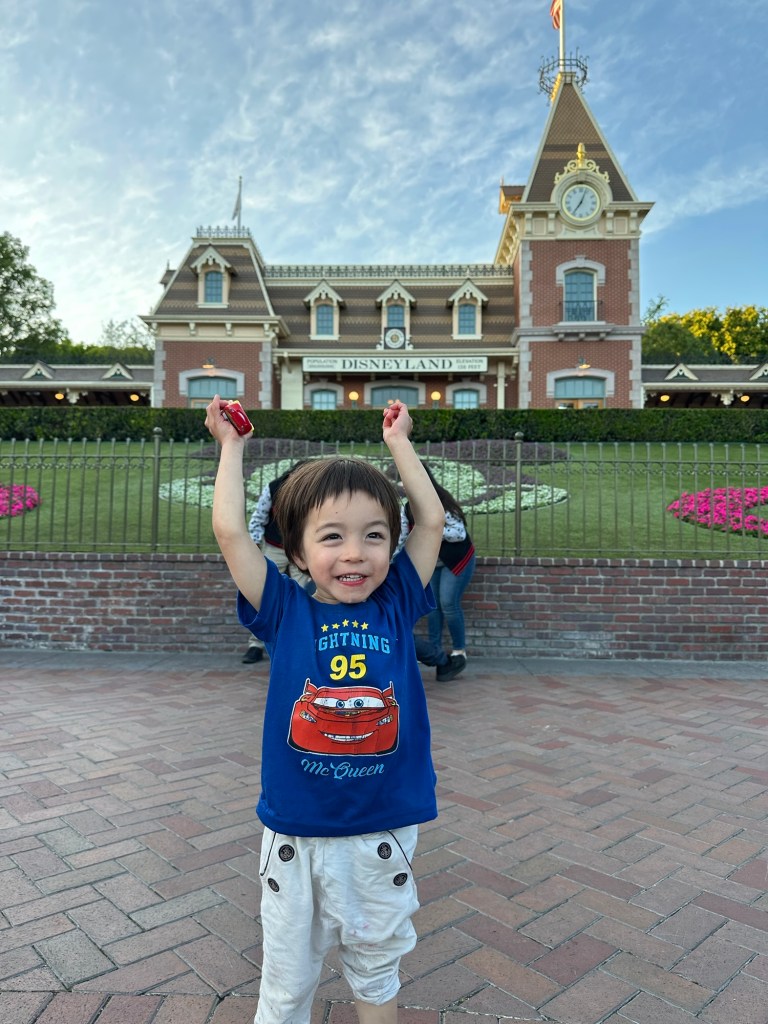
Tov’s first Disneyland trip

The last time I was at Disneyland was three years ago with David, when Tov was but a fetus tucked into my womb, his presence only having just been revealed to his soon-to-be parents.

It was our babymoon. We booked a hotel near Disneyland, to which I lugged my new best friend, a giant slug of a pregnancy pillow, and then spent a whole day at Disneyland, grousing about the lines and the crowds. I remember for the first time noticing how many strollers there were at Disneyland. I had previously been completely blind to them, but all of a sudden, I noticed parking areas for strollers, double strollers, four-seat quad strollers, bougie strollers, cheap-as-plastic strollers, rental strollers, everrrrrrrywhere. How had I never noticed the tens of thousands of strollers zipping around Disneyland?

Oh, those were my before-kids days, when my eyes didn’t even register babies, toddlers, or any young children whose heads reached under my waist.

Three years later, I am back to Disneyland, this time with an almost-3-year-old and a 8-month-old, testing out our super-nifty, ultra-lightweight Zoe double stroller for the first time. My last visit to Disneyland, my biggest luggage was my pregnancy pillow and my skincare products. This time, I had two full bags jammed with about a dozen different snacks, water bottles, four extra sets of clothes, diapers, wet wipes, teethers, and God knows what else, and I STILL forgot the kids’ sunscreen.

And man, was I excited! It was Tov’s first ever Disneyland experience! We decided to take him there just before he turned 3– young enough not to have to pay a ticket, and old enough to really appreciate the magic of Disney.

“We’re going to Disneyland tomorrow!” I kept telling Tov the day before, and although the kid had no idea what Disneyland or Disney is, has no idea who Mickey and Donald and Goofy are, he grinned and gleamed as though he knew wherever that was, it was gonna be awesome.

The next morning, we woke him up with excited cheers: “We’re going to Disneyland!”

David dressed him in his favorite T-shirt– a hand-me-down, imitation Lightning McQueen blue T-shirt bought from the Philippines– while I bustled around getting all the snacks and my coffee ready, and then we were off! I was so excited I didn’t even fall asleep on our way there.

Oh, the wonderful magic of Disney! First, we got on the 50-minutes-long “line up to get into the car park” ride. And then, we got on the 15-minute “line up to get on the tram” ride. Then! A “line up for the restroom” ride. And then! The “line up for the security screening” line. And then, dum dum dum, here comes the “line up to get through the entrance” line!
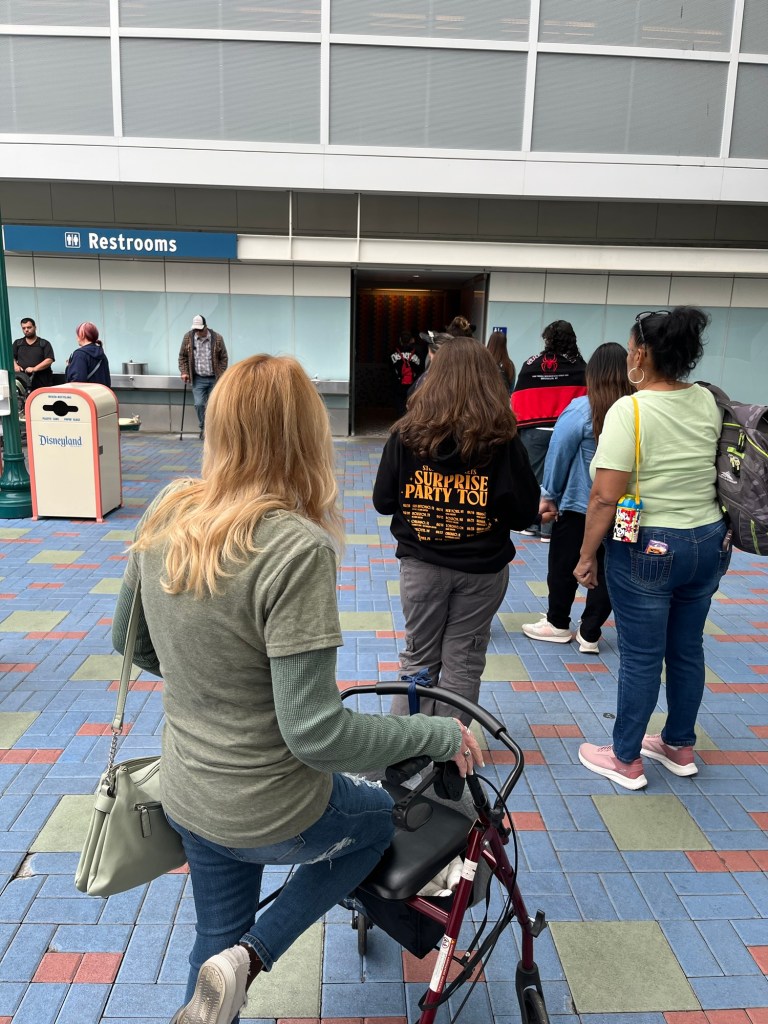
Altogether, it was almost two hours of breathless, thrilling waiting in long lines so that we can line up 40 more minutes for the Astro Orbiter ride, which lasted all of 5 minutes. Is THIS the magic of Disney? We are all magicked into happily lining up for hours and hours under the scorching California sun, grinning and sweating under our Mickey ears, and then leave the park saying, “That was fun! What a great day”

Yes. That’s pretty much how our day went. We spent a small part of our day with my friend Joyce, her husband Tyler, and their sons Cían and Taigh until they left around 2pm, and we chugged on for more than five hours. We rode on a total of four rides. One of them was Pirates, which David was most excited about, except Tov yelled, “I want to go out!” soon after the ride took off.

He loved Astro Orbiter though, and rode it twice– once with David, once with me. It’s this rocket ship ride that lifts you high into the air and spins you round and round, and I HATED every second of it, close to puking and passing out from dizziness. Grimacing, I looked down at my son who was leaning against me, smiling with his mouth open, his hair flailing in the wind, and that redeemed every agonizing second.

After we got off the Astro Orbiter, the ground was still spinning around me, and I felt every ounce of the greasy turkey leg I just ate churning in my stomach like cement in a concrete mixer truck. David tried to take Tov to the Buzz Lightyear Astro Blasters, which we know would be so fun for Tov, but he refused, afraid of the dark indoors, too much like Pirates.

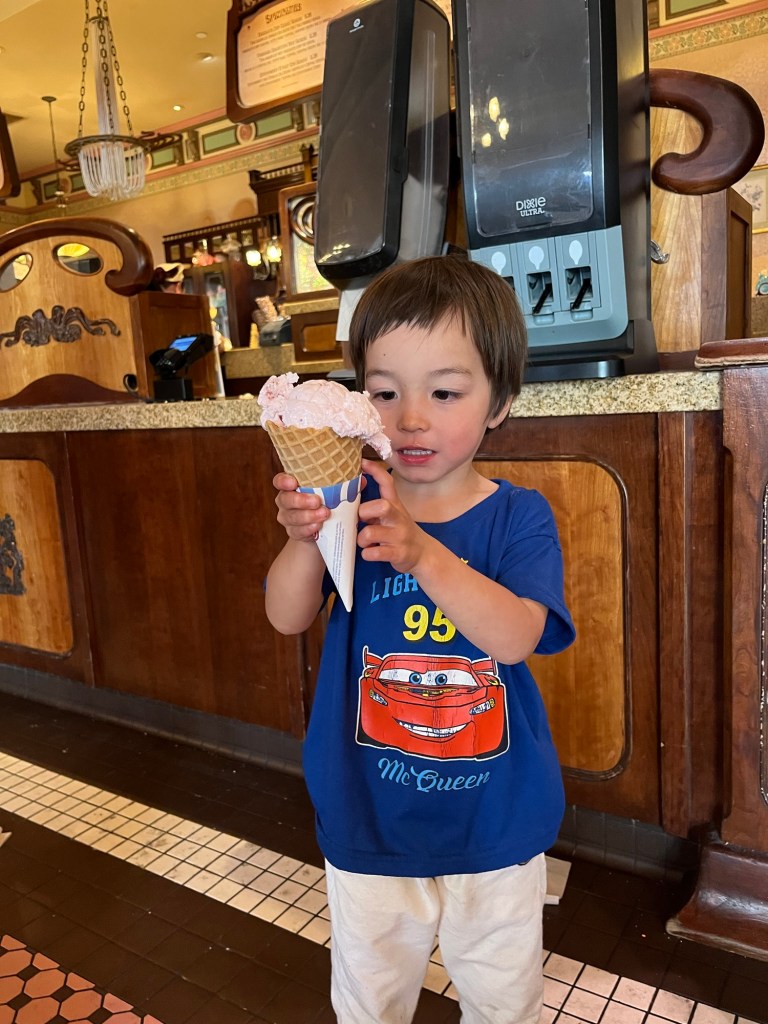
So we ambled instead. We got Tov a strawberry ice cream cone bigger than his face– his first real cone!– and while we sat by the sidewalk, watching all the other Disneylanders pass by, he licked and licked and licked his cone until the whole thing was gone into his belly.
Then, because Tov had been asking for a lollipop all day, David caved and got him a cherry lollipop, also the size of his face.
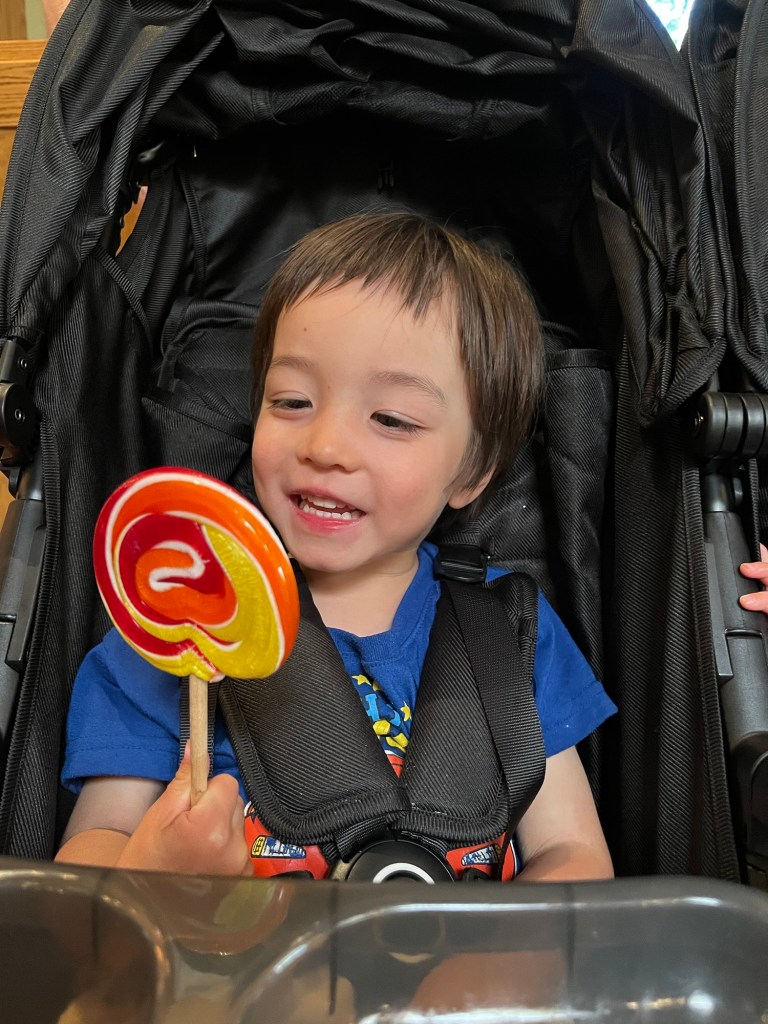
On any other day, I would have gotten very annoyed that we are giving him so much sugar, but I shook it off– eh, it’s Disneyland. There’s only one first experience of Disneyland, and half the joy of Disney is being able to eat all the sugar you want.

Of course, we had to go to California Adventureland, where Tov got to meet his hero, Lightning McQueen, and take a picture with him.
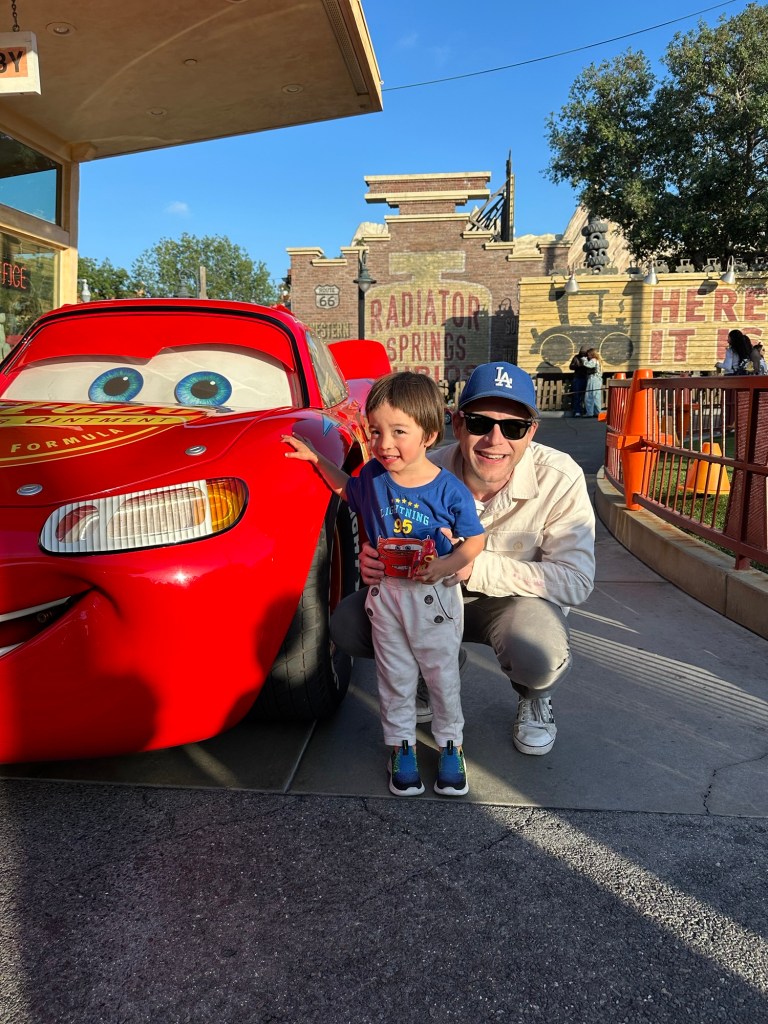
We also got him a set of toy Cars that light up underneath, and oh, the joy on his face! He really doesn’t need more car toys, but really, we bought the set for ourselves– for that momentary, yet eternally pleasing, joy of seeing the delight on his face.

It might have been Tov’s first Disneyland trip, but it was my best Disneyland experience.

I remember the first time I came to Disneyland, I was 12, on a family trip from Singapore to the United States. Back then a Disneyland ticket cost a lot less, but it was still significant, especially for a missionary’s income. I thought it was so magical. I don’t even remember most of the day, but all I remember is how in awe I was of that place, how I deemed it the most magical experience in my life, and to this day, I can still taste the leftover pixie dust from that trip. And I remember too how happy my parents were that day, not because they enjoyed Disneyland, but because they kept looking at our faces, grinning at our grins, excited at our excitement, wondrous at our wonder.

“Did you have fun?” abba kept asking us as the day ended, and each time we nodded happily, he beamed.

And now, full circle, here I am, a mother myself, grinning at my son’s grins, excited at his excitement, wondrous at his wonder, a child again through my child.

I actually did not even mind waiting in line, because that was a rare Tov-and-omma-only time, in which I got to hug him, lift him, spin him, kiss him, for the full 40 minutes we waited in line. I squeezed his hands, still little in my own adult hands, marveling that this boy with a real neck and sweat odor was, last time I was here, a curled, thumb-suckling mystery in my womb.

That chapter of my free, childless days has closed, and then the newborn baby chapter opened and closed, and now here I am, in the last few paragraphs of the toddler chapter, feeling so incredibly thankful and sad at the same time.

While Tov was eating his ice cream and I sat by him, holding Woori and people-watching, I saw an Indian family standing near us. It was an older couple and an old lady in a wheelchair with a long, grey braid, who was, like Tov, licking happily on an ice-cream cone. While we were at Disneyland to treat our child, it was clear they were at Disneyland to treat their mother.

For some reason, that scene moved me. They were enjoying the same moment as David and I, but flipped generationally. For this family, a chapter had opened and closed as well: The chapter of their mother taking care of them had long closed; the chapter of their young parenthood days have also closed; and here they are now, probably with adult children long out of the house, here to relive the Disney magic with their aging mother, before she got too frail for Disney.

I hugged Woori closer to me, as she wobbled on her tippy toes and scratched my face with her sharp tiny nails. She is still a baby now, but the next time we come to Disneyland, she might be a running toddler, and Tov a Kindergartener. And who knows? Maybe one day they’ll be the ones taking David and me to Disneyland in wheelchairs. By then, so many chapters would have opened and closed, opened and closed, each with its dragons and witches, each with its adventures and feasts and magic like this day at Disneyland.

At about 7:30 pm, as both kids started to fade and Tov was no longer running around licking walls and pavements like King Nebuchadnezzar when he turned mad, we got in line to ride the tram back to the parking lot.

In front of us stood a young Arab family, a good-looking couple and their young toddler son. They too were saddled with a stroller and diaper bags and all the goddarn tools a parent needs to keep tantrums and blowouts at bay. As we struggled to hoist all our stuff onto the tram, every one of us weak with exhaustion and overstimulation, the mother commented wryly, “I don’t know why we pay so much to do this.”

But we do it anyway, and we’ll do it again, because that cliche is so true: Time passes so fast. They grow up so fast. And at Disney, time seems to stand still for a day. At Disney, we all turn into a child, from the grey-braided old Indian lady to this young tired mother in a hijab. It doesn’t matter if there are dozens more chapters of our life left, or if we’re on the last chapter— here at Disney, the magic goes on and on, passed from generation to generation.
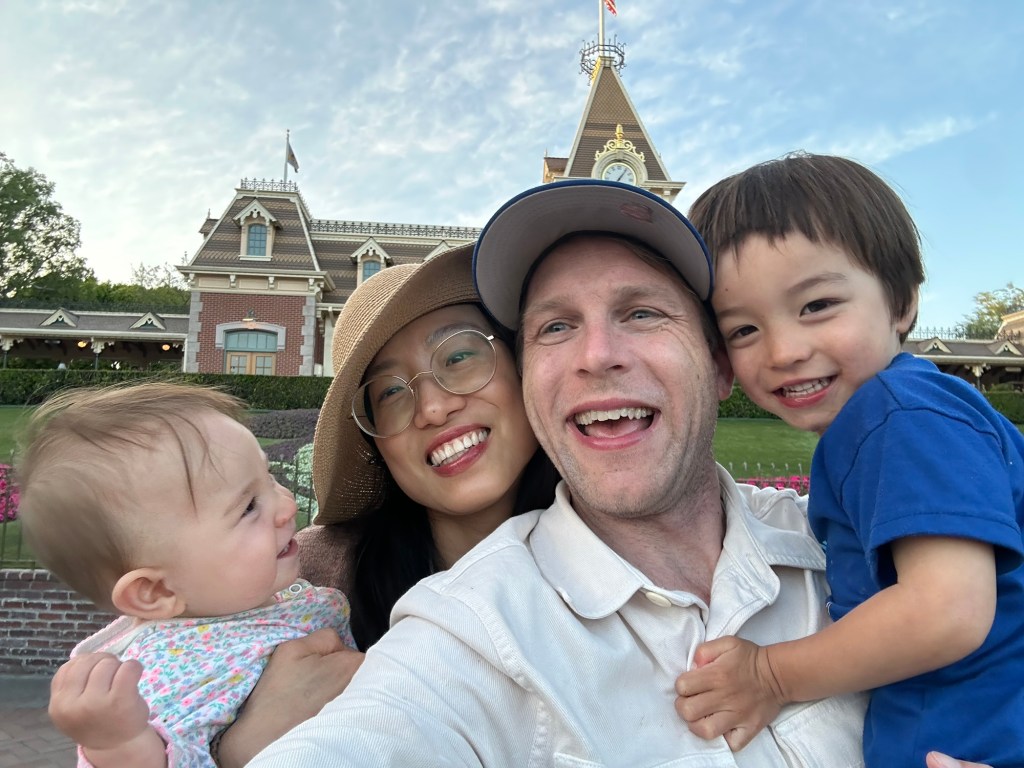
That’s the magic of Disney.

And as David and I drove back onto the 5 freeway, while Woori shrieked in her car seat and Tov complained that the baby is “too loud,” we looked at each other and said, “That was fun! What a great day!”

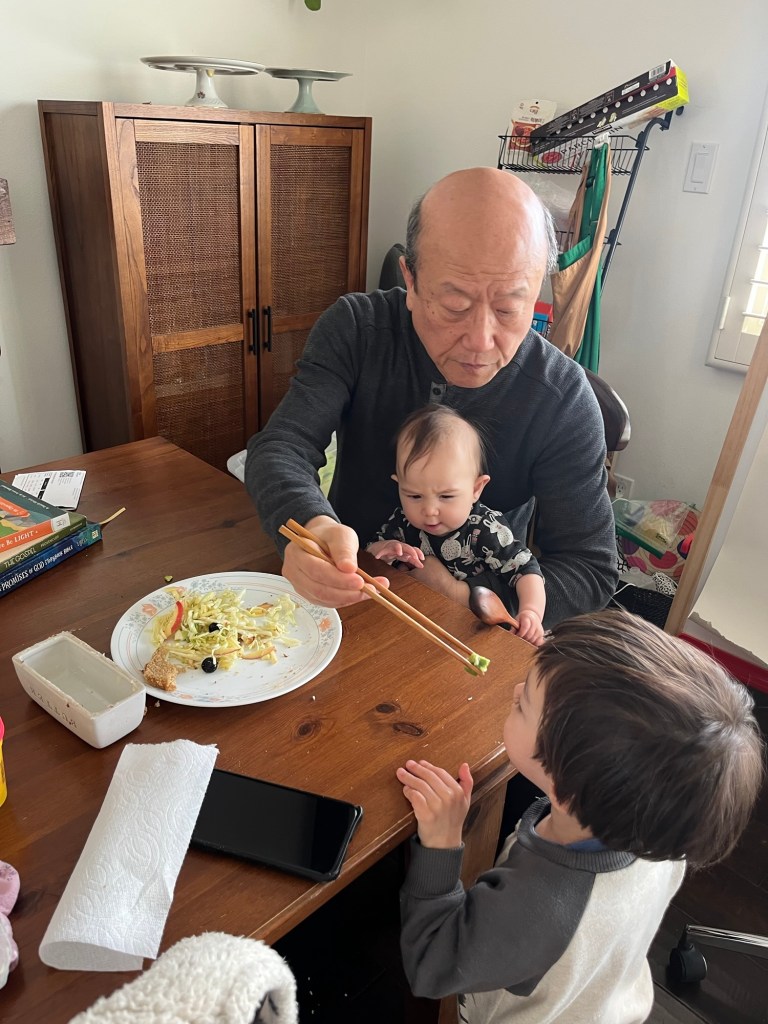
Saying goodbye to my parents

On February 28, 2025, I dropped my parents off at Hell on Earth, aka LAX, early in the morning. I’ve dropped them off at this airport numerous times. But this time, they weren’t flying back home to Virginia. They flew back to their mother home, South Korea.

They had four luggages and one backpack. For people who had lived so economically and simply, they were shocked by how much stuff they had accumulated over the 24 years they had lived in the United States– mountains and mountains of stuff that they threw out and donated and gave away.

I remember the story my father used to repeat to us, the way patriarchs retell family legends, of them packing all their belongings in Korea into two luggages, and landing in Singapore as fresh missionaries with a 4-year-old and a 2-year-old. My father was filled with ambition; my mother filled with apprehension. Now they return home with twice the luggage, five times the wrinkles, 34 times the lived experience of full-time ministry, and infinite times the joy and gratitude.

Woori was wailing as we drove to the airport that day. She hates being in the car seat, and no matter how many tongue-clucking and funny faces my omma made, she made her displeasure known. So by the time I pulled the Mazda SUV up to the curb of Tom Bradley International Terminal, I was a little frazzled, my overstimulated senses as messy and stuffy as my heart.

We pulled the heavy luggages out to the curb. Then we embraced. Once, twice. I had to let go quickly as I wasn’t technically allowed to park there, but my hugs were also hasty because once I enfolded my arms around my omma and abba, breathing in their familiar scents, touching the bodies that cradled me skin-to-skin from the moment I was born, I didn’t want to let go.

They waved. I waved. Then I hopped into the SUV and pulled out, back into the smoky tunnel of LA morning traffic. And as I drove away, Woori cried, and I too cried.

It is an end to an era.

It is silly, I tell myself, to be this sad. It’s not like my parents are dying, or unreachable. They are simply moving an ocean away, and with technology, I need only tap my screen to see their faces and chat with them. It’s not like I got to see them that often even when they were stateside, since we lived in opposite coasts.

But it does feel, in a way, like death. Or at least, an ending. They have closed down their church of 24 years, the church I grew up in, served in. The church that sent me off to college and then welcomed me back when I dropped out after being hospitalized, and then sent me back off again. The church about which I have complex feelings, the way anyone does with family members squeezed under one roof. The ministry my parents gave more than half their life to is changing. I can no longer go back “home” to Virginia, and that feels sad, even though Virginia hasn’t felt like home in years.

It also feels like a death to my hope that my children will be close to their grandparents. Living overseas, I grew up seeing my own grandparents once every three years, at most, and whenever we visited them, I felt awkward. Each visit was like meeting strangers for the first time. We had almost zero history and shared very little memories and experiences. They didn’t have much to say to me, and I didn’t have much to say to them. I really don’t want that for my own children. The thought of them not knowing their grandparents, not receiving their affection and admonishments and doting, pains me.

But more than anything, this closing of an era is a jolting reminder to me that my parents are aging. During the two weeks they spent with us here in LA before they flew to Korea, I saw my parents get more easily tired. Omma has lost more than 15 pounds and is dealing with health issues, while abba needs a few naps a day to push on. Omma has always been more physically fragile, but Abba to me has always been like an oak tree– thick, strong, unwavering, abounding. Even his voice was like oak– a rich, loud baritone. To see his sparse gray hairs, to hear his cracking voice, I felt fear and anxiety, knowing the thing that most human beings face at some point in their lives– the passing of their parents– is drawing near.

Death was a regular topic while my parents were in LA. For the first time, they told me what they wanted when they died. Both told me they want us to pull the plug should they be in a coma. They want us to scatter their ashes in the mountains. We also talked about what to do if one of them dies before the other. It’s terrible talk, but it needed to be said.

Being a 37-year-old wife and mother is to be sandwiched between two duties– one to the family I’m raising, and the other to the family that raised me. One family is fresh and new, still knobly and plump like buds about to bloom. The other is wilting, the peak season long passed. I myself am in full bloom, but I’m noticing a few petals starting to droop, and I know my peak is over, particularly as I feel the growing aches and creaks of aging. It is a very odd, uncomfortable, conflicting season in life, to be worrying about your kids at the same time you worry about your parents.

I knew my parents would have financial issues. Now that they are no longer receiving an income from the church, they had to figure out a new living situation. They didn’t have anything planned for retirement other than social security. They have no property, no assets. When they applied for a new credit card, the company gave them a $1,000 credit line. They couldn’t even afford to continue staying where they’ve been living for 22 years– a townhouse that’s 40 years outdated, with tiny rooms and laminated kitchen cabinets that are literally falling apart.

That’s how my parents had been living all these years. They tithed about a third of their income to the church. They never considered building wealth, at least not the earthly kind. My mother didn’t once own a designer handbag. My father wore the same suit he bought in Korea decades ago, and his ties were gifted by others. They lived simply and trusted that the Lord will provide.

I have less faith, I suppose. I got a little angry when they refused, several years ago, David’s offer to buy their townhome for them so they didn’t have to worry about housing. I got irritated thinking about this again after they told me they shut down the church. “You should have said yes to David’s offer when you had the chance!” I said to omma.

And that’s when they decided to return to South Korea and apply for dual-citizenship. It was the most practical decision– Korea has great benefits for the elderly so they don’t have to worry about health care; they could comfortably live on their social security there, since housing is cheaper, as long as it’s not in major cities such as Seoul. But they underestimated the cost of housing even in smaller towns. Their budget could only afford old, rundown places in rural villages.

Meanwhile, David and I are renovating our new house. What was originally going to be a bit of a fix-up here and there turned into a full gutting. Basically, we are building a new customized house. Our renovation budget has blown out of proportion and I’m embarrassed to share it. While my parents were here, I was deciding on wall paint colors, and omma accompanied me to get some paint samples, which cost me about $160– for freaking paint SAMPLES! The money we are spending on this house is insane. Three exterior doors cost us $15,000!!!

It just didn’t feel right, that we are building our dream house while my parents look for crappy, bug-infested housing in the countryside. I felt a pang to see how excited my mother was for us. She wanted to know what we’re doing for the kitchen, the bathrooms, the exterior paint, and had plenty of opinions. She told me she enjoys watching home renovation videos on YouTube, something I learned for the first time, and it wrung my heart to realize that she admires a tastefully decorated and designed home but never had the chance to live in one, and in fact, never imagined she could.

So one evening, while my parents watched Tov and Woori, and David and I were on a date, I proposed to David that we help my parents buy a house in Korea. Years ago, David had loaned his brother money for a business project, and his brother was finally returning that sum back to us. Perhaps we could direct those funds to my parents’ housing instead?

I was a little nervous suggesting this to David, not because I thought he’d refuse, but because it puts me in a vulnerable position, and I pride myself for being self-sufficient and independent. And though technically this money belongs to both of us, it’s still a lot of money, and it’s money that came from David’s earning, not mine. So it took a lot of swallows for me to ask David.

I wasn’t surprised when he agreed. I knew he would. But I was still touched beyond words when he did. Turns out, a day ago, he had been listening to a devotion about not storing your treasures on earth but on heaven, and that had made him ponder. Then that Sunday, our pastor preached on the Ten Commandments. To honor your parents, the pastor said, includes providing for them financially in their later years.

What’s more, both of us had been praying about money this year. I’m praying about generosity, and David’s praying about wise stewardship of our finances. The Lord has blessed us financially with a new house, and we want to use it for the glory of Him and the good of others.

All of this didn’t feel like a coincidence. It felt like God was blessing us to bless our parents.

David and I agreed to broach the subject on the last night with my parents before they left LA. I told David I was nervous about bringing it up, because historically, abba has been strongly against receiving any help from us. I had no idea how he would react, and I braced myself for a five-point argument on why he should accept our help. I told David he had to be the one to offer it; it couldn’t come from me. And I told him to emphasize how this conviction came from God.

That night, after dinner, David and I exchanged glances. It’s time, I said with my eyes. David turned on a show on TV so Tov won’t bug us, while I took Woori off her high chair and held her on my lap so she’d be quiet.

“So,” David began. “Sophia and I have been praying about being generous with what God gave us. And I’ve been thinking about how we want to invest with what we have…”

“Oh?” Abba said, having no idea where his son-in-law was going with this.

Well, I was really proud of David that night. He mentioned everything I had hoped he would, and when he was done, my father grasped his hand, nodded, and said, “I receive.” And then he choked up, and said again, “Thank you. Thank you Lord. I receive.”

I was so shocked that I couldn’t believe my ears. Omma was just as incredulous, so she asked him, “Wait, so what do you mean. Does this mean you will accept the money?”

Yes, Abba said. He sees how much the Lord has blessed us, and by accepting it, He too is receiving God’s blessings, and because God blesses those who give, he believes he is also blessing us by receiving it.

I felt my heart release with relief and gladness. Before David and I got engaged, I had actually asked him to use whatever he would have spent on my engagement ring, and donate it instead to my parents’ ministry. That didn’t end up happening, but now that I had more than I could have ever imagined– I, who once couldn’t afford laundry detergent and had to make my own!– it made my heart feel so full that I was able to present this one gift for my parents in their older age, in this new season of their life. This was the first significant financial support I’d ever given my parents. It was also the first step in tilting the balance towards me supporting my parents, rather than them supporting me– an end to an era, indeed.

What made my heart just as full, however, was that David was doing this with me. As I pray about generosity this year, my own husband is showing me how to be generous not just with his finances, but with his heart.

It is easy for me to be generous with my own parents; I would give them part of my liver if they needed it. But it’s not as easy for a son-in-law to be as generous, to treat his wife’s parents as his own. He wasn’t just giving my parents a better house; he was giving them his love, and in there is his love for me. And I think in that moment, my father recognized that too– he was moved not just by the unexpected gift of a house, but by the clear display of a husband’s care and love for his daughter. In this, he saw God’s grace, His love and providence and goodness and faithfulness that have never failed him in his almost 35 years of ministry.

After my parents left to pack up for the next day’s travels, and after David and I had put the kids to bed, I gave my husband a hug.

“Thank you,” I said, tearing up.

“For what?” he said, acting all cool.

“For everything,” I said, and I meant it.

David made a “huh” noise, a sound he makes when he’s pleased but also trying not to sound too pleased about it. Then we talked about the show he’s watching.

We’ve never been a couple who talks all sweet and cooey and sentimental. We reserve nice sappy words for birthday cards, where we don’t have to make eye contact and hear those words out loud, so awkward and unnatural to our ears; we don’t kiss goodnight, we knock heads.

But within that brief exchange was a lifetime of card sentiments– I felt seen, valued, cherished, respected. David’s act of generosity had so many layers of blessings in it, like a mille crepe. He blessed my parents. He blessed me. He blessed our children by showing them what it looks like to honor one’s parents. He blessed my brother, who now can worry less about our parents. He blessed my relatives in Korea, who no doubt will hear from my father how the Lord has blessed him through his son-in-law. This is how true generosity works– it just keeps on giving and giving.

Saying goodbye to my parents felt strange. I felt a little like I was the parent, sending my kid to school for the first time. As the last person to hug them goodbye before they left the U.S., I felt like I was sending them out into the next chapter of their lives. I was a little worried, a little anxious, but also excited and proud. I wanted to cling on, but I had to let go. And I heard God usher them away, saying, “Well done, good and faithful servants.”

And off they go.

Dad Health Logic

My parents have been visiting for about two weeks en route to Korea. They are moving— permanently— back to Korea, a decision that I still am processing emotionally.

Anyway. David once said I could write a book about my father because he is just…such a character. We really love and respect abba but also make fun of the way he dresses (that classic Korean ahjeossi high-waist pants cinched with a black leather belt) and talks (he can dive into an hour-long soliloquy with lots of earnest hand motions) and eats (chews like a cow; if he’s chewing a gum you could hear him a mile away).

We make fun all out of adoration, of course. I know some people find my abba intimidating and severe because he’s a pastor who’s serious and bold about his faith. But there’s so many more sides to him that’s amusing, endearing, and fun, if not exasperating.

The most exasperating yet entertaining part about abba is his own dad health logic. He writes his own health book and lives earnestly by it.

For example. Abba developed his own workout that he claims can give him twice the benefits of an hour’s traditional workout session in 5 minutes. What he does is lean against the wall with a finger or an elbow, and then he tenses up the rest of it his body to the point of trembling, the way an overweight ballerina might tremble with the exertion of trying to hold a pose on one tippy toe. He calls it “떨공,” or “trembling exercise.”

This trembling exercise works out every fiber of muscles in his entire body, he claims. “It’s better than an hour on the…the…” He doesn’t know the word for “elliptical,” so he acted it out by vigorously pumping his arms back and forth.

How does he know that trembling exercise is superior?

“Oh,” he exclaims, gesturing down the length of his core, as though this fine specimen of a body should be evidence enough, “Oh, I know.” God gave him the wisdom for this efficient technique, because He knows my father doesn’t have the time for long exercise regimens.

Never mind that he’s got a boomer belly; that’s just testament of God’s grace— the Lord has never let him starve, and besides, that belly is also a sign of God’s wisdom— it serves as a cushiony ledge on which his grandbabies can sit.

Even with concrete numerical data, my father says otherwise. About a year ago we were in Korea, at a clinic because David was not feeling well. There’s a free blood pressure measuring machine by the waiting area, so abba decided to check his blood pressure. I knew something was up when he tried to shove the piece of paper with his results into the pockets of his high-waist pants, like a kid smuggling candy in his shorts. I sneaked up on him and pickpocketed the result, which read: 185.

“Isn’t that really high?” I yelped.

“Oh no,” abba assured me. “At my age, blood pressure should be a bit high.” According to him, it would be unhealthy to have blood pressure within the “normal” range at his age. Besides, he can always eat more garlic and onion to remedy it.

Speaking of onions and garlic. Have you ever tried abba’s onion wine?

I have. So has David. He almost choked.

Onion wine (except abba calls it “onion’s wine”) is abba’s homemade recipe for a healthful life: He chops up raw onions, drops them into a big-ass mason jar, then glugs cheap Cabernet from Costco over the onions and lets them steep for a few days. The finished product is onion-flavored wine, every sip more pungent and briney than the one before, and if you fancy, you can crunch on a side of red-dyed winey onion with each onion-y sip, like one would nibble on olives with their martini.

It tastes vile to me, but abba loves it. I don’t know how omma sleeps next to him after he drinks a glass of that; he’s got to be releasing tons of onion fumes.

Another example: Abba loves Shin ramen.

Shin ramen has become a global phenomenon since hallyu, showing up by the boxes in Mexican supermarkets and Japanese convenience stores and Amazon and Costco. Kimchi has also become a global phenomenon, but mostly as a probiotic health superfood that white people discovered and veganfied to great profits. Shin ramen is no health food. It’s deep-fried dried noodles with a packet of unpronounceable addictives and preservatives.

While my parents are here in LA, the first stop they made to the grocery store (Aldi’s), my father tagged along to make sure to drop an armful of Shin ramen into the shopping basket.

I told abba not to eat too much instant ramen. “How many times a week do you eat Shin ramen?” I asked.

“Only about twice a week,” abba said.

Omma overheard and let out a laugh of incredulity. “Twice a week? Ha! Try five times a week!”

“Abba!” I scolded.

“Don’t worry,” abba said. “I put in tons of onions in my ramen.”

Apparently onion not only makes a glass of red wine even more salubrious, it also cancels out the health negatives of all the chemicals in instant ramen. Who knew onion has such magical powers? Why don’t more people drink onion smoothies instead of the inferior green kale smoothies? Why is there no cookies made from dehydrated onion flour that go viral on TikTok? Why hasn’t Erewhon marketed $35 liters of organic onion water in recycled glassware? If abba were a more business-minded man rather than the Lord’s humble servant, he could make a fortune off his onion health theory.

But it’s too late. Abba is slowing down. He’s almost 70. After weeks of packing up everything in their house, throwing things away, and figuring out next steps in Korea, he is physically and mentally wiped out. He arrived in LA exhausted and hasn’t been given much time to fully rest, what with a whiny toddler and a shrieking baby to help look after.

One Sunday, he had leftover pepperoni pizza for breakfast, a huge pita sandwich with harissa sauce for lunch, and then pork belly for dinner. My mother has been on a health kick since she found out she is prediabetic, and since then, she’s been strictly controlling the menu: no more fried food, very little red meat, no more seasoning. As a result, abba told me mournfully, “Our meals have gotten weird.”

So while here in LA, away from omma’s health-conscious kitchen, he took full advantage of the sudden access to flavorful foods, and ate to his heart’s content.

The next day, his body squeaked in protest. He had a bellyache and felt dizzy, lethargic. He had no onion wine to delete the greasy pepperoni, the slabs of butter, and the glutinous pork fat, and hence, he suffered. This is quite a shock to all of us, because abba almost never gets sick.

Abba decided to take it easy that day. He dutifully ate a few spoonfuls of the oatmeal (with chia seeds) that omma made him. That evening, he only ate half of the bulgogi that he would normally eat, though I did catch him slurping up more of the sauce when no one was paying attention.

The next morning, he woke up at 6:30 am after a full 10 hours sleep, a luxury he hasn’t been able to enjoy in years. He felt much better! Hurrah!

So what did he do? He made Shin ramen for breakfast, waking omma up with the fumes of spicy MSG.

When I found out, I yelled at him. “You said you weren’t feeling well! Why are you eating Shin ramen for breakfast??”

He shook his head sagely. “Don’t you know? Eating what you love is healing.”

Another one of his dad health logic: Something about how when you eat something delicious to you, you produce tons of saliva, which helps properly digest your food, which then becomes the critical nutrients and minerals that your body readily absorbs, because it is in a state of joy and thankfulness in the Lord. If I’m honest, it kind of makes sense.

Omma nags at him like I do. She lectures him about all the YouTube videos she’s watched, which inform her not to eat more than an egg a day and to avoid all artificial sweeteners.

Abba doesn’t dismiss them. He’s not against science, he says, but neither does he think health obsession is all that healthy. The anxiety you have over health and nutrition is more harmful than the state of bliss you have when enjoying your favorite foods, he preaches.

“So let’s examine the evidence,” he concluded during a particular debate with my mother: “You eat steamed veggies and pasture-raised egg and chia seeds. I eat ramen. Who between us is healthier?”

“I had nothing left to say,” omma told me.

I don’t know what it is, whether it’s the onion wine or his radical faith in God, but something’s working. My abba, despite slowing down in his older age, is still healthy. And even though he did feel slightly ill for a day, he recovered as swiftly as a brawny teenager in the prime of youth.

Onion wine, anyone?