
-
How Middlemarch Shaped My Perspective as a Mother

I am 38 and only just discovered Middlemarch by George Eliot, and now it’s in my top 5 favorite novels of all time, and I thank God I didn’t wait another 30 years before I opened this book, because not only is it a classic for a reason– timeless, universal, exceptionally written– but it hit me just at the right season of my life as a 38-year-old wife and stay-at-home mother who wrestle with this need to feel “fulfilled” and “accomplished” in my life.
When I picked up Middlemarch, I expected to read a great Victorian classic. I didn’t expect it to tug at my soul and expose its contents and re-narrate the story I had scripted about my own life. Middlemarch spoke poignantly to some of my deepest longings and questions and fears, the way no self-help book or therapy can, by expressing humanity through deep and complex characters going through ordinary life.
This post is not a review, though it does contain elements of it, and will include spoilers. This post is about how Middlemarch helped me see myself in this season more clearly and empathetically, how it defined the image I had for myself through a pretty annoying character, and how it helped me feel more content and fulfilled in my life.
First of, George Eliot writes beautifully. Her prose is just unrivaled, and I was copying down sentence after sentence that were so beautifully and gracefully crafted that I wept at how my own writing paled in comparison. Her characters have flesh, blood, movement, tears, sweat, creaking joints, excrements. They are alive. They are not satirical or angelic like most of Charles Dickens’ characters. They are not melodramatic and overwrought like some of Fyodor Dostoevsky’s characters. They are noble and egoistic; earnest and foolish; generous and selfish– all the dimensions that make up the complex nature of a human being who’s both made in the image of God yet is also fallen and depraved.
And you can really tell that Eliot loves her characters. She’s got such tenderness towards them, the way God does to His image-bearers. She exposes their shortcomings, yet covers them with grace and mercy and compassion. None of her characters are pure villains or angels. They are so richly complex, so vibrantly flawed, yet uniquely sympathetic and whole and…well, dignified in their own right. Many writers do this well, but Eliot is next level. As a narrator, she flows naturally from counselor to pastor to philosopher to a fellow human being in the way she illustrates and analyzes what’s happening. She’s no postmodernist— she’s got a strong moral core, but without being sanctimonious.
Middlemarch is set in a small early 19th-century town called Middlemarch in England, at a time when Britain was globally powerful and prosperous, when society was still rigidly divided into social status and gender, when women were expected to be naturally more virtuous than men yet stay dependent, private, powerless, and fragile, and when the Industrial Revolution was gearing up, causing new and inextricable issues regarding class, labor, human rights, politics, education, democracy.
At its core, the book is about unmet idealism. It follows the ambitions, limitations, and disappointments of two main characters, Dorothea Brooke and Tertius Lydgate. (By the way, who’s named Dorothea or Tertius these days?)
We meet Dorothea as a “handsome” and “remarkably clever” 19-year-old orphaned woman who intentionally wears such plain garments in contrast to her beauty that she’s compared to the “Blessed Virgin appeared to Italian painters.” She’s described as having a mind that’s “theoretic, and yearned by its nature after some lofty conception of the world.” She’s “enamoured of intensity and greatness, and rash in embracing whatever seemed to her to have those aspects; likely to seek martyrdom.” She’s ardently pious with a fierce sense of social justice and compassion, to the point where meeting a sick labourer would cause her to “kneel suddenly down on a brick floor” and pray “fervidly as if she thought herself living in the time of the Apostles.”
In short, she’s tiresome. She’s annoying. She’s the kind of Bible-quoting, moral policing, self-denying, self-righteous social justice warrior who would chastise you for swearing or being apathetic about oppression.
Here’s one early scenario, where her younger sister Celia suggests looking through their dead mother’s jewels. Dorothea is instantly dismissive— Why? Only worldly people wear jewels. Celia argues that they should respect mama’s memory, that necklaces are quite usual these days, not at all extravagant, and “surely there are women in heaven now who wore jewels,” she tries feebly.
Dorothea consents and they admire their mother’s jewels. Dorothea is delighted in Celia’s delight. Then Celia suggests Dorothea keep a beautiful pearl cross, thinking that would suit her religious aesthetic.
“Not for the world, not for the world. A cross is the last thing I would wear as a trinket.” Dorothea shuddered slightly.
“Then you will think it wicked in me to wear it,” said Celia, uneasily.
“No, dear, no,” said Dorothea, stroking her sister’s cheek. “Souls have complexions too: what will suit one will not suit another.”
OK. YOU SEE WHAT I MEAN? She is maddening!
Here, in one passage, Eliot brilliantly captures the paradox of Dorothea. She clearly admires the jewels, but she justifies it with religious speak. It’s OK for her sister to wear a cross necklace, but no, absolutely not her, because she’s different, she’s set apart, she’s extraordinary. This is Dorothea’s contradiction: She’s genuinely humble and good…but she’s also freaking full of herself, and she’s completely unaware of it. She believes she’s called to an unconventional vocation, a heavenly mission.
Trouble is, she’s a woman in the early 1800s in England. The best permitted ambition for her is to marry up. So she decides she’s going to marry someone extraordinary– an exceptional husband for a woman who seeks the exceptional things in life. When Sir James Chettam, a wealthy, good-natured, handsome young landowner expresses interest in Dorothea, she shuts that down real quick. Sir James might be the ideal catch for many a women, but not Dorothea, oh no. No, she decides to marry Edward Casaubon.
Let Eliot describe Casaubon to you: “the set of his iron-grey hair and his deep eye-sockets made him resemble the portrait of Locke. He had the spare form and the pale complexion which became a student; as different as possible from the blooming Englishman of the red-whiskered type represented by Sir James Chettam.”
Eliot is being charitable by describing him through the eyes of Dorothea. Celia describes Casaubon more candidly: “How very ugly Mr Casaubon is!”
When Dorothea rebukes her sister, saying Casaubon is as distinguished-looking as Locke, Celia retorts, “Had Locke those two white moles with hairs on them?”
Oh man. I DIE. Do you know what John Locke looks like? This is a portrait of Locke:

Dashing, he is not. His nose is large enough to hang a coat. Add two white moles with hairs, and that’s Casaubon. Also, Casaubon is 45 years old to Dorothea’s 19.
Besides, he is just…that kind of self-important, self-serious, mansplainer who talks “as if he had been called upon to make a public statement.” He is not just old enough to be Dorothea’s father; he is also physically ailing. He’s spent too much time indoors poring over his tomes, working on a scholarly masterpiece that have yet to materialize, and his sallow skin and weak frame reveal it.
And THEN! The proposal he writes Dorothea! I won’t quote it, because it’s incomprehensible with all its stylized, obtuse garble (even by Victorian standards), but basically, he tells her that he’s a Very Important Man, working on a Very Important Work that demands all his energy and attention (basically, he’s trying to compile the world’s mythologies into one scholarly religious text), but he senses another need that he once feared would interrupt that Very Important Work, and that is a female helpmate. But hark! He’s finally found a companion worthy of assisting him in this Very Important Work: Dorothea! How amazing is he– uh, she? Would she marry him?
And Dorothea’s reaction? She “trembled while she read this letter; then she fell on her knees, buried her face, and sobbed.” Not out of outrage and indignation, as any sensible woman should have, but out of overwhelming gratitude that she had been chosen. She herself didn’t choose Casaubon out of love: “Her whole soul was possessed by the fact that a fuller life was opening before her: she was neophyte about to enter on a higher grade of initiation.”
So I guess they deserved each other. They married to fulfill their own needs. And their marriage is disastrous. Not only does Casaubon not show much affection or appreciation for who Dorothea is as a person, he starts resenting and belittling her once he realizes that she realizes that Casaubon is indeed a big fat fraud. And worse, he’s a BORE. He can parrot important, serious-sounding intellectual words, but it’s all regurgitation. He’s well-read, but as bland as soggy bread. He’s disciplined, but utterly unoriginal and uninspired. He always does what is right, but there’s a stinginess even to his charity.
Dorothea had expected Casaubon to elevate her spiritual purpose, to stimulate her hunger for intellectual nourishment. Instead, their marriage spirals into a toxic prison of resentment, frigidness, jealousy, bitterness, suspicion, fear, insecurity. For all her high-minded ways, Dorothea is an earnestly joyful person, but he sucks the joy and zest out of her. Finally, Casaubon dies, and Dorothea is a young widow bereft not just of a husband, but her dreams of a fulfilling some deep purpose in life.
And then there’s Tertius Lydgate. Now Lydgate is a middle-class man. He’s got way more power and resources and opportunities than Dorothea. He’s also whip-smart, young, educated, visionary. He’s progressive and scientific in the medical field, at a time when doctors still drew blood to “restore bodily balance” and placated patients with nonsense brews. He arrives in Middlemarch as an ambitious doctor aiming to reform medicine in a conservative rural town suspicious of anything new and progressive. He wants to save lives…and make a name for himself.
His is an even more tragic story. Lydgate had so much potential and worthy goals. But then he marries a beautiful woman with elegant charm and a sweet singing voice and pretty smiles but no moral compass, sensibility, or perspective other than her own. His story is a painfully gradual, downward slide— first financially, then maritally, then socially and idealistically…until he quietly fades into comfortable mediocrity, which quite literally diminishes him.
Dorothea and Lydgate are similar in many ways: They are both idealistic and intelligent. They both marry disastrously and becomes disillusioned. But their ending is different. By the end of the book, one commands admiration. The other evokes pity.
The difference between Dorothea and Lydgate is that Dorothea had moral resilience. When her life didn’t turn out the way she wanted, she learned and evolved. Dorothea faces her disappointments with a strong, principled determination to continue doing what is right and good. She might not feel respect or love for her husband, but she continues to act in love and faithfulness even when he’s cold and bitter towards her. She exchanges bitterness for compassion. She gives up her lofty ideals, but not her values, and in the process, she gains empathy, wisdom, resilience, strength, discipline. She is still passionate and high-minded, but her passion and orientation become refined, grounded, and authentic. Eventually she marries again, this time giving up status and influence for a life of invisibility and ordinariness, but one that’s also rich in love and relationships. This is someone who redirects her passion to what truly matters.
Lydgate is not like Dorothea. He diminishes. He gets smaller and smaller. He compromises, shrinks, and eventually, succumbs to defeat. He gives up relationships and purpose. He becomes passive. And he stops striving for what is good and true, and simply…lives on because he’s still breathing, and bills need to be paid. This is someone who loses his passion.
There is so much to unpack here.
As much as Dorothea irritated me with her youthful delusions of grandeur and martyrdom, even more irritatingly, I saw myself in her. I have those delusions of grandeur. I always thought it would be quite awesome to die while reporting in a war zone, or to get entangled in danger because I’m exposing corruption in powerful authorities. I had so much passion in me to make the most of life, to make it matter, to do something that matters. I also deeply identified with Lydgate’s ambitions and potential, and his sometimes awkward inability to fit neatly into societal conventions and expectations.
It’s in my nature to be idealistic, but I think it was also nurture. I was raised by a very idealistic, passionate, intense father with firm principles on what is right and wrong. He sought righteousness with all his heart and might all his life, and he raised me to be that way. All of those traits are wonderful and good…until it gets twisted with human ego and a fear of failure. I also remember as a kid attending church conferences by Darakbang, a Korean evangelistic denomination that’s…slightly cultish (but not a cult) and super intense about evangelism and discipleship. Through Darakbang, I heard so many exhortations to be this era’s “Daniel” and “David” and “Moses”– highly educated, highly accomplished, powerful “elites” (they actually used that term “elite”) who will shake society and heaven.
I strived to be a Daniel and Moses. I wanted to be an elite. Someone who does great things. A transformer. A mover and shaker. A legacy.
And what do I do now? I read Middlemarch after the kids go to bed, and that’s the main intellectual exercise I get for the entire day.
I wake up with two little kids clinging onto me like little koalas. I pick up toys and shoes and underwear as I strut around the house, changing diapers, washing poopy hands, wiping apple sauce off counters and floors, wiping snot on my sweatpants (my daily attire), holding a tantrumy toddler in one arm while stir-frying dinner with the other, telling a high-energy preschooler for the twelfth time to sit his butt on the chair instead of rolling underneath the dining table, and teaching a highly unmotivated 4-year-old to sound out the word “CAT.”
I do not feel like a Daniel or a Moses or a David. I feel…like a Martha. Constantly doing, rushing, repeating chores and duties that are invisible only because someone is doing them, day in day out. Someone who’s quietly resentful of the countless things she does all day but has nothing to show for at the end of the day.
By the time I read Middlemarch, I had accepted that this is my life, a life I’ve chosen. I chose to stay at home. I chose to homeschool. I mentally closed the door to a career, likely forever. I stopped seeing myself as a former journalist, and more as a mother.
But it didn’t mean I felt good about it. Not that I felt bad about it— I was truly grateful to have this privilege to spend time intentionally raising my children. But I did feel like my original ambitions, my desire to do great things, had shriveled away for the sake of this life. I felt like a flower with a few petals ripped off. When I saw other former colleagues travel overseas to report on important issues, producing fantastic work, getting promoted to more distinguished journalistic positions, my heart ached with a sense of loss. And I would console myself by saying, “Well, I had my fair run. Now I’m a mother, and that’s important work, too.” It was more placating than true contentment and pride in where I am right now. I didn’t feel…well, great.
The problem is not that I sought greatness. It was that my idea of “greatness” didn’t mature all that much with my age. I still had that image of an “elite” as my vision of greatness. Doing great things was large, visible, measurable, extraordinary. But motherhood is one of the most ordinary vocation.
And then I finished Middlemarch, and contemplated the lives of Dorothea and Lydgate. And I read and re-read the ending. Here, Eliot is honest about Dorothea’s life. She re-marries someone who’s deemed far lower than herself, giving up her inheritance, and everyone proclaimed it a mistake. She was known in town as that
fine girl who married a sickly clergyman, old enough to be her father, and in little more than a year after his death gave up her estate to marry his cousin– young enough to have been his son, and with no property, and not well-born. Those who have no seen anything of Dorothea usually observed that she could not have been ‘a nice woman’, else she would not have married either the one or the other.
She was once seen as beautiful, clever, a bright and morning star. Now she’s considered a failure, a disappointment— that is, if anyone considers her at all. Meanwhile, as a modern-day feminist reader, I applaud Dorothea for following her heart this time, but there’s a sense in me that’s disappointed that she became “just” a wife and mother. But Eliot redeems her by famously ending with:
But the effect of her being on those around her was incalculably diffusive: for the growing good of the world is partly dependent on unhistoric acts; and that things are not so ill with you and me as they might have been, is half owing to the number who live faithfully a hidden life, and rest in unvisited tombs.
Dorothea didn’t lose herself– at least, not the parts that were essential to how God created her. She still chose the unconventional by marrying her second husband, who later became a social reformer, while nothing much is said about Dorothea marking her impact in the public sphere. It’s implied that she was still influential within her realm, albeit invisibly, and earning zero credit or recognition for it. And Eliot dignifies and redeems that in her.
In the season I’m in right now, I have a conscious choice to make: Dorothea, or Lydgate?
I am still the same person I was before I gave up my career to be a stay-at-home mother. I still have passions, ideals, curiosity, and desires for an intellectually and spiritually fulfilling, rich life— things that drew me to my career as a journalist in the first place. I think those are natural traits that God formed in me. It’s what makes me me, and I believe God honors that.
Reading Middlemarch awakened those things in me, while reminding me that just as Dorothea had to refine and temper those natural instincts in her as she grew from a 19-year-old girl to a mature, time-tested, experienced woman, I too am in the process of fine-tuning my passions and ideals and dreams, from youthful impulsion and selfish ambitions into something more real, more true, more pure…and it’s not just motherhood.
It’s being a whole person. A fuller person. A person who seeks goodness and does good even when no one is watching, when no one recognizes me, when there’s no accolades or promotions. A person who doesn’t long to be seen, but sees others. A person who doesn’t just plan and dream, but acts and lives out my values. That’s what it means to be fulfilled in life– to fill my life with faithfulness, goodness, and contentment. I don’t need to seek purpose; there’s purpose already in the life I’ve been given.
Dorothea was an irritating girl when I first met her. But by the last page of Middlemarch, she earned my respect and admiration. She’s not a typical role model exemplified in society, whether in the 1800s or today. But she is mine.
-
Mom rage
You know that certain fart, which oozes out silent but thick, with a noxious stink that lingers and permeates long after expulsion? That’s mom rage for me: I’m just sitting in this poison gas, and all it takes is one little ignition for it to explode into WWIII-level, fire-breathing rage.
Mom rage comes in waves for me. There are days when I am just trapped in full mom rage mode, and I can’t seem to quell that simmering urge to scream. It’s like a sinister fog that settles in my heart, coating everything with the black soot of negativity. Every little thing triggers me– the clutter on the kitchen countertop that magically appears after I’ve just cleaned; the toy cars and spat-out apple pieces scattered all across the hallway for me to step on; the high-pitched whines of dissatisfied, nit-pickity children; the breeze-in-breeze-out husband who enjoys his coffee piping hot in his office (IYKYK)…just about everything grates at my nerves and sets me on edge.
There are few things as humbling and self-exposing as parenthood. When I lived alone, which I did for 12 years, I might fall into one of these moods, but then I could just stay home, and nobody had to suffer the brunt of my foul temper. And honestly, I rarely got ragey because nobody was constantly beside me bothering me, and if someone did bother me, that person didn’t sleep next to me at night.
And then I married. And then I had children. And thereafter I realized the length and breadth and height and depth of my emotional immaturity. I am sensible enough to know what is right, but not so sensible enough to do what is right (like apologizing for my husband for snapping at him, even if, truth be told, he sometimes deserve it). I am mature enough to recognize when I’m sinking into moodiness, but not mature enough to pull myself out of it immediately. In short, I am horrible at emotional regulation.
Good news is, my mom rage is pretty predictable. I have some reliable trigger points: I get triggered when things get out of my control– which is often, when you have strong-willed little human beings. For example, when Tov completely ignores me while I’m trying to do a 5-minute lesson that was supposed to be fun and play-based. When he defies me and continues playing with his trucks after I’ve repeated twelve times for him to go clean up his blocks first. When he disobeys me and steamrolls his sister, and she’s crying, and he’s cackling, and I cannot immediately help her because I’m chopping raw chicken and there’s poultry slime all over my fingers.
I also get triggered when I’m dealing with too many sensories at a time– when my bladder is bursting and I’m hungry, and my hands are smeared with somebody’s poop, and Tov is screaming because I put carrots in his udon noodles, while Woori is spitting out mushed-up apple on the floor that stick to my feet. Meanwhile, the kitchen is cluttered, the music is on too loud, and…I flip OUT.
It isn’t just the external stimulations that trigger mom rage. The internal stimulations are silent but just as noisy. Those internal overstimulation are from frustration, discontentment, and anxiety that come from comparing myself to others. Some comparisons are from hear-say: A friend once raved about this family with four kids who are so well-behaved, they do all their chores every morning without complaints. Apparently even the two-year-old knows how to clean the toilet. In my mind, he probably also wears a button-up shirt with collars and keeps the shirt whitey-white all day. Somehow, this two-year-old collared toilet-cleaner with neatly-combed hair has become my gold standard, and I cannot help wondering what parenting skills I so lack that it takes 243 reminders for my 3.5-year-old to make his own bed.
Some comparisons come from social media, those homeschool moms who cheerfully tell me that all I need is gentle persistence and sweet reminders to my children to “obey with a joyful heart” and they shall one day obey with gladness and cheer. And should they err, just shoot them a look— and they shall quickly correct their ways. WHAT ON EARTH. Who are these angel children? Somehow these homeschool moms are all super fertile with 10 or 11 (no exaggeration) kids, so they must know what they’re doing, right? How do they stay sane? What am I doing wrong?
These are the thoughts running through my mind during those moments when I spiral into mom rage. I compare my kids to others and find my parenting skills lacking. I compare my husband to others and find him dissatisfactory. And I compare myself to the super fertile podcast influencers with super well-behaved, developmentally advanced children and find myself inadequate.
And so, as I’m drowning in this ocean of negativity, as I’m overstimulated and overcritical, as much as I chant to myself, “Don’t yell, don’t yell, don’t yell”– another voice pipes, “So what if you yell? You’ll feel better. Besides, you need to strike fear into your children, otherwise they’ll be undisciplined. They’ll be spoiled and unregulated and tyrannical. You need to show them who’s BOSS by screaming at the top of your lungs.” And then Tov does something triggering, and I just…ROAR.
That voice is a lie. Never once have I felt better afterwards. Instead, I feel like shit. In fact, I feel like I want to scream even more. I feel even more out of control of my own emotions. The kids don’t behave any better because I lost my temper. So I berate myself. Condemn myself. Hide somewhere deep in the dungeons of shame. Resolve to do better. And then I do it again.
I once expressed this struggle with some friends, and one woman’s answer was: “Honestly, what you need is Jesus.” Another woman said, “It’s all a spiritual problem. It’s Satan.”
I understood what these women meant. I mean, I’m a pastor’s kid. I grew up in church. I’ve been preached to all my life. I taught Bible studies. I know the Gospel forwards and backwards, upside down and right side up. They are not wrong. Of course I need Jesus. Of course we live in a spiritual battle. And yet, I also kind of resented their response. I resented it because it was just too simple. It felt glib and patronizing, like the Christian version of the secular sermon “Just Love Yourself.”
It also made me feel even more frustrated and discouraged, because how many times have I muttered a prayer, only to lose my temper minutes later? I’ve tried reading my Bible, but some days the words just swarm like flies in front of my eyes– just more buzz, more noise, noise, noise. In those moments of mom rage, I feel so helpless and out of control, while the voices in my head is loud and mocking: “You don’t deserve to be a mother.” “Your husband regrets marrying you.” “And you teach your children to be gentle and kind? What a freaking joke.” “Hypocrite.” “Your kids will curse you to their therapist one day.”
Of course, part of mom rage is physiological. I’m perpetually tired. I can never get enough sleep. My hormones are off-kilter. I am constantly trying to meet needs that are never satisfied. I rarely get a moment to sit down by myself for more than five minutes. I am surrounded by noises of all decibels. Two sets of little hands are always grabbing at me, pulling at me, needing, needing, wanting, demanding.
I once tried to film a 3-minute video for our podcast, and gave up after a dozen tries because I couldn’t even get 3 minutes to myself without interruption. There is no moment of silence. I cannot hear myself think, only voices of self-criticism. I cannot feel myself feel, except reactive rage.
Then one day, as I was driving, I heard this familiar passage on a daily devotional podcast: “Come to me, all you who are weary and burdened, and I will give you rest. Take my yoke upon you and learn from me, because I am lowly and humble in heart, and you will find rest for your souls. For my yoke is easy and my burden is light.”
Even as I read this verse again, I feel this pang, this trembling longing. At times I believe, and at times, I think, “Lord, help my unbelief.” This is a promise Jesus made to all followers– not that we will be completely unyoked, that we are free to run to our own base desires, or that we will have no burdens at all, but that he gently welcomes all those who are weary and burdened, and offers rest and a fresh heart– his heart.
I’ve been thinking about what it means to “thrive” in this season of life. It’s a buzz word on social media. Everyone’s looking for ways to “thrive.” Well, I can’t optimize my life like the health influencers who wake up at 5 am for their green juice-workout-meditation morning routine. Sleep deprivation, sickness, fresh worries, new transitions, overstimulation– all these are constants of this season of my life. So what does it look like to “thrive” in this particular season?
Case in point. This week, Tov got really sick. He caught some kind of virus, and other than a runny nose, he seemed fine until all of a sudden, he was having trouble breathing, making weird noises and straining at his chest and stomach. I took him to the ER, fully expecting us to be back home within a few hours, but we ended up staying at the hospital for two nights.
I remember Tov getting wheeled to a room at the ER. I’ve gotten quite familiar with this ER by now, but it was Tov’s first time there, and he didn’t understand what was happening. There was a constant loud beeping noise somewhere, amid lots of scufflings of nurses and doctors, and he began crying and screaming. “I’m scared! I’m scared!” he cried, and no matter how much I hugged him and wiped his tears and tried to explain to him that the beeping was just a machine, the unfamiliar noises, the foreign environment, the discomfort of labored breathing, all of that terrified the poor little boy.
By then, I had been reciting Psalm 23 regularly to Tov, and we had been praying Psalm 23 at night before bed almost every day, so we had both memorized the entire psalm. So I took his hands and said, “Hey Tov, remember Psalm 23? Let’s pray. The Lord is my shepherd, I shall not want…”
He recited the words with me out loud. I emphasized the words “for you are with me, your rod and your staff, they comfort me,” and I could feel his heartbeat slowing down a little. He stopped screaming.
I’m not sure how much he understands Psalm 23. But I know he instinctively knows there’s something sacred and powerful about these words; that these are not just words but a prayer, a communication to Someone, because Tov, as young as he is at 3.5 years old, has a spirit that yearns and responds to the Spirit who created him.
I needed this prayer just as much as he did. And at that moment, I was so grateful for this opportunity to breathe life into the Word of God for him– and for me. I was grateful for the prompting of the Holy Spirit to begin this practice of reciting Psalm 23 with Tov, long before this incident, so that when we needed it, all the words of truth and power were already stored in our mind, ready to burst into life. I saw it then– how meticulous God is in His providence, and how my one little act of obedience to the Spirit’s prompting gifted me one of the most precious and practical lessons I could ever give to my child.
That got me thinking. For as long as I have been a Christian, for as long as I’ve read and studied the Bible, I still had not memorized Psalm 23 in its entirety until recently. I know a lot of Scripture, but I would not be able to recite and reference passages by heart without flipping through my Bible.
Recently, I was reading Ephesians 3– a chapter full of familiar verses– when I saw that years ago, I had marked a passage and written, “Do I truly believe?” The verses I marked were Eph 3:14-21:
“…that according to the riches of his glory he may grant you to be strengthened with power through his spirit in your inner being, so that Christ may dwell in your hearts through faith– that you, being rooted and grounded in love may have strength to comprehend with all the saints what is the breadth and length and height and depth, and to know the love of Christ that surpasses knowledge, that you may be filled with all the fullness of God.
Now to him who is able to do far more abundantly than all that we ask or think, according to the power at work within us, to him be the glory in the church and in Christ Jesus throughout all generations, forever and ever, amen.”
Even 10 years ago, years before I got married and became a mother, I had asked myself, “Do I truly believe?” I must have felt the same pang then as I do now– that longing, that desperation for rest and power, to “know the love of Christ that surpasses knowledge,” to “be filled with the fullness of God” because I felt so depleted, so empty. It isn’t parenthood that’s making me feel drained; parenthood is merely exposing the holes that have always been in me, leaking strength, peace, and joy.
I’ve been thinking about that passage ever since. These are exactly the words I need during this season of my life, when the wave of mom rage tosses me to and fro, and I’m drowning in negative thoughts, and I just need to hold on to an anchor that’s easily accessible, that’s always there, ready for me to grasp and catch my breath.
Problem is, as familiar as I am with those verses in Ephesians, it’s hard for me to recall exactly what the words are, and what they mean, because I have not committed them to memory. Instead, I find my brain going, “Right, I remember it’s something about comprehending the height and depth of Christ’s love…right…Christ loves me…OK…” and I lose the full potency and precision of God’s Word, and then it becomes vague Christianese platitudes, like “Jesus got you.” And then I feel like I’m just trying to wave a magic wand over my problems, to will or chant my issues away with positive thoughts, instead of letting God infuse me inside-out.
So here’s my challenge to myself: It’s time to start the discipline of scripture memorization. And I’m going to have my children join me. Just like I memorized Psalm 23 with my children, I’m going to simply recite some key scriptures out loud, again and again, until the words are chiseled into our brains. It’ll be relaxed, with no pressure of deadlines to memorize by a certain date, but it will be part of our daily routine, like brushing our teeth and making our beds. We will start with Ephesians 3:16-19.
This is why having children is a blessing. They can feel like a curse sometimes, when I’m overwhelmed and exhausted and overstimulated, but that’s exactly what the enemy wants– to turn our blessings into curses.
I refuse to give in to that lie. Raising children is a great responsibility, but it’s also one of the most profound, practical ways God teaches us (and sometimes forces us), as Ephesians 3 says, to comprehend what is the breadth and length and height and depth, and to know the love of Christ that surpasses knowledge.
-
Rethinking my political journey
I’ve been wanting to process and write about this topic for a long time, but I had pushed it off because 1) the only time I have to blog is usually after 9 pm when the kids are in bed and 2) my brain is musty from full-time childcare, and it’s even mustier at night when all I want to do is snack and read fiction.
But now with the shocking murder of Charlie Kirk, and the conversations that have swarmed out like ants from a smoking ant hill, I feel like this is the time to seriously, carefully rethink my political journey, especially as a parent raising young children in this divisive and politically violent age. I’ve been feeling twinges of conviction from time to time, but I have yet to sit down and parse through them on my knees before God. So here’s that time.
I remember my first encounter with Charlie Kirk.
It was some time in 2017 or 2018, I don’t remember exactly. I was attending a bipartisan political convention, partly for work as a journalist, and partly out of personal curiosity. At the time I had been only just developing my own political conscience, and marking “TBD” on many key issues on which the Bible isn’t clear. One of the panels I sat in on was a debate between Charlie Kirk and a young progressive whose name I cannot remember. The conference room was packed, and from the noises in the crowd, I guessed that the audience– most of them young white men– were majority Charlie Kirk fans.
That debate seared an impression on me because it left a bitter distaste in my mouth. The debate itself was civil, but it was the spirit of the audience that bothered me. I felt like I was watching a pro-wrestling match, with two ridiculously-costumed performers on stage pretend-punching each other for the sake of entertaining pubescent males. The audience jeered, hooted, laughed, and clapped as though watching a slapstick show. At one point Charlie jumped to his feet to point his finger and yell at the founder of The Young Turks, a leftwing news and commentary group, and the audience went nuts.
I remember glancing around at the expressions on these young people’s faces, and the looks of tittering delight, scorn, and thrill made my stomach squish with uneasiness. I thought of that one famous line from Gladiator, when Maximus roars at the bloodthirsty Roman crowd, “Are you not entertained?!”
This is not it, I remember thinking. This is base. This kind of political theater appeals to the basest, animal-like instincts of human nature.
But also… I, too, was entertained. You cannot help but be entertained when two articulate guys verbally spar each other on stage. You cannot help but feel a collective thrill when people around you are howling and stomping in response to a snarky “gotcha!” moment.
And I think that’s what disturbed me the most. How easily I, then an apolitical, open-minded journalist, could also get swept into the current of political fervor. None of us are immune. I am not immune.
Now it’s 2025. I am no longer apolitical. I am not politically active, but I am most certainly politically jaded. The danger with forming a political consciousness is that I’ve solidified where I land on certain issues, and the stronger I feel about it, the stronger I feel about opinions of people with whom I disagree. What used to be curiosity turned into polite disagreement and then stiffened into vehement disagreement. I could not listen to people talk about an issue I felt passionately about without viscerally feeling a rush of negative emotions, which like gush of red dye colored my image of that person.
I didn’t used to be like this. What happened?
One thing I’m really thankful to my parents is that they never raised me in a political environment. My parents didn’t have Fox News and Rush Limbaugh constantly blaring in the house like some did, and I didn’t even know what political party my parents identified with until the 2016 election. They focused on raising me in God’s Word; emphasized that we are exiles belonging to a heavenly kingdom, not an earthly one; and taught me values and virtues without sticking them onto a political ideology. Growing up in public schools in Singapore and Northern Virginia, I was exposed to diverse cultures and viewpoints, and actually enjoyed getting to know people who were different, but also had the confidence to speak my own views, which helped me identify and correct mistakes in my delivery and tone.
And then the 2016 election happened. That was a landmark election in so many ways, and for me, it was the moment when I observed with shock how many Christians so enthusiastically support Donald Trump. And then when the shock finally faded, disgust replaced it. How did the values that we preach fit in with that man?
That was also when I started listening to The Ben Shapiro Show for an article I was working on. His was the first political podcast I’d ever listened to, and what started as reporting research turned into a daily habit. He released content daily, so there was barely a day in which I didn’t have Ben Shapiro’s glib tongue waggling his free-flowing thoughts and opinions in my ear. I was first drawn to him because he originally came out as a Never Trumper, and he was an Orthodox Jew who shared my belief in a God and respect for the Bible, and I found his views interesting. He was also entertaining…but I was foolishly oblivious to why he was so entertaining, because I listened to him while distracted with other things such as grocery-shopping and washing dishes, and because I had naively trusted him simply because he seemed to hold fast to his convictions as a conservative who refused to kowtow to the Trump mania.
I don’t know when it started…but the more I listened to him, the more I absorbed his tone and attitude. A lot of his content was mocking the left. I learned terms such as “liberal tears” from him, and without even being conscious of it, began to see people in categories of left and right. There was little nuance in Ben Shapiro’s portrayal of the left– he handpicked the more radical and extreme views of the left, and trumpeted them often with contempt and derisive humor. He’s a very intelligent, eloquent man, but I wonder how good it is for him to sit in front of a mic daily for an hour with nothing but headlines on a sheet of paper as a launchpad to spew off his instinctive reactions. I know that’s how he works because I visited him in his studio for an interview, and even then, I remember feeling concerned: Where is the time and space to sit with a thought and work through them with humility, empathy, and wisdom? How many of us can speak with nuance when we look at a headline designed by clickbait-hungry editors to enrage and alarm? We would get into trouble if we all ejaculated our first thoughts without a second and third draft, yet political commentators gain fame and funds for doing that for a living.
At some point, I deleted Ben Shapiro from the Apple Podcast app after realizing that my on-the-ground reporting on immigration didn’t line up with his offhand remarks on the show, but by then, the damage had been done. My curiosity had hardened into emotional triggers and mental rebuttals. I couldn’t listen to people’s opinions without an immediate checklist of “why you’re wrongs” unfurling in my mind.
Meanwhile, vicious political disagreements also entered my workplace, particularly during 2020. I also made the absolutely stupid decision to lurk on Twitter whenever I had a spare moment. My disappointment in Christians deepened. I hated how politics became so intertwined with the Christian witness, how much muck politically active Christians raked into the gospel until their testimony was fruitless and powerless. The Bible is offensive enough, but often, Christian clothes and painted it with so much political ideology and cultural niche that it became a clown, a slogan, a monster. What offended people wasn’t what the Bible said but how Christians used it to justify their ideology.
But here’s where I need to owe up to personal responsibility. My anger and distaste about this phenomenon of Christian nationalism is, I think, right, but I also allowed a lot of self-righteousness and cynicism to rule over it. Plus, I had already ingrained the habit of categorizing human beings into political labels after at least two years of listening to political podcasts and even more years of being addicted to Twitter. What that meant was I was getting constantly triggered, but did not know how to release those negative emotions. So my spirit kept getting chafed, and chafed, and chafed, until its flesh was raw and pulpy, sensitive and twitchy to the lightest touch. It got to the point where I refused to talk current news with my own husband, because my immediate responses were aggressive and argumentative, even though he and I are aligned on a lot of values. I need a detox, I told David. I don’t want to talk about politics anymore. I need to heal.
I thought by avoiding politics, my spirit would heal. But that is not the case. I can’t just leave a gaping wound open to the winds and dust of the environment, because the environment will never ever be kind to untreated sores. I need something more proactive, something more surgical. I knew this subconsciously, but what with all the mental load of parenthood, and my aforementioned musty brain, and my own blend of cynicism and apathy, I pushed it to the side as something I’ll deal with when I feel like it. So my posture with politics have mainly been outward avoidance while internally seething.
Well. I don’t think I can push it off any longer.
When I first heard that Charlie Kirk was shot, God have mercy on me, my immediate thought was, “Oh God, I can’t stand that guy. He’s a horrible person.”
The first image I had of him was his tweets, clips of his most controversial videos, and that debate I attended years ago. I didn’t see his face, his humanity, but his viewpoints and rhetoric about race, women, and immigration. I forgot that he’s a beloved father to a 1-year-old and a 3-year-old– that he’s a beloved husband, son, brother, friend. He’s Charlie, he’s Dada, he’s honey, not a commercialized “The Charlie Kirk Show.”
And then the news came out that he died. It was then that the Lord grabbed ahold of my heart and said, “Stop. Look here. Look at his face, his eyes, his soul. I knitted this guy in his mother’s womb. I stamped him with my image. Do you see me in him?”
Oh, the shame! That bleak, stark, blinding, wretched exposure of my heart! I did not just lose my sense of empathy and humanity to politics; I have lost God’s heart. That’s what is most grievous of all. What did it matter, that I formed all these political convictions out of supposed values of justice, compassion, and righteousness, if I lost God’s heart in seeing what politics addresses in the first place– the working outs of humanity?
So far, social media has reacted to the Charlie Kirk assassination exactly as I anticipated it would. I’ve seen some encouraging responses calling for a national introspection and return to mutual respect and civil discourse, but I’ve also seen responses that disturb and dismay me– from apathy and even cheers from some on the left, to vengeful rage and politicization from some on the right. I see Christians encouraging more political activism, and lionizing Charlie Kirk as a martyr (my former publication even called him “the American Stephen”).
I could call them out– and I suppose in a way I have– but really, it’ll just make me even more cynical, triggered, and upset, because I’ll face my own impotence against a whole society. What weapon can I swing against a formless, invincible social phenomenon?
So I start with what I do have agency over– myself, and my household.
The triggers I have now were formed over years of thoughts that became so habitualized that I think these things without realizing it. That’s what they really are– habits of the mind that I allowed and empowered for way too long. To break this habit, I need to form new habits. Whenever I feel triggered, I can pray, and ask God to protect and guard my heart and mind, instead of letting those triggers infest my soul. I can practice the virtues of silence and charitable thoughts. I can return to my journalistic roots– that open curiosity that attracted me to journalism in the first place, the discipline of objectivity and truth-seeking, the practice of discernment and wisdom.
Forming new habits is hard. It’ll be uncomfortable, but leaning on what felt comfortable has gotten me to this spot. Discomfort is good. Discomfort is refining. Plus, I have no choice. I have to do this, for the sake of my own soul, for the sake of my children, the next generation of thinkers and doers.
-
Teaching my child to love God

As Tov is now 3, David and I have been discussing more about how to intentionally instill a living faith in our children, and that got me thinking about how I was raised as a Christian.
I grew up as a pastor and missionary’s kid, so my parents were very intentional about developing our faith. We spent about as many hours playing in church as at home. We had family worship time at home, with my father strumming the guitar as we sang Korean hymns from black-leather, zip-up Korean Bibles that included about 500+ classic translated hymns. I engaged in a lot of cat fights with fellow PKs and broke a couple of glasses that way. We were required to sit in the front row while my father preached for two hours, which meant everyone behind me could see my head nodding away, and I knew I’d get a scolding from my father on the way home.
All that intensive training to be a devoted Christian, and by God’s grace, and through my parents’ fervent prayers for us, I am today a committed, Bible-believing Christian. I thank my parents for that, but mostly, I thank God, knowing how much of a child’s faith is out of the parent’s control.
Still, if I have to confess: I don’t always love to pray. I never did, actually. Growing up, I really did not like reading the Bible; I didn’t like going to church; I didn’t like participating in worship; and I especially hated the children’s worship time, absolutely detested those perky Sunday teachers forcing us to stand up and do silly dances and hand motions when I’d rather be tucked in bed reading and sucking on chocolate mints.
I also remember the week-long church retreats in Korea that my parents registered us in. Koreans can be kind of extra, and the prayers there were definitely…dramatic. Korean Christians do a lot of simultaneous prayers, which means everyone prays out loud together. Today I see a lot of value and beauty in that kind of communal prayer setting, but even as a kid with a sensitive BS meter, sometimes all I saw was a bunch of adults competing to one-up each other on passion and zealousness for God. It was mostly a lot of ahjummas with the ubiquitous Korean perm, lifting their arms up, beating their breasts, wailing, hollering, weeping, screaming “Ju-Yeo! Ju-Yeo!” or “Lord! Lord!” in Korean. And I remember watching some littler kids looking around stupefied, and then starting to cry themselves, and nobody paid heed to them, because that was just the kind of response one was supposed to have in the presence of God.
All these religious rituals of prayer and worship and Bible-reading felt onerous to me. At times it felt performative. Mostly it felt burdensome, like doing worksheets after school or eating broccoli because it’s “good” for me and because my parents said so. I still remember the shame I felt when my father glared at me from the pulpit because I couldn’t keep my eyes open, or the family worship that erupted into tears and bellows as my father boxed our ears because we weren’t paying attention and showing proper devotion to God.
Now as a mother of two still very young children, I feel the impendence of this terrible, tremendous, awesome burden of Deuteronomy 6: 5-9:
Love the Lord your God with all your heart and with all your soul and with all your strength. These commandments that I give you today are to be on your hearts. Impress them on your children. Talk about them when you sit at home and when you walk along the road, when you lie down and when you get up. Tie them as symbols on your hands and bind them on your foreheads. Write them on the doorframes of your houses and on your gates.
My parents certainly did this for us, quite literally. They truly loved God with all their heart, mind, and strength. My father in particular also had a lot of zealousness, and the severity of an eldest son of an extremely traditional Korean household. He talked about God all the time. He preached to us from the dinner table, during the drive to church, after church, on family vacations, at random times during the day when he was struck with a conviction to teach us something Very Important, and we better sit up and listen with the respect due to him as our father but especially, to God.
We weren’t allowed to watch a lot of movies and shows. (Beauty and the Beast was evil, my mother told us, because it was too close to bestiality. Thankfully they relaxed on this a little as we got older.) We couldn’t listen to secular music, because Satan was a worship leader, and rock and roll is near satanic. We didn’t have much decor at home, because my parents had no time or aesthetic sense to design our house, but we did have a small wooden cross, a giant painting of (white-looking) Jesus and his disciples, and scripture verses in Chinese printed out on A4 paper and taped onto the bathroom wall at eye level from the toilet. When my parents visited our house, my mother commented with dismay at the lack of religious decor in our home, and I internally shuddered, because I now associate religious decor with the hideous, cheesy, ostentatious artifacts of the 90s and early 2000s. (I do appreciate a simple cross though. We have a small wooden cross in our house– gifted by my parents, of course.)
I don’t want to raise my kids exactly like the way my parents raised me and my brother. But they also did a lot of things well. They taught us that God is to be taken seriously. They taught us to take His Word with reverence, to the point where my father would get upset if we placed the Bible on the floor. They drilled into us spiritual disciplines such as going to church, tithing, and reading the Bible, and they themselves lived that out diligently and faithfully in their own lives. I never once doubted the existence of God, because I saw that God is real to my parents. God is not a political symbol, a cultural expression, a proud heritage of our forefathers– He is a real, living being. They placed this faith– love God and love others– first and foremost in their priority of values, and to this day, this value comes before all other common values such as wealth, comfort, popularity, health, ego, success, and vanity– and for that, I’m eternally thankful, because that shaped my own value system to this day.
My parents modeled what it looks like to be a Christian in real time, and as a missionary kid, I also heard a lot of testimonies from people all over the world whose lives were transformed by God, and I heard lots of biographies of missionaries who sacrificed everything to share the gospel. I had so much knowledge. I had so many examples of how to be a real Christian. I was proud of my parents, and I still am.
As I look back, however, I think something was also lacking. I don’t know if it’s lacking because of something deficient in the way my parents raised us, or if it’s because of my own sins and shortcoming. But what was lacking was joy. There were not enough joy and delight in the way my parents taught us faith. I didn’t find God very enjoyable or delightful. In fact, church services were stressful for me because I knew I would fall asleep and then have to face my father’s disappointment, and I absolutely dreaded family worship because I knew it’ll end with, again, my father’s anger and disappointment.
But what could I do about it? I told myself honestly that I simply did not love God enough, didn’t love Him like my father did, but I did not know how to make myself love someone I couldn’t see, hear, or touch, no matter how much my parents tried to discipline this apathy out of me. God felt like a distant cousin’s uncle, yet His presence was heavy and stifling, like a thick blanket over me, making it hard to breathe or move without feeling its fabric hanging over my face.
It didn’t help that my father was also my pastor, and our family was rather patriarchal and hierarchical, in which my father’s word was the ultimate authority, so it was confusing to me whether my father’s words was God’s Word, or a human father’s words. So much of God was channeled through my parents’ words, actions, and expectations that I couldn’t disentangle the two; it was like trying to hear God through a faulty landline buzzing and hissing with other people’s conversations. I suppose this is a very common issue among second-generation Christians, especially those whose parents are in ministry. There were just too many words, too much knowledge, too much theology, stuck in my mind like an apple core in a gullet, unable to be fully digested and absorbed into the heart.
And so. Now the responsibility of raising our children according to Deuteronomy 6:5-9 falls upon David and me. It’s our turn now, and that means we need to start with Deuteronomyu 6:5: “Love the Lord your God with all your heart and with all your soul and all your strength.”
When I really think about it, really sit and dwell on it in the midst of the chaos of early parenthood, I feel stabs of anxiety. I can go to church every Sunday, tithe a good amount, go to small group and discipleship groups, do my devotions, serve others, all that. But love the Lord with everything I have, to the deepest depths of my soul? Oh, dear. How much of my daily life reflects that? And my goal for our children is pretty lofty: I don’t want to them to just be good Christians; I want them to be better Christians than David and I. I want them to love God– truly, desperately, delightedly, joyfully love God, with all their heart and soul and might.
Now, how do I achieve that?
When Tov turned 3, I decided it’s time to be more intentional about setting healthy spiritual habits for our son. Every morning, during breakfast, we now have Bible time. It’s short and relaxed, especially because Tov has a hard time sitting still, and he’s only just begun being able to sit through a picture book.
Here’s how our Bible time looks like: We begin with a short prayer. Currently we are praying for gentle and kind hands, because Tov can be quite rough with his little sister. Then we read a short story out of a children’s Bible. (We started with The Tiny Truths Bible for Little Ones, which is really more on Tov’s level and he loves the cute pictures of angels in there, and now we’re going through The Jesus Storybook Bible, which I love but the artwork is not as engaging for Tov and the narrative is profound but seems a little over Tov’s head.) Then I read a short passage out of my Be Thou My Vision liturgy book, which is definitely way over Tov’s level, but the purpose of it is just to get Tov habituated with the language and posture of liturgy, and it’s really for me, because I’m part of this Bible time, too. Then depending on the story we read in the Bible, I play a song for him so he can get the wiggles out. For example, when we read about Abraham, I played the song “Father Abraham” for Tov, and he turned on the karaoke mic to sing (scream) along and ran to his room to get his guitar so he can have a proper jam session. We end with a brief lesson on an alphabet letter.
All this is maybe 15 minutes, at most. That’s the longest I can hold his attention at a time, and I don’t want to push it in case Bible time becomes more burdensome than enjoyable. Even within that short 15 minutes, it’s controlled chaos: I’m often telling Tov to sit down instead of climbing onto the table, being interrupted by Woori who’s flinging food everywhere, and reminding Tov to eat his breakfast. For now, at least, I was surprised by how easily Tov adopted Bible time into his daily routine, and even asks for it every morning.
Fifteen minutes of Bible time, but then there’s a long stretch of all the other hours when my children are also learning about God through David and me– and that’s the terrifying part. These kids are always watching you, learning from you, including things that you weren’t even aware of, things you don’t want them to learn. Everything is a teaching moment. And I wonder: Is God real and loving and lovable and awesome to them, based on how David and I live our lives? Sometimes I think they’re just too young to even understand the concept of God. But then, I also wonder at what point they will being to understand, and what they’ll absorb and learn until the day I realize that they do understand. It doesn’t matter when they understand. We have to start living our faith out authentically, today.
Two nights ago, we had a teaching moment come by, and it would have passed us if not for the fact that I lost my cool in front of Tov.
Tov had pooped in his little potty in the bathroom, and as he left the room to ask me to wipe him, he pushed the lock inside and then slammed the door shut. So now there his poop sat, steaming in the little pink plastic Baby Bjorn potty, out there in the open air, and I could not get to it. I could smell it from behind the door as I fiddled with the knob.
David was out for a work dinner, so it was up to me to figure out how to open this door. Google told me to straighten a hair pin and poke it into the lock until I hear a click. I did that and I heard no click. I jammed and rammed and jiggled and wiggled the damn hair clip, hearing the metal scratch at metal, while Tov, in a great state of excitement, tried to “help.”
“I’ve got an idea,” he told me, poking his finger in the air, and ran around the house ransacking drawers and cabinets, bringing me a bandaid, a cheese knife, multiple masking tapes, batteries, a wine opener, even a Covid test. He shoved each item into my face, talking up a storm, while I wrestled with the locked door, the fumes of his stool bruising my nostrils. It was just too much sensory overload for me, and I let out a frustrated roar as I violently shook the door knob.
Tov immediately burst into tears. “I don’t like that!” he cried, fat tears running down his red cheeks. He grabbed my face and held it. “Don’t do that! I don’t like that!”
I felt ashamed of my behavior. It wasn’t Tov’s fault. He had shut the door because I had previously told him to do so, as I didn’t want Woori climbing into the toilet and licking his potty.
“Hold you, hold you,” Tov cried, trying to climb onto my lap. I hugged him and apologized. “Omma isn’t angry at you,” I told him. “I’m just frustrated. I don’t know how to fix this. I’m trying, but it’s not working.”
He understood what this means, but he was also puzzled, because every time his toy stopped working or something broke or his Yoto went out of juice, we knew how to “fix” it. What did it mean that his mother couldn’t fix this door?
And then God convicted me: This was a great teachable moment. An opportunity to make faith come alive, in ways that Tov can understand.
“Let’s pray,” I told Tov. “I can’t fix this. But you know who can? God! Can you pray to God?”
Tov bowed his head, put his hands together, and mumbled something with God and Jesus in it and declared, “Amen!”
“Amen,” I echoed. “OK! God is going to fix this!”
OK, God, you heard him, I prayed silently. It’s all up to you now. You’re not going to let a little boy down, will you?
So I continued wiggling with that hair pin in the lock, trying to conjure up that magical “click,” but to no avail. I was losing faith. I mean, did God really care about a stupid locked door? Does Tov even understand what he prayed about, who he prayed to? This lock is probably faulty. Maybe I’ll just wait till David gets home and he’ll either figure it out or we’ll have to break the door. And then I reminded myself that I needed faith, even just for the sake of my child’s faith. Surely God cares about Tov. Surely He’s listened to this prayer, however trivial it is.
“Your omma has less faith than you,” I remarked to Tov. And then I prayed, Come on, God. I may have little faith, but a young boy’s faith is on the line. Please please don’t fail him!
Woori began to whine. It was past her bedtime. I nursed her and put her down. Then David reminded me via text that we may have some tools in the toolbox that’s small enough to fit the lock.
I dragged the toolbox out. I tried with a small screwdriver that fit into the lock, but no matter how much I jabbed, there was no click. I tried another. Nope. Then another. And there it was– that gorgeous sound, click! And the door swung open to a gentle whoosh of poop fumes.
“Oh my God! Tov! Tov!” I exclaimed to my son. He came sprinting over. “What, what omma, what?”
“Look!” I yelled. I almost said I fixed it, and then caught myself– “I– God fixed it! Look!”
Tov opened the door and entered the bathroom with open-mouthed amazement and wonder. We high-fived in glee. Then I went in to clean his poop.
“Who fixed the door?” I asked him later, as we got ready for his bedtime routine.
“God!” he beamed.
Oh, I never felt prouder of our son.
It was a pretty silly, insignificant event. People unlock locked doors all the time. It doesn’t take a genius. But that event transcended into something that fed into the eternal soul of a child who learned that nothing is too small or silly for God’s attention. And that child was me.
That’s it, though. So much of parenting is reminding ourselves that we are daughters and sons of God first, omma and abba second. God commands us to talk to our children about Him when we’re sitting at home or walking on the road or lying down or getting up, because we also–especially so– need to hear it, as guardians of young, impressionable, moldable, wonderfully and fearfully made souls.
When I think back to how I was raised as a Christian, I have a lot of gratitude and compassion for my parents. They were both the first Christians in their family. They were first-time parents and first-time Christian parents. They discipled us the way they knew how, which was very traditional, formal, and rigid. But they did it out of genuine love, love for both God and their children. That love set the foundation from which God added brick and mortar, curtain rods and wallpaper. God honored their love and prayers, and sprinkled so much grace over their mistakes. And over the years, my parents grew, too. They are not the same people they were when they were raising toddlers. They too were son and daughter of God first, parents second, and they are continuing to grow and change to this day.
I felt immense peace that night. It’s not that my sense of duty and responsibility to raise my kids in the Lord has in any way diminished. It’s just that I felt a little wind in my sails. Oh, so this is what it’s like: I invite my children into my growth process as a Christian, as a daughter of God. We don’t have to have it all figured out right now. We just need to have our sails up and ready, so that when that gentle wind of the Holy Spirit blows, we take off in the right direction, with our kids aboard us. And putting our sails up can start as simple as a 15-minute Bible time in the morning, with Tov hopping up and down on his seat, while Woori spread banana paste on her hair.
-
A son made in my image
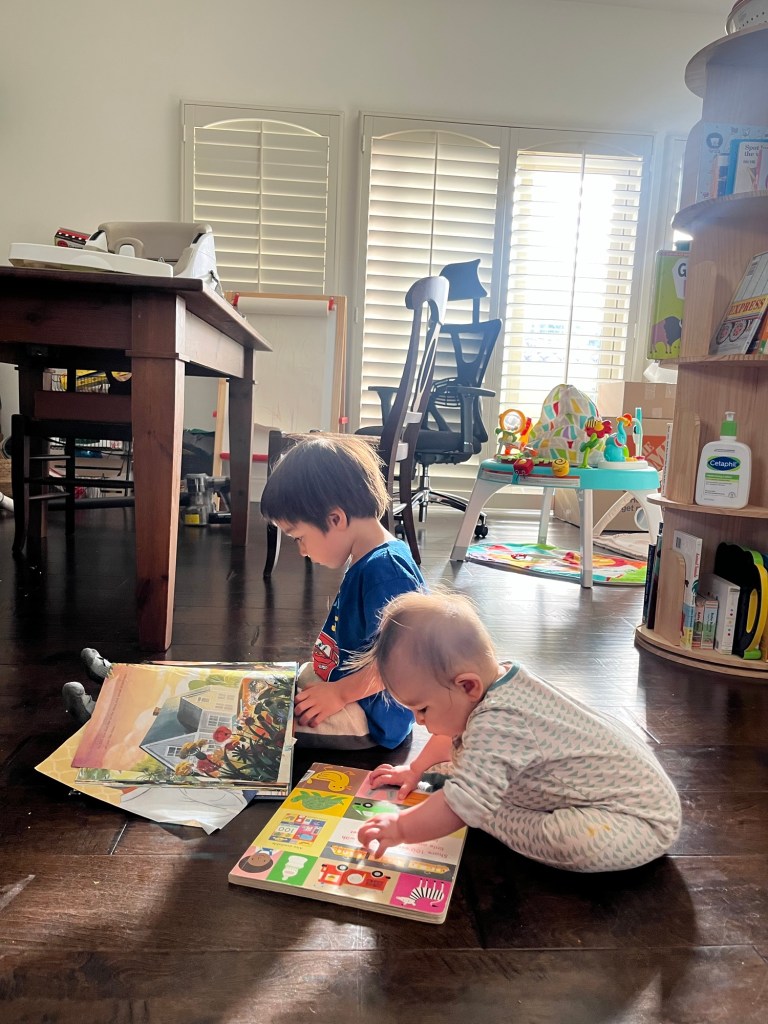
When Tov was first born, I started imagining.
I imagined how our son will grow up, what his personality will be like, what interests and passions will drive him, who he’ll hang out with. Would he be into sports? Music? Art?
That’s what makes the Korean tradition of doljabi so fun, but also laced with anticipation: What destiny will my 1-year-old pick? As parents of young, not-yet-formed human beings, we have the power to present to our children certain life opportunities, but absolutely no control over which path they will pick, and that’s what makes doljabi a fun, light-hearted way to play-pretend. We lay out only the desirable options for our children’s doljabi, but ultimately, our 1-year-old babies will grab whatever their heart fancies.
I remember for my niece’s doljabi, my sister-in-law refused to include a ball because she didn’t want her daughter to go into sports. I didn’t want to offer sports as an option either, but David would be apoplectic if Tov didn’t like baseball, so I reluctantly allowed him to include a baseball, comforted by the fact that neither of us has athletic talents, so most likely, neither will our children. Our doljabi was not very traditional. Because I would love for Tov to become a journalist like me, I added a reporter’s notebook into his doljabi options, and I also included a globe because I wanted him to be well-traveled and globalized in his worldview.
Tov chose the globe. I rejoiced, even as I knew all this is just a game designed to please the parents’ ambitions for their child, nothing more. Even then, I thought, “I don’t care what Tov chooses to be when he grows up, as long as he’s just like his name– a good person, full of God’s goodness. I will be content with whatever he chooses.”
That was then, when Tov was still very young and malleable. Now that Tov is 3, I realize I might be more ambitious than my professed noble goal for my son. I know it, because I have been fighting some rather strong disappointment that my son– my wonderful, adorable, good son, who is indeed so much like his name– does not seem to be much literary-inclined.
Often with firstborns, there are childhood stories that parents repeat to prove their firstborn is special (these kinds of stories seem to diminish with the younger siblings, interestingly enough). For me, apparently I was about 2 when my parents searched all over the house for me until they finally found me hidden behind a pile of books. I had been “reading” for hours, completely engrossed. There’s another story that apparently prove my unique brightness. According to my parents’ folklore, as a child I had very curious, observant eyes. I would stare at things and people with intensity, as though analyzing them in deep thought, and I remember my parents constantly admonishing me to stop staring at strangers.
Now that I think about this, I don’t think it proves anything about my specialness or intelligence; it sounds like I was a pretty creepy child indeed. But all that to say, my parents told these stories proudly to anyone who would listen, which showed a value they upheld and instilled in me: Intellect.
I too uphold this value. I value minds that think and read and create. I admire people who are well-read, who can quote literary giants, who can discuss Dostoevsky and Kierkegaard and C.S. Lewis. If I’m completely honest, I probably uphold that value higher than any other virtues such as goodness, gentleness, self-control. And that value system is becoming more blatantly obvious as I watch Tov grow from a baby to a boy, as I take him to the library and offer to read him books, but he’d rather just run and climb between the bookshelves. Or when five seconds after I pointed out the letter “A” to Tov, he’s already forgotten what it is. My literary ambitions for my child is even more abundantly clear when I meet other kids similar to his age who love reading, have a strong grasp of language, and can recite entire books front to back. I can’t stand those kids. I hate them, really.
One evening, I was trying to read a book with Tov, when as always, he kept grabbing the page from me and interrupting me, fixating on that one page with the picture he likes. “What’s that?” he asked, for the fifteenth time.
“Oh my God, Tov, can I just finish this book!” I cried, losing my patience, yanking the book away and startling the poor little boy, who just wanted to look at the orange ball again and again.
At that moment, so many thoughts were flicking through my head, all poking at perceived flaws in my son: Why can’t Tov just sit through a book? Why does he only want to read this one stupid book? Why doesn’t he like books? Are we letting him watch too many stupid firetruck shows on YouTube? Why hasn’t he learned his letters yet? I’ve been trying to teach him his ABCs for months now! Is it the screen time? My niece could memorize the entire Brown Bear book by his age; why can’t he? God, we need to stop letting him watch shows, it must be rotting his attention span!
Oh, the slash of terror: What if…God forbid, my son never likes to read? What if my son is not very intelligent? What if…Good God!– my son becomes an atrocious writer? And, to my self-dismay, what I felt then was shame. Shame, that my flesh-and-blood might not carry this value that I hold so dear. Shame, at the thought of my son struggling with math and spelling and grammar.
And then, of course, I felt instant shame at my shame. Is this what I’m really all about? I, a professed Christian, called to set apart from the world, has allowed secular standards to infiltrate my value system, and it’s going to impact my parenting and shape my children. But is it not an instinctual, parental desire to create my child to my own likeness?
I wrestled with this thought for months.
I don’t think that wanting my children to love and read books, to have deep critical thinking skills, and to cultivate a rich intellectual mind is a bad thing. I know it’s a worthy and good goal to try to instill these values into my children’s education, which will serve them well in life, and raise them as solid citizens of the world.
It’s also healthy and natural for me to want to share my passions and interests with my own children. Just like David can’t wait to take our children to their first baseball game, I can’t wait to read the Harry Potter books with my children, and also The Good Earth, Jane Eyre, East of Eden, The Brothers Karamazov, and discuss them together.
What I struggle with is how much I want it. How much it’s insidiously tied to my own ego, ambition, and identity. And how disappointed, frustrated, and mad I fear I’ll get if they fail to meet my standards.
People say Tov looks like me, which pleases me, because I think Tov is a very handsome boy— no bias at all. And maybe, if I’m brutally honest, I’d like people to also say Tov is sharp and intelligent because that too reflects well on me. Because those are values I hold high and dear. Because I want Tov to fit my ideals of a worthy person, and create him according to my image, when he has already been wonderfully and fearfully made in the image of God.
As a parent, I have the responsibility to raise my children to be the best person they can be, to stretch their weak points and cultivate their strong points. But it’s also my responsibility– and joy– to get to know and understand who they already are as a person, and delight in how God created them, just as they are. There’s a fine balance between accepting who my child is, and recognizing that they have more potential, and then pushing them lovingly and firmly towards it. It’s this fine balancing act that make my head twirl and my heart clench. Man, parenting requires so much wisdom and discernment. There’s just so many life-altering decisions and judgments that I feel, at this current moment, so ill-equipped to make. Lord, help me.
Tov is still only 3. I have yet to see all the hidden parts of Tov. He has yet to emerge from his chrysalis, yet to fully spread his wings. He might still learn to love books. Or he might not. My brother was raised the same way I was, with the same parents, and he is still not a reader, but he has many other interests and capabilities that I don’t have.
So what can I do?
I still want to do what I can to foster a rich intellectual life for my children. So I plan to take Tov and Woori to the library once a week. I can keep surrounding them with books, keep reading with them, and let them see me read.
And also: I can just relax and enjoy who they are.
That’s easy enough. Tov truly is a wonderful person. He is kind and empathetic and sweet and resilient and curious and fun. He loves his little sister, loves his umma and abba, loves his teachers and friends, loves laughing and rolling and the color pink and fire trucks and Lightning McQueen and listening to music and collecting rocks.
I adore 3-year-old Tov. He makes my heart so full. And I’m so proud to be his umma.
-
Tov’s first Disneyland trip

The last time I was at Disneyland was three years ago with David, when Tov was but a fetus tucked into my womb, his presence only having just been revealed to his soon-to-be parents.
It was our babymoon. We booked a hotel near Disneyland, to which I lugged my new best friend, a giant slug of a pregnancy pillow, and then spent a whole day at Disneyland, grousing about the lines and the crowds. I remember for the first time noticing how many strollers there were at Disneyland. I had previously been completely blind to them, but all of a sudden, I noticed parking areas for strollers, double strollers, four-seat quad strollers, bougie strollers, cheap-as-plastic strollers, rental strollers, everrrrrrrywhere. How had I never noticed the tens of thousands of strollers zipping around Disneyland?
Oh, those were my before-kids days, when my eyes didn’t even register babies, toddlers, or any young children whose heads reached under my waist.
Three years later, I am back to Disneyland, this time with an almost-3-year-old and a 8-month-old, testing out our super-nifty, ultra-lightweight Zoe double stroller for the first time. My last visit to Disneyland, my biggest luggage was my pregnancy pillow and my skincare products. This time, I had two full bags jammed with about a dozen different snacks, water bottles, four extra sets of clothes, diapers, wet wipes, teethers, and God knows what else, and I STILL forgot the kids’ sunscreen.
And man, was I excited! It was Tov’s first ever Disneyland experience! We decided to take him there just before he turned 3– young enough not to have to pay a ticket, and old enough to really appreciate the magic of Disney.
“We’re going to Disneyland tomorrow!” I kept telling Tov the day before, and although the kid had no idea what Disneyland or Disney is, has no idea who Mickey and Donald and Goofy are, he grinned and gleamed as though he knew wherever that was, it was gonna be awesome.
The next morning, we woke him up with excited cheers: “We’re going to Disneyland!”
David dressed him in his favorite T-shirt– a hand-me-down, imitation Lightning McQueen blue T-shirt bought from the Philippines– while I bustled around getting all the snacks and my coffee ready, and then we were off! I was so excited I didn’t even fall asleep on our way there.
Oh, the wonderful magic of Disney! First, we got on the 50-minutes-long “line up to get into the car park” ride. And then, we got on the 15-minute “line up to get on the tram” ride. Then! A “line up for the restroom” ride. And then! The “line up for the security screening” line. And then, dum dum dum, here comes the “line up to get through the entrance” line!

Altogether, it was almost two hours of breathless, thrilling waiting in long lines so that we can line up 40 more minutes for the Astro Orbiter ride, which lasted all of 5 minutes. Is THIS the magic of Disney? We are all magicked into happily lining up for hours and hours under the scorching California sun, grinning and sweating under our Mickey ears, and then leave the park saying, “That was fun! What a great day”
Yes. That’s pretty much how our day went. We spent a small part of our day with my friend Joyce, her husband Tyler, and their sons Cían and Taigh until they left around 2pm, and we chugged on for more than five hours. We rode on a total of four rides. One of them was Pirates, which David was most excited about, except Tov yelled, “I want to go out!” soon after the ride took off.

He loved Astro Orbiter though, and rode it twice– once with David, once with me. It’s this rocket ship ride that lifts you high into the air and spins you round and round, and I HATED every second of it, close to puking and passing out from dizziness. Grimacing, I looked down at my son who was leaning against me, smiling with his mouth open, his hair flailing in the wind, and that redeemed every agonizing second.
After we got off the Astro Orbiter, the ground was still spinning around me, and I felt every ounce of the greasy turkey leg I just ate churning in my stomach like cement in a concrete mixer truck. David tried to take Tov to the Buzz Lightyear Astro Blasters, which we know would be so fun for Tov, but he refused, afraid of the dark indoors, too much like Pirates.
So we ambled instead. We got Tov a strawberry ice cream cone bigger than his face– his first real cone!– and while we sat by the sidewalk, watching all the other Disneylanders pass by, he licked and licked and licked his cone until the whole thing was gone into his belly.

Then, because Tov had been asking for a lollipop all day, David caved and got him a cherry lollipop, also the size of his face.

On any other day, I would have gotten very annoyed that we are giving him so much sugar, but I shook it off– eh, it’s Disneyland. There’s only one first experience of Disneyland, and half the joy of Disney is being able to eat all the sugar you want.
Of course, we had to go to California Adventureland, where Tov got to meet his hero, Lightning McQueen, and take a picture with him.
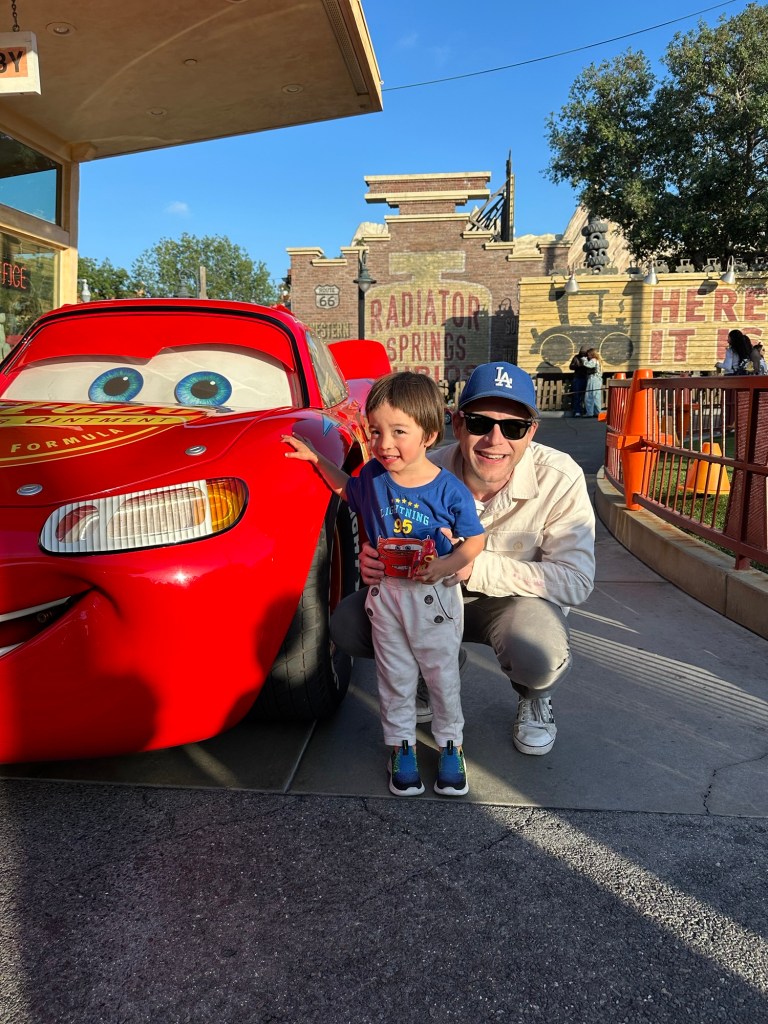
We also got him a set of toy Cars that light up underneath, and oh, the joy on his face! He really doesn’t need more car toys, but really, we bought the set for ourselves– for that momentary, yet eternally pleasing, joy of seeing the delight on his face.

It might have been Tov’s first Disneyland trip, but it was my best Disneyland experience.
I remember the first time I came to Disneyland, I was 12, on a family trip from Singapore to the United States. Back then a Disneyland ticket cost a lot less, but it was still significant, especially for a missionary’s income. I thought it was so magical. I don’t even remember most of the day, but all I remember is how in awe I was of that place, how I deemed it the most magical experience in my life, and to this day, I can still taste the leftover pixie dust from that trip. And I remember too how happy my parents were that day, not because they enjoyed Disneyland, but because they kept looking at our faces, grinning at our grins, excited at our excitement, wondrous at our wonder.
“Did you have fun?” abba kept asking us as the day ended, and each time we nodded happily, he beamed.
And now, full circle, here I am, a mother myself, grinning at my son’s grins, excited at his excitement, wondrous at his wonder, a child again through my child.
I actually did not even mind waiting in line, because that was a rare Tov-and-omma-only time, in which I got to hug him, lift him, spin him, kiss him, for the full 40 minutes we waited in line. I squeezed his hands, still little in my own adult hands, marveling that this boy with a real neck and sweat odor was, last time I was here, a curled, thumb-suckling mystery in my womb.
That chapter of my free, childless days has closed, and then the newborn baby chapter opened and closed, and now here I am, in the last few paragraphs of the toddler chapter, feeling so incredibly thankful and sad at the same time.
While Tov was eating his ice cream and I sat by him, holding Woori and people-watching, I saw an Indian family standing near us. It was an older couple and an old lady in a wheelchair with a long, grey braid, who was, like Tov, licking happily on an ice-cream cone. While we were at Disneyland to treat our child, it was clear they were at Disneyland to treat their mother.
For some reason, that scene moved me. They were enjoying the same moment as David and I, but flipped generationally. For this family, a chapter had opened and closed as well: The chapter of their mother taking care of them had long closed; the chapter of their young parenthood days have also closed; and here they are now, probably with adult children long out of the house, here to relive the Disney magic with their aging mother, before she got too frail for Disney.
I hugged Woori closer to me, as she wobbled on her tippy toes and scratched my face with her sharp tiny nails. She is still a baby now, but the next time we come to Disneyland, she might be a running toddler, and Tov a Kindergartener. And who knows? Maybe one day they’ll be the ones taking David and me to Disneyland in wheelchairs. By then, so many chapters would have opened and closed, opened and closed, each with its dragons and witches, each with its adventures and feasts and magic like this day at Disneyland.
At about 7:30 pm, as both kids started to fade and Tov was no longer running around licking walls and pavements like King Nebuchadnezzar when he turned mad, we got in line to ride the tram back to the parking lot.
In front of us stood a young Arab family, a good-looking couple and their young toddler son. They too were saddled with a stroller and diaper bags and all the goddarn tools a parent needs to keep tantrums and blowouts at bay. As we struggled to hoist all our stuff onto the tram, every one of us weak with exhaustion and overstimulation, the mother commented wryly, “I don’t know why we pay so much to do this.”
But we do it anyway, and we’ll do it again, because that cliche is so true: Time passes so fast. They grow up so fast. And at Disney, time seems to stand still for a day. At Disney, we all turn into a child, from the grey-braided old Indian lady to this young tired mother in a hijab. It doesn’t matter if there are dozens more chapters of our life left, or if we’re on the last chapter— here at Disney, the magic goes on and on, passed from generation to generation.

That’s the magic of Disney.
And as David and I drove back onto the 5 freeway, while Woori shrieked in her car seat and Tov complained that the baby is “too loud,” we looked at each other and said, “That was fun! What a great day!”
-
Saying goodbye to my parents

On February 28, 2025, I dropped my parents off at Hell on Earth, aka LAX, early in the morning. I’ve dropped them off at this airport numerous times. But this time, they weren’t flying back home to Virginia. They flew back to their mother home, South Korea.
They had four luggages and one backpack. For people who had lived so economically and simply, they were shocked by how much stuff they had accumulated over the 24 years they had lived in the United States– mountains and mountains of stuff that they threw out and donated and gave away.
I remember the story my father used to repeat to us, the way patriarchs retell family legends, of them packing all their belongings in Korea into two luggages, and landing in Singapore as fresh missionaries with a 4-year-old and a 2-year-old. My father was filled with ambition; my mother filled with apprehension. Now they return home with twice the luggage, five times the wrinkles, 34 times the lived experience of full-time ministry, and infinite times the joy and gratitude.
Woori was wailing as we drove to the airport that day. She hates being in the car seat, and no matter how many tongue-clucking and funny faces my omma made, she made her displeasure known. So by the time I pulled the Mazda SUV up to the curb of Tom Bradley International Terminal, I was a little frazzled, my overstimulated senses as messy and stuffy as my heart.
We pulled the heavy luggages out to the curb. Then we embraced. Once, twice. I had to let go quickly as I wasn’t technically allowed to park there, but my hugs were also hasty because once I enfolded my arms around my omma and abba, breathing in their familiar scents, touching the bodies that cradled me skin-to-skin from the moment I was born, I didn’t want to let go.
They waved. I waved. Then I hopped into the SUV and pulled out, back into the smoky tunnel of LA morning traffic. And as I drove away, Woori cried, and I too cried.
It is an end to an era.
It is silly, I tell myself, to be this sad. It’s not like my parents are dying, or unreachable. They are simply moving an ocean away, and with technology, I need only tap my screen to see their faces and chat with them. It’s not like I got to see them that often even when they were stateside, since we lived in opposite coasts.
But it does feel, in a way, like death. Or at least, an ending. They have closed down their church of 24 years, the church I grew up in, served in. The church that sent me off to college and then welcomed me back when I dropped out after being hospitalized, and then sent me back off again. The church about which I have complex feelings, the way anyone does with family members squeezed under one roof. The ministry my parents gave more than half their life to is changing. I can no longer go back “home” to Virginia, and that feels sad, even though Virginia hasn’t felt like home in years.
It also feels like a death to my hope that my children will be close to their grandparents. Living overseas, I grew up seeing my own grandparents once every three years, at most, and whenever we visited them, I felt awkward. Each visit was like meeting strangers for the first time. We had almost zero history and shared very little memories and experiences. They didn’t have much to say to me, and I didn’t have much to say to them. I really don’t want that for my own children. The thought of them not knowing their grandparents, not receiving their affection and admonishments and doting, pains me.
But more than anything, this closing of an era is a jolting reminder to me that my parents are aging. During the two weeks they spent with us here in LA before they flew to Korea, I saw my parents get more easily tired. Omma has lost more than 15 pounds and is dealing with health issues, while abba needs a few naps a day to push on. Omma has always been more physically fragile, but Abba to me has always been like an oak tree– thick, strong, unwavering, abounding. Even his voice was like oak– a rich, loud baritone. To see his sparse gray hairs, to hear his cracking voice, I felt fear and anxiety, knowing the thing that most human beings face at some point in their lives– the passing of their parents– is drawing near.
Death was a regular topic while my parents were in LA. For the first time, they told me what they wanted when they died. Both told me they want us to pull the plug should they be in a coma. They want us to scatter their ashes in the mountains. We also talked about what to do if one of them dies before the other. It’s terrible talk, but it needed to be said.
Being a 37-year-old wife and mother is to be sandwiched between two duties– one to the family I’m raising, and the other to the family that raised me. One family is fresh and new, still knobly and plump like buds about to bloom. The other is wilting, the peak season long passed. I myself am in full bloom, but I’m noticing a few petals starting to droop, and I know my peak is over, particularly as I feel the growing aches and creaks of aging. It is a very odd, uncomfortable, conflicting season in life, to be worrying about your kids at the same time you worry about your parents.
I knew my parents would have financial issues. Now that they are no longer receiving an income from the church, they had to figure out a new living situation. They didn’t have anything planned for retirement other than social security. They have no property, no assets. When they applied for a new credit card, the company gave them a $1,000 credit line. They couldn’t even afford to continue staying where they’ve been living for 22 years– a townhouse that’s 40 years outdated, with tiny rooms and laminated kitchen cabinets that are literally falling apart.
That’s how my parents had been living all these years. They tithed about a third of their income to the church. They never considered building wealth, at least not the earthly kind. My mother didn’t once own a designer handbag. My father wore the same suit he bought in Korea decades ago, and his ties were gifted by others. They lived simply and trusted that the Lord will provide.
I have less faith, I suppose. I got a little angry when they refused, several years ago, David’s offer to buy their townhome for them so they didn’t have to worry about housing. I got irritated thinking about this again after they told me they shut down the church. “You should have said yes to David’s offer when you had the chance!” I said to omma.
And that’s when they decided to return to South Korea and apply for dual-citizenship. It was the most practical decision– Korea has great benefits for the elderly so they don’t have to worry about health care; they could comfortably live on their social security there, since housing is cheaper, as long as it’s not in major cities such as Seoul. But they underestimated the cost of housing even in smaller towns. Their budget could only afford old, rundown places in rural villages.
Meanwhile, David and I are renovating our new house. What was originally going to be a bit of a fix-up here and there turned into a full gutting. Basically, we are building a new customized house. Our renovation budget has blown out of proportion and I’m embarrassed to share it. While my parents were here, I was deciding on wall paint colors, and omma accompanied me to get some paint samples, which cost me about $160– for freaking paint SAMPLES! The money we are spending on this house is insane. Three exterior doors cost us $15,000!!!
It just didn’t feel right, that we are building our dream house while my parents look for crappy, bug-infested housing in the countryside. I felt a pang to see how excited my mother was for us. She wanted to know what we’re doing for the kitchen, the bathrooms, the exterior paint, and had plenty of opinions. She told me she enjoys watching home renovation videos on YouTube, something I learned for the first time, and it wrung my heart to realize that she admires a tastefully decorated and designed home but never had the chance to live in one, and in fact, never imagined she could.
So one evening, while my parents watched Tov and Woori, and David and I were on a date, I proposed to David that we help my parents buy a house in Korea. Years ago, David had loaned his brother money for a business project, and his brother was finally returning that sum back to us. Perhaps we could direct those funds to my parents’ housing instead?
I was a little nervous suggesting this to David, not because I thought he’d refuse, but because it puts me in a vulnerable position, and I pride myself for being self-sufficient and independent. And though technically this money belongs to both of us, it’s still a lot of money, and it’s money that came from David’s earning, not mine. So it took a lot of swallows for me to ask David.
I wasn’t surprised when he agreed. I knew he would. But I was still touched beyond words when he did. Turns out, a day ago, he had been listening to a devotion about not storing your treasures on earth but on heaven, and that had made him ponder. Then that Sunday, our pastor preached on the Ten Commandments. To honor your parents, the pastor said, includes providing for them financially in their later years.
What’s more, both of us had been praying about money this year. I’m praying about generosity, and David’s praying about wise stewardship of our finances. The Lord has blessed us financially with a new house, and we want to use it for the glory of Him and the good of others.
All of this didn’t feel like a coincidence. It felt like God was blessing us to bless our parents.
David and I agreed to broach the subject on the last night with my parents before they left LA. I told David I was nervous about bringing it up, because historically, abba has been strongly against receiving any help from us. I had no idea how he would react, and I braced myself for a five-point argument on why he should accept our help. I told David he had to be the one to offer it; it couldn’t come from me. And I told him to emphasize how this conviction came from God.
That night, after dinner, David and I exchanged glances. It’s time, I said with my eyes. David turned on a show on TV so Tov won’t bug us, while I took Woori off her high chair and held her on my lap so she’d be quiet.
“So,” David began. “Sophia and I have been praying about being generous with what God gave us. And I’ve been thinking about how we want to invest with what we have…”
“Oh?” Abba said, having no idea where his son-in-law was going with this.
Well, I was really proud of David that night. He mentioned everything I had hoped he would, and when he was done, my father grasped his hand, nodded, and said, “I receive.” And then he choked up, and said again, “Thank you. Thank you Lord. I receive.”
I was so shocked that I couldn’t believe my ears. Omma was just as incredulous, so she asked him, “Wait, so what do you mean. Does this mean you will accept the money?”
Yes, Abba said. He sees how much the Lord has blessed us, and by accepting it, He too is receiving God’s blessings, and because God blesses those who give, he believes he is also blessing us by receiving it.
I felt my heart release with relief and gladness. Before David and I got engaged, I had actually asked him to use whatever he would have spent on my engagement ring, and donate it instead to my parents’ ministry. That didn’t end up happening, but now that I had more than I could have ever imagined– I, who once couldn’t afford laundry detergent and had to make my own!– it made my heart feel so full that I was able to present this one gift for my parents in their older age, in this new season of their life. This was the first significant financial support I’d ever given my parents. It was also the first step in tilting the balance towards me supporting my parents, rather than them supporting me– an end to an era, indeed.
What made my heart just as full, however, was that David was doing this with me. As I pray about generosity this year, my own husband is showing me how to be generous not just with his finances, but with his heart.
It is easy for me to be generous with my own parents; I would give them part of my liver if they needed it. But it’s not as easy for a son-in-law to be as generous, to treat his wife’s parents as his own. He wasn’t just giving my parents a better house; he was giving them his love, and in there is his love for me. And I think in that moment, my father recognized that too– he was moved not just by the unexpected gift of a house, but by the clear display of a husband’s care and love for his daughter. In this, he saw God’s grace, His love and providence and goodness and faithfulness that have never failed him in his almost 35 years of ministry.
After my parents left to pack up for the next day’s travels, and after David and I had put the kids to bed, I gave my husband a hug.
“Thank you,” I said, tearing up.
“For what?” he said, acting all cool.
“For everything,” I said, and I meant it.
David made a “huh” noise, a sound he makes when he’s pleased but also trying not to sound too pleased about it. Then we talked about the show he’s watching.
We’ve never been a couple who talks all sweet and cooey and sentimental. We reserve nice sappy words for birthday cards, where we don’t have to make eye contact and hear those words out loud, so awkward and unnatural to our ears; we don’t kiss goodnight, we knock heads.
But within that brief exchange was a lifetime of card sentiments– I felt seen, valued, cherished, respected. David’s act of generosity had so many layers of blessings in it, like a mille crepe. He blessed my parents. He blessed me. He blessed our children by showing them what it looks like to honor one’s parents. He blessed my brother, who now can worry less about our parents. He blessed my relatives in Korea, who no doubt will hear from my father how the Lord has blessed him through his son-in-law. This is how true generosity works– it just keeps on giving and giving.
Saying goodbye to my parents felt strange. I felt a little like I was the parent, sending my kid to school for the first time. As the last person to hug them goodbye before they left the U.S., I felt like I was sending them out into the next chapter of their lives. I was a little worried, a little anxious, but also excited and proud. I wanted to cling on, but I had to let go. And I heard God usher them away, saying, “Well done, good and faithful servants.”
And off they go.
-
Dad Health Logic
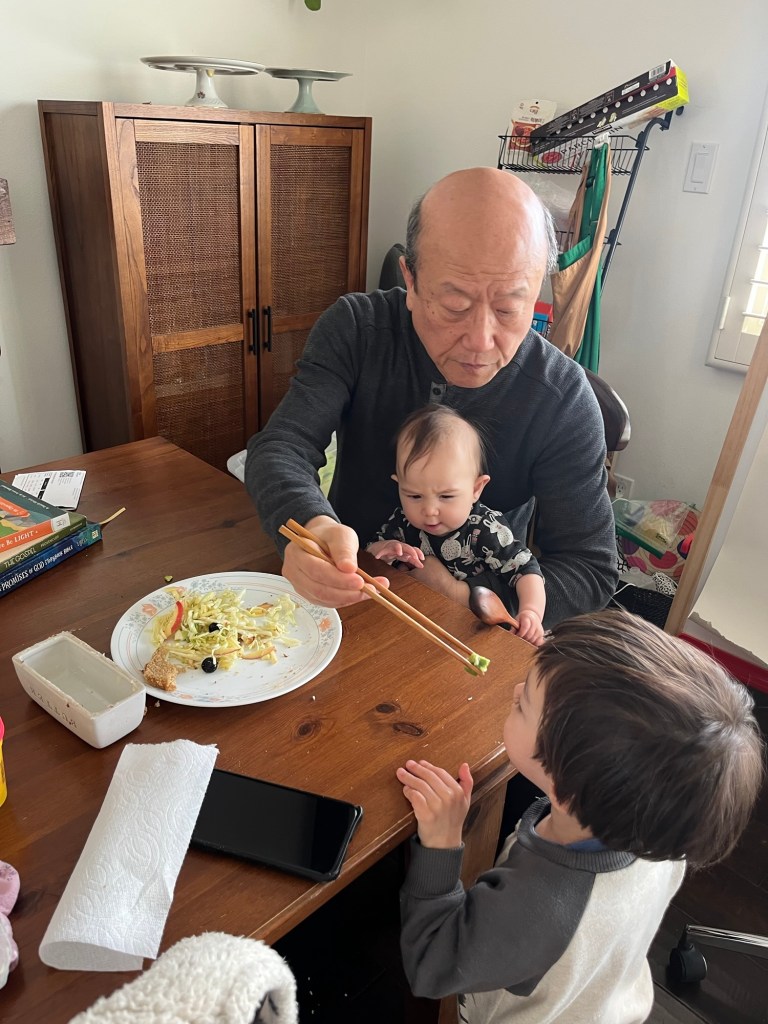
My parents have been visiting for about two weeks en route to Korea. They are moving— permanently— back to Korea, a decision that I still am processing emotionally.
Anyway. David once said I could write a book about my father because he is just…such a character. We really love and respect abba but also make fun of the way he dresses (that classic Korean ahjeossi high-waist pants cinched with a black leather belt) and talks (he can dive into an hour-long soliloquy with lots of earnest hand motions) and eats (chews like a cow; if he’s chewing a gum you could hear him a mile away).
We make fun all out of adoration, of course. I know some people find my abba intimidating and severe because he’s a pastor who’s serious and bold about his faith. But there’s so many more sides to him that’s amusing, endearing, and fun, if not exasperating.
The most exasperating yet entertaining part about abba is his own dad health logic. He writes his own health book and lives earnestly by it.
For example. Abba developed his own workout that he claims can give him twice the benefits of an hour’s traditional workout session in 5 minutes. What he does is lean against the wall with a finger or an elbow, and then he tenses up the rest of it his body to the point of trembling, the way an overweight ballerina might tremble with the exertion of trying to hold a pose on one tippy toe. He calls it “떨공,” or “trembling exercise.”
This trembling exercise works out every fiber of muscles in his entire body, he claims. “It’s better than an hour on the…the…” He doesn’t know the word for “elliptical,” so he acted it out by vigorously pumping his arms back and forth.
How does he know that trembling exercise is superior?
“Oh,” he exclaims, gesturing down the length of his core, as though this fine specimen of a body should be evidence enough, “Oh, I know.” God gave him the wisdom for this efficient technique, because He knows my father doesn’t have the time for long exercise regimens.
Never mind that he’s got a boomer belly; that’s just testament of God’s grace— the Lord has never let him starve, and besides, that belly is also a sign of God’s wisdom— it serves as a cushiony ledge on which his grandbabies can sit.
Even with concrete numerical data, my father says otherwise. About a year ago we were in Korea, at a clinic because David was not feeling well. There’s a free blood pressure measuring machine by the waiting area, so abba decided to check his blood pressure. I knew something was up when he tried to shove the piece of paper with his results into the pockets of his high-waist pants, like a kid smuggling candy in his shorts. I sneaked up on him and pickpocketed the result, which read: 185.
“Isn’t that really high?” I yelped.
“Oh no,” abba assured me. “At my age, blood pressure should be a bit high.” According to him, it would be unhealthy to have blood pressure within the “normal” range at his age. Besides, he can always eat more garlic and onion to remedy it.
Speaking of onions and garlic. Have you ever tried abba’s onion wine?
I have. So has David. He almost choked.
Onion wine (except abba calls it “onion’s wine”) is abba’s homemade recipe for a healthful life: He chops up raw onions, drops them into a big-ass mason jar, then glugs cheap Cabernet from Costco over the onions and lets them steep for a few days. The finished product is onion-flavored wine, every sip more pungent and briney than the one before, and if you fancy, you can crunch on a side of red-dyed winey onion with each onion-y sip, like one would nibble on olives with their martini.
It tastes vile to me, but abba loves it. I don’t know how omma sleeps next to him after he drinks a glass of that; he’s got to be releasing tons of onion fumes.
Another example: Abba loves Shin ramen.

Shin ramen has become a global phenomenon since hallyu, showing up by the boxes in Mexican supermarkets and Japanese convenience stores and Amazon and Costco. Kimchi has also become a global phenomenon, but mostly as a probiotic health superfood that white people discovered and veganfied to great profits. Shin ramen is no health food. It’s deep-fried dried noodles with a packet of unpronounceable addictives and preservatives.
While my parents are here in LA, the first stop they made to the grocery store (Aldi’s), my father tagged along to make sure to drop an armful of Shin ramen into the shopping basket.
I told abba not to eat too much instant ramen. “How many times a week do you eat Shin ramen?” I asked.
“Only about twice a week,” abba said.
Omma overheard and let out a laugh of incredulity. “Twice a week? Ha! Try five times a week!”
“Abba!” I scolded.
“Don’t worry,” abba said. “I put in tons of onions in my ramen.”
Apparently onion not only makes a glass of red wine even more salubrious, it also cancels out the health negatives of all the chemicals in instant ramen. Who knew onion has such magical powers? Why don’t more people drink onion smoothies instead of the inferior green kale smoothies? Why is there no cookies made from dehydrated onion flour that go viral on TikTok? Why hasn’t Erewhon marketed $35 liters of organic onion water in recycled glassware? If abba were a more business-minded man rather than the Lord’s humble servant, he could make a fortune off his onion health theory.
But it’s too late. Abba is slowing down. He’s almost 70. After weeks of packing up everything in their house, throwing things away, and figuring out next steps in Korea, he is physically and mentally wiped out. He arrived in LA exhausted and hasn’t been given much time to fully rest, what with a whiny toddler and a shrieking baby to help look after.
One Sunday, he had leftover pepperoni pizza for breakfast, a huge pita sandwich with harissa sauce for lunch, and then pork belly for dinner. My mother has been on a health kick since she found out she is prediabetic, and since then, she’s been strictly controlling the menu: no more fried food, very little red meat, no more seasoning. As a result, abba told me mournfully, “Our meals have gotten weird.”
So while here in LA, away from omma’s health-conscious kitchen, he took full advantage of the sudden access to flavorful foods, and ate to his heart’s content.
The next day, his body squeaked in protest. He had a bellyache and felt dizzy, lethargic. He had no onion wine to delete the greasy pepperoni, the slabs of butter, and the glutinous pork fat, and hence, he suffered. This is quite a shock to all of us, because abba almost never gets sick.
Abba decided to take it easy that day. He dutifully ate a few spoonfuls of the oatmeal (with chia seeds) that omma made him. That evening, he only ate half of the bulgogi that he would normally eat, though I did catch him slurping up more of the sauce when no one was paying attention.
The next morning, he woke up at 6:30 am after a full 10 hours sleep, a luxury he hasn’t been able to enjoy in years. He felt much better! Hurrah!
So what did he do? He made Shin ramen for breakfast, waking omma up with the fumes of spicy MSG.
When I found out, I yelled at him. “You said you weren’t feeling well! Why are you eating Shin ramen for breakfast??”
He shook his head sagely. “Don’t you know? Eating what you love is healing.”
Another one of his dad health logic: Something about how when you eat something delicious to you, you produce tons of saliva, which helps properly digest your food, which then becomes the critical nutrients and minerals that your body readily absorbs, because it is in a state of joy and thankfulness in the Lord. If I’m honest, it kind of makes sense.
Omma nags at him like I do. She lectures him about all the YouTube videos she’s watched, which inform her not to eat more than an egg a day and to avoid all artificial sweeteners.
Abba doesn’t dismiss them. He’s not against science, he says, but neither does he think health obsession is all that healthy. The anxiety you have over health and nutrition is more harmful than the state of bliss you have when enjoying your favorite foods, he preaches.
“So let’s examine the evidence,” he concluded during a particular debate with my mother: “You eat steamed veggies and pasture-raised egg and chia seeds. I eat ramen. Who between us is healthier?”
“I had nothing left to say,” omma told me.
I don’t know what it is, whether it’s the onion wine or his radical faith in God, but something’s working. My abba, despite slowing down in his older age, is still healthy. And even though he did feel slightly ill for a day, he recovered as swiftly as a brawny teenager in the prime of youth.
Onion wine, anyone?
-
These are the best days of my life

Woori has been going through a sleep regression the past three weeks or so, exacerbated by teething. Like clockwork, at about 12:30 am, she wakes up screaming. And from then on, she wakes up every hour or two hours.
In the past month, she also stopped napping in her bassinet. She doesn’t even last 5 minutes before screaming and flailing so hard she’s breathless and hyperventilating.
All that to say, I am a walking zombie. I wake up in the morning groggy, with that deep-in-the-brain ache because my brain has barely been able to shut off all night. My body and hormones are off, because I’m night-sweating again, waking in a soaked T-shirt. I’m almost falling asleep as I drive Tov to school. Often, I pass out half-dead with lurid dreams while holding Woori in the nursing chair. (Somehow, I still have energy to read novels late at night, but that’s the kind of nonsensical superpower parents have when we are liberated after putting the kids to bed.)
It’s been hard, but honestly I don’t really have the mental and physical energy to even think about how it’s hard. I just go on, putting one foot before the other, day by day, dragging my weary body through the mire of parenthood.
There have been moments of lucidity though. I remember one morning, as I heard Tov having a tantrum with David in his room, and Woori starting to fuss in bed with me (we co-sleep now— it just keeps everyone sane), and felt the bunched-up clammy sheets under me, and raked my hand through my damp, disgusting postpartum hair, probably pulling out 237 strands of hair that I don’t have to lose, all of a sudden, this thought came to me: “These are the best days of my life.”
It’s cathartic to complain about parenthood, especially those early childhood years, when everything is a struggle, from shoving a sweatshirt over a screaming, snotty toddler’s head, to driving stressed because the baby’s shrieking like a banshee in her car seat and there’s nothing you can do about it. Complaining about the hard moments of parenthood is viral content on social media— I enjoy them; I enjoy commiserating and sharing them with my fellow moms and dads. It brings much-needed comic relief to a period that feels so long and consuming.
But still. These will be the best moments in our life.
When I was young, I could not wait to grow up. I wanted to be independent, to earn my own money, choose what I want to eat, where I want to go, without asking my parents for permission.
Meanwhile, my childhood best friend dreaded growing up. “I want to stay a child forever,” she told me. She liked her cocoon of innocence and lack of responsibilities, liked the assurance that someone bigger and wiser is taking care of her.
“You’re stupid,” I told her, with all the eloquence of a 9-year-old. “Or crazy. Why would anyone ever want to stay a child?”
She gazed with longing into the past. I gazed with impatience into the future.
And I’ve lived like that since. I’ve always been impatient for what’s next, what’s new. When we immigrated to the United States, I eagerly kissed everything and everyone in Singapore goodbye. Next! In high school, my actions and thoughts were all set towards preparing myself for college. Next! Once in college, I couldn’t wait to graduate and be done with school forever, and kickstart my career. Next! Then once I got a job, I was never content in my career. I wanted to work in someplace more prestigious, and lived in constant frustration of feeling stuck in my job, watching with envy when my peers seemed to hop on to shinier opportunities. Next. Next. Next!
What’s next? What’s new? Is this it? To what end I was working towards, I did not know. What was the achievement that would finally satisfy me, to make me relax and say, “This is it,” what was the accomplishment that would allow me to start enjoying what I have, I do not know. I was just perpetually restless, rootless, reaching out and out.
And now. As a parent, as a mother of a 2.5-year-old and a 5-month-old, I seem to do both, looking both forward and backward. I look at old pictures of Tov and my heart aches. Sometimes he looks up at me a certain way and I lose my breath; I’m so shocked at how boyish, how non-toddler his expression is. My boy is growing up before my very eyes, and I am still caught off guard by how fast.
Even as I hold Woori, who blessedly still fits in my arms and stays where I put her, I am already mourning, looking into to the near future when she’s 2 like Tov and Tov is almost 5, and I feel nostalgic for the very period I’m currently in.
Parents have talked about the importance of “soaking in” every moment, but I feel like every moment, even as I’m living right in it, keeps slipping through my fingers like water. Rather than soaking, the moments seem to flow out like a stream, and all I have are pictures and reels on my iPhone as memories that are memories because they are already in the past.
Yet at the same time, I’m still planning my future, wondering what’s next. When are my kids going to be independent? When can I start having my time back, my body back? When can I restart my career? When I can have my mind and creativity back? When can I start writing again? And because motherhood makes you insane, I also wonder: When can we have a third baby?
Perhaps the present moments keep slipping me by because I keep looking back to the past and out into the future, but rarely stay still to enjoy the present. Honestly, I don’t know how. I haven’t practiced that enough to suddenly do it now.
Which brings me to that morning when I woke up feeling that heaviness of trying to swim upstream, facing the new day with exhaustion, and that seemingly random thought came to me— that these are the best days of my life. I was startled by how strongly this sentence entered my mind, so I took it as a conviction from the Lord, and I thought of Ecclesiastes: “Hevel, hevel, all under the sun is hevel.”
Working hard on a career is hevel, or meaningless, or vanity. Marriage is hevel. Raising kids is hevel. All in life is hevel, unpredictable and fleeting, impossible to grasp and control. So I was right: It is hard to “stay in the moment” because time keeps moving, tick tick ticking along even as we practice meditation to “be still.”
But there’s still joy found in the hevel, Ecclesiastes tells us: “Light is sweet, and it is pleasing for the eyes to see the sun. Indeed, if someone lives many years, let him rejoice in them all, and let him remember the days of darkness, since they will be many.”
I love how realistic and grounded Ecclesiastes is, at once exhorting us to enjoy what we have while also acknowledging that life feels futile and hard. Yes, we are all drawing one day closer to death every day. We all die, including powerful filthy-rich smart-alec jerks like Elon Musk and saints like Mother Teresa. Death is the ultimate equalizer; as terrible as it is, it is fair.
Accept the hevel, accept that time is passing us by, accept that a lot of things that mean so much to us will not mean much after we’re gone. Enjoy our remaining youth while we can. Work hard while we can. Enjoy our bread while we can, and enjoy the sun when it’s out.
And always remember: “Fear God and keep his commands, because this is all humanity. For God will bring every act to judgment, every hidden thing, whether good or evil.”
“Judgement” sounds so ominous, but not when the judge is God, who is perfect in every way. This perfect God sees it all. He sees me nursing Woori at 4 am. He sees me packing Tov’s lunch in the morning before my first cup of coffee. He sees me holding back my temper when Tov is having a tantrum. My kids will not remember all these little acts of service, and if I’m banking on my husband or society to acknowledge everything I do, I’ll become bitter and petty. But God does. He sees what I do, and He also sees right into my heart as I do these daily domestic duties.
As I slide into the early stage of middle age, as the rosiness of youth wilts, as I gain hard-lived experience and knowledge with every fine line and wrinkle, I want to remind myself that I’m living the best days of my life.
One day I’ll look back and miss these days when I can still carry Woori on one hip, when I can cuddle and smother Tov in kisses while he giggles, and hopefully, hopefully, by then I would have gained enough wisdom and contentment to be able to miss the past yet also wake up every morning declaring, “Today is the best days of my life.”


hello, my name is Nayara. I’m Brazilian mother of two. I live in Maryland. My daughter’s name is Sophia. I am reading your texts one after other because for the first time I found someone describing what’s in my mind and my soul. Your blog came to me in a Google search response for my question: is my desire for more kids legit?
yeah, it’s weird to ask this to Google.
but wanted to let you know I enjoy reading your blog and we share many thoughts, fears and questions.
ill continue reading now , bye.
nayara
LikeLike
Thank you so much for reading, Nayara! I’m glad you can relate. 🙂
LikeLike