Keeping score

I am in Nairobi, Kenya, as I write this. It is the last day of my six days here, though if you add up the travel days, I would be away from home for a total of eight days.

It is hard to be away from Tov. I missed him from the moment I stepped into the Uber that took me to the LAX airport. But there are ways to mitigate that ache, thanks to technology. I can watch him sleep at real time through the baby camera; I can FaceTime him; I can rewatch old videos of him on my phone. What’s harder and unmitigable, is the burden these travels put on David and me. It puts a strain on our marriage.

There are a pair of traditional Korean wooden ducks in our home. On our wedding day, I carried these ducks instead of a bouquet of flowers, and when people asked me what they mean, I told them the ducks symbolize commitment, longevity, and loyalty in marriage. If the ducks are facing each other, that means all is well in our marriage. If the ducks are facing opposite away from one another, that means we’ve had a quarrel, and you better pray for us.

Currently, the ducks are neither facing each other nor away from one another. They’re both angled so that they’re wing-to-wing facing the same direction. I placed them that way, because I felt it captured where David and I are in our marriage in this season of our life: We are not at odds, but neither are we quite “together” the same way we used to be before we had a child. We rarely have time where it’s just him and me, with optimal energy and undivided attention to each other. We’ve only been on one date since Tov was born. Our daily evening walks are usually quite stressful when Tov is fussing. We don’t sit together at church anymore, because one of us has to hold Tov so he doesn’t disrupt the service. We are always tired, like an old, outdated iPhone that can never be fully charged. By the time I put Tov down to bed at night, David is zoning out, and I’m either zoning out myself or catching up on work that I’ve missed.

This is co-parenting. We share a son, and we share the responsibilities of keeping him alive and raising him well. All our attention and energy and priorities are directed at him, and less so at each other.

Yes, yes, I know going on regular dates is very important, blah blah. I know of couples with young babies who go on resort vacations and ski trips. Well, we are not that couple. We simply do not have the energy or interest to go on a “vacation” in which we pay thousands of dollars just to do the same thing we do at home, only with more stress. People have kindly offered to babysit Tov, but with his separation anxiety, I feel bad asking anyone to watch him when I know he’ll be screaming for hours, and it would grieve my heart to know that anyone would have to “tolerate” Tov.

The first year of parenting has been rough for David and me in terms of figuring out how to partner together so that the burden of parenthood doesn’t fall disproportionately on one person. That’s probably a modern dilemma, now that typically both wife and husband work. But even so, the vast majority of the time, the burden of parenthood does fall heavier on the woman, if only because of biology. That’s been piling up irritation and resentment inside me– not just towards David, but toward the entire male species. Subconsciously, I’ve been keeping score of all the times I’ve felt like I’ve been taken for granted, unappreciated, stretched, and neglected. And David feels the same when I’m gone on work trips for long stretches of time.

Which brings me here to Nairobi. I could feel David’s fatigue when his text messages to me became increasingly brief and curt. From his position, it probably felt like he was breaking his back solo-parenting while his wife is in some exotic place galavanting with the giraffes. Everything is off at home when I’m gone, and Tov feels it. He doesn’t sleep as well and he gets very needy. It makes parenting extra hard. From my position, I’m just doing my job. I’m not in Kenya to play. I think of David and Tov all the time and don’t even have much interest in going on a safari trip because they’re not here with me. Does he want me to quit my job? And why does it have to be me who sacrifices my career? Why do I have to feel like I have to “make up” to him when I return home, when I myself am tired and jet-lagged?

You see where my brain goes? And do you see where it begins?

I’ll speak for myself only: I keep score. There’s a tally in my brain– you did this much, I did this much. I did this much more, so you should be OK with doing at least this much. You do this much, I’ll repay with this much.

The greatest struggle in a marriage with a young child is this invisible tally. It makes parenthood almost transactional. We often bounce Tov back and forth like a basketball– here, your turn. OK, now it’s my turn. Here, you take him so I can do this, and later I’ll take him so you can do that.

It sounds pretty terrible to write it out like this. I am exposing the biggest issue in our family that we need to solve prayerfully, wisely, lovingly. There is no question both David and I love each other, and we love Tov with all our heart. We both want the best for Tov, and we want him to grow up in a thriving, healthy home. We do it well individually– but we’ve yet to figure out how to do it together as one family unit. We are the pair of ducks looking at the same direction, but not at each other. Our child is off to our side, not in between us.

This is something I’m praying about.

Tov is one

Tov is one. Well, he’s 13 months today. I’ve been wanting to write a post about his first birthday, but for all my good intentions of keeping this blog regularly updated, I’ve failed to do so because of time and energy and priorities…and also, how did time whoosh by so freaking fast?! How is my son already one? How is he no longer a baby, but almost a toddler?!

I often swipe through older pictures on my iPhone, and it’s so strange to look at pictures of when he was a newborn, a six-month-old, a nine-month-old, and not really recognize his face just several months ago. He was a pink tiny alien with scabby forehead and cheeks when he was a newborn, an apple-cheeked, double-chinned little nugget with bald spots when he was six months old, and even at nine months old, his face looked different– more baby, less little boy. And now he’s a 13-month-old busy body opening every cabinet, climbing into every box, banging and slamming spoons and kabochas, and chomping on everything he can find, including the wall.

He is still barely 20 pounds, but he is mini and mighty. His legs don’t have much meat on them, but those bones are thick and strong. He must do at least 300 squats a day, standing up to reach for me or bouncing his butt up and down to some beat only he can hear.

The weeks before and after his first birthday have been rough. He was non-stop sick, and more than two months since he first caught a viral infection, he was still runny-nosed and coughing. A week before his birthday, the poor boy had an eye infection and then a double-ear infection.

Fluids and gunk dribbled down his face constantly, and his face and body were breaking out into inexplicable rashes. He had no appetite and was eating more snot than food. He lost pounds that he didn’t even have. We were in and out of the clinic, checking his heart and lungs and temperature, and returning home with not much useful tips from the doctor other than to “watch him.”

Those days were brutal, but more so for me and David than Tov. Once his ear infection cleared up, the little boy was back to his happy, loud, busy self, exploring every corner and nub in the house until his energy levels dipped because he wasn’t eating enough. The sticky liquid dripping from his nose was more a nuisance than any serious ailment. But for his parents, every hacking cough shaking his little body pinched at our hearts: Oh, the poor, poor boy. The parents’ hearts are more fragile than the child’s body and spirit.

Tov also went through some weird sleep regression or separation anxiety phase around the same time. He started waking up around midnight every night as though he’s had a nightmare. His cries were different from his usual cries when he wakes up– this time, he was screaming as though terrified. He bolted up in his sleep sack, clutching the rails of his crib, sobbing and sobbing until I went in to calm him down. Some nights, all he needed was for me to stroke his head and lull him back to sleep. Other nights, he wouldn’t let me leave for hours. He would jolt up every few minutes to check if I’m still there, feeling around for me, and sobbing again if he couldn’t. Those nights, I had to sleep next to his crib with one hand through the rails.

I remember one particular night in which Tov woke up at midnight again and was in such a state of separation anxiety that he would not let go off my hand. I laid next to him in that awkward side-position with one hand in his death grip. It was pitch-dark in his room, but I could sense his presence, his warmth, his force of life– just a barely 17-pound baby, but man, how he marks his existence, how he’s shaken my world. Even in that moment, with my night disrupted and my body exhausted, his cries– which would have annoyed anyone else– softened my heart, like butter under the afternoon sun. What flowed out of me wasn’t irritation, but tenderness and deep, deep love.

I thought then about Diane Langberg’s book Redeeming Power: Understanding Abuse and Power in the Church. Langberg is a Christian psychologist and an early pioneer talking about trauma and abuse within the Christian world when such issues were either hush-hushed or considered secular, anti-biblical psychology. In that book, she defines what “power” is– how power can be a source of blessing when used the way God intended, how it is inherent to being human, and how every human being, as image-bearers of God, wields some kind of sacred power, however weak and vulnerable one may be. Power, when used right, can be beautiful and transformative.

Tov has power over me. When he cries in the middle of the night, when he coughs like a dying old granny, when his body breaks out into hives, all those things affect me and David as his parents. When he smiles and laughs, our hearts melt; we laugh and smile with him. When he’s sick and hurting, our hearts bleed; we drop everything and inconvenience ourselves to take him to the doctor.

“The power of the vulnerable infant to express her needs exposes the hearts of the more powerful adults,” Langberg wrote. “Over time, their habituated response to the infant shapes not only the personhood of the infant but the hearts of the adults. Our responses to the vulnerable expose who we are.”

I read this book way before I became a mother, but I highlighted that part in the book because the simple truth of this statement moved me. It reminded me of the nature of God’s relationship with us as His children. God is all-powerful, and He is the only one whose power is wholly good and just. And yet, we as mere human beings also have the power to touch God’s heart, to move Him, to grief Him, to gladden Him. That God will willingly and joyfully create such creatures who have the power to influence Him exposes who He is, and what divine power is.

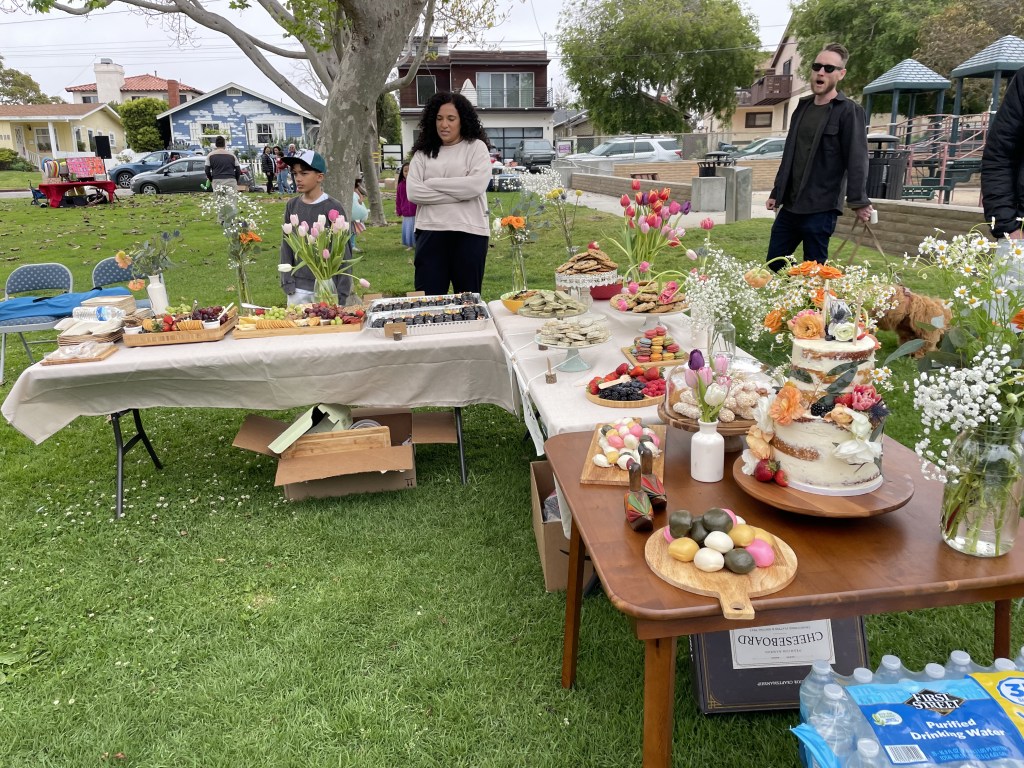
For Tov’s dol (first birthday in Korean), I began preparing weeks ahead. I bought a 25-pound bag of flour and lots and lots of butter. I made multiple batches of three kinds of cookie dough and froze them. I ordered a dozen Amazon packages full of cake-making and party supplies that I’ll probably not use again. I looked up countless recipes looking for the best cake recipe, and tested them out so I can find the best lemon olive oil cake recipe. I watched dozens of YouTube videos on how to make a naked tiered cake.

It wasn’t just me. My parents spent thousands of dollars to fly out for his dol, and so did my father-in-law. My mother made a huge pot of japchae while my father tried in vain to put Tov down for a nap. My mother and I spent took much time trying to arrange flowers I had bought at Trader Joes that didn’t really work well together. The day off, David and my father-in-law hauled boxes and boxes of stuff to the park to set up for the party. David’s uncle and aunt and cousins all helped me assemble everything together while I barked orders and ran around like a stupid chicken all stressed and frazzled because Tov had been crying nonstop and everything was still in boxes when we had 15 minutes until the party starts.

To be honest, I did not have all that much fun. I wasn’t able to hang out with anyone very much because I had to hold Tov most of the time, which also meant I wasn’t able to eat much of the food I had prepared, either. I was cold and tired and over-touched and over-stimulated.

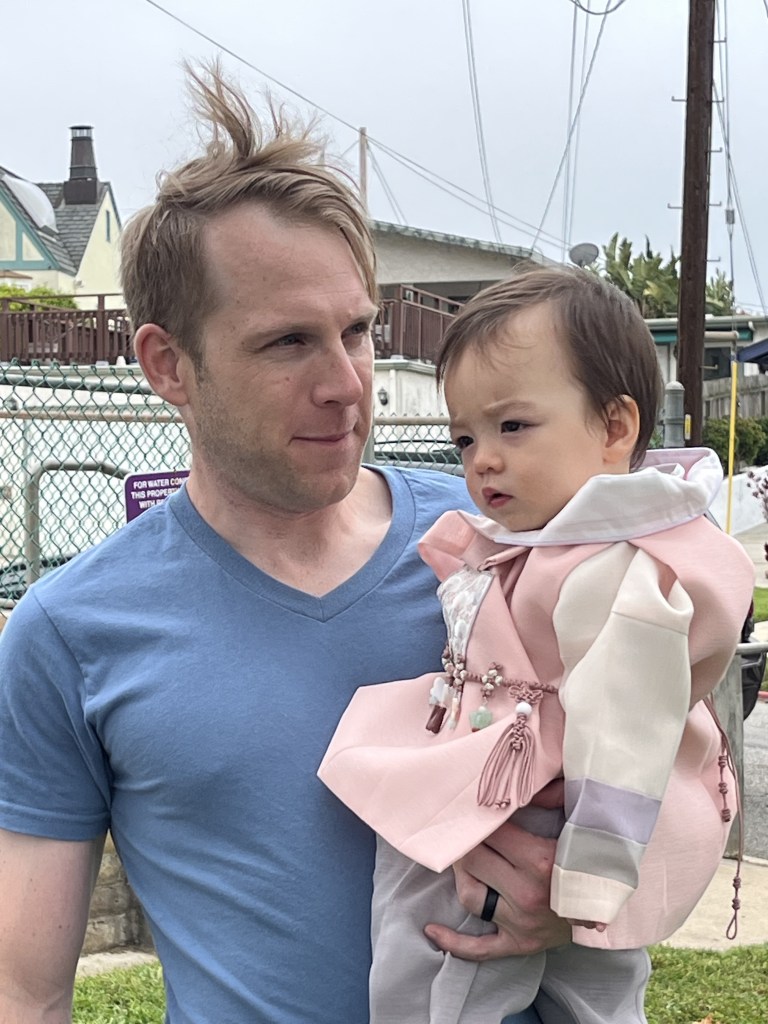
All this backbreaking work, for a one-year-old boy who couldn’t give a crap, who didn’t want to wear his traditional Korean hanbok, who cried and fussed because he missed his nap, and eventually passed out on David’s shoulder.

Oh, the things we suffer through for a child. Oh, the things a child suffers through for us adults.

But there was one redeeming thing to this whole affair: Except for Tov, we all willingly did it. People willingly sacrificed several hours of their Saturday afternoon to drive a far way down to us. Parents and grandparents willingly gave up time and money and energy to gift Tov a special celebration that he’ll not remember, but will hopefully bless him in immeasurable, invisible ways because it is a reflection of our love for him and each other.

Another redeeming factor: For his doljabi, Tov picked a globe! He shall be a globe-trotter! I was thrilled, though David was a bit sad he didn’t even give the baseball a glance. I cannot wait to take Tov around the world and let him see and experience the peoples and cultures I meet as a journalist.

Happy birthday, Tov. Even if you don’t remember the details of your dol, remember this: Even at that age, you had the power to bring together all these people to celebrate and bless you. That power is love. You still have it. You’ll always have it.

Little giant disrupters

Tov is nine months old.

In the last several months, he’s found his hands and his feet. Instead of laying helpless and limp on the bed, he has learned to grab things, hit things, thump his foot on the floor. He’s also found his voice, and instead of simply crying when hungry, he has learned to yell, exclaim, babble, growl.

What all this means is that Tov has become very very loud. There was a time when we could wheel him in a stroller into church or a restaurant, and he’ll sit quietly in the stroller next to us, either drifting asleep or sucking on his pacifier. There really wasn’t much else he could do. Now he’s wiggling and flailing to get out of his stroller so he can explore the world. He wants to commando-crawl from corner to corner, and touch shiny and dangerous things. He wants to put everything in his mouth, including dirt and soiled diapers. He wants to smack his open palms on the floor, clang objects on tables, and exclaim “Aaaaah! AaaaaAAH!” at the bangs and booms he’s making. He wants to screech– not because he’s hungry or poopy or tired, but just for the sake of screeching, because listen to me, mama, did you know I have a voice?

Our little son is a 16-pound creature who makes as much noise as a boom box– doesn’t matter if we’re at a prayer meeting, or a Bible study, or a dinner party. There is no shushing him. (Those amazing baby shushers? They only worked for the first two months, if that.) Pacifiers are no longer self-soothers to suck quietly, but projectiles to fling across the room, or hit the nearest person with it.

We cannot take him anywhere without apologizing for the constant disruption. Those self-care mommy IG accounts often preach that mamas don’t need to apologize for our baby’s noises. But I do apologize, because there is no other honest way to say it: My son, my adorable son whom I love so much I could stare at his little head for hours, is a tiny-sized massive disrupter.

Back in my childless days, these disruptions would annoy the heck out of me. They disturbed my peace, my space, my concentration and comfort. One time when I was an intern at a church, a parent brought their infant into the church office. The parent put the infant down for a nap in a room and must have been busy at a meeting, because the moment the child woke up, he wailed and wailed.

“Waaaaaah! WAAAAAAAHHHH!” went the little disrupter, and the high-pitched screeches raked like a witch’s fingernails on my eardrums and gave me a splitting headache. I would have rather listened to Blink-182 blasting full volume on a boom box, because at least I could turn that off. There is no “off” button for a human baby.

Finally, a friend who has a grown-up son hurried over to pick the baby up and calm him down.

“Poor baby,” she sighed. “He was in distress.”

“I don’t understand why babies cry so much,” I complained. “I don’t think they’re in distress. They just want attention.”

My friend raised her eyebrows and looked at another friend who was with us. “Oh dear,” she said. “When Sophia has her own baby, we’ve got to run over, because she’s gonna need a lot of help.”

Well, I’m never going to have a baby, so that solves the problem, I thought to myself.

Joke’s on me. Now I’m the parent dragging her kid around and causing disruptions. Now it’s my kid wailing in distress in the middle of a Sunday service, or breaking dishes in restaurants. Now I’m the harried-faced, apologetic parent, while others stare or glare at us. It isn’t just my life that’s been disrupted– everywhere I go, my family was disrupting other people’s lives, and for the sake of everyone’s convenience, it was just so much easier to stay home and be antisocial.

Except we need community. Parents of babies especially need community, at a time when our world constricts and squishes into a vortex of baby talk, diapers, and feedings, when all our energy and love is poured out out out out out and we just need someone outside of us to pour an ounce back into us. That’s been our prayer topic as a family for this year: We need community. Not a “see you on Sunday after church for 20 minutes” kind of community, but fellow brothers and sisters in Christ in the neighborhood with whom we can regularly and intentionally practice our faith together, people with whom we meet up so often that they know what’s happened in our lives yesterday, instead of two months ago. Because our church is a little further out, we haven’t been able to find that kind of neighborhood community yet.

So recently we decided to join another church’s community group, which meets every Wednesday night at a coffee shop owned by a church couple. Even on a weeknight during traffic hours, the group is only about a 15-minutes drive away. The one pitfall is, the group meets between 6 and 8 pm. Tov’s bedtime is between 7 and 8 pm.

This Wednesday, we wheeled Tov in his carseat-stroller into the coffee shop, and almost immediately he was wiggling to get out of the stroller. We took turns carrying and bouncing him around. We gave him things to distract him. I took him to the corner so he can crawl on a rug.

There was no silencing him. He took a plastic communion cup and repeatedly smacked it loudly on the tabletop. Smack. Smack, smack, smack! He punctuated the smacks with a happy yelp: “Aaah! Grrrrr! Aaaaah!” When I took him aside so he can crawl in the corner, he bolted out of the rug, slid under people’s chairs, and tried to lick their shoes. I gave him toys, but they were wooden and the floor was concrete. He banged them on the hard floor– bang, bang, bang! And when I took those toys away, he squealed, then smacked the floor with his hands instead. Smack, smack, smack! I let him crawl for a while again, and he thumped his foot on the floor– thump, thump, thump! All the while exclaiming, “Aaaah! Aaaaah!”

By 7:30, those “aaah”s were no longer happy exclamations, but angry screams. He was overtired and hyperactive– refusing the bottle, refusing to be held, twisting his body and flailing all limbs and scrunching his face into exhausted, enraged howls. Time to go home.

“I’m so sorry,” I said.

“Sorry, sorry,” David said.

We quickly strapped the yowling Tov into his stroller and hurried out.

The coffee shop co-founder, one of the leaders of the community group, rushed out with us. “I just want you guys to know, it’s totally OK. You all are always welcome here,” he said. “I have three boys. We understand. We all understand. Don’t ever feel like you can’t be here.”

“Thank you,” I said, incredibly moved, but I couldn’t help adding, “I’m so sorry.”

Two things can be true at once: My son is disruptive; he will distract and inconvenience people. And! There is also space for him, for us.

We’ve been craving community because we needed someone to pour into us during times when we feel like we’ve been poured out empty. And one of the biggest way people pour into us is to scoot an inch aside and make room for our noisy family, and to reassure us, “It’s OK. You are welcome here. We understand.”

It’s a grace that I never once extended to others when I was childless and single, and perhaps that’s why I have trouble allowing that grace to myself. I feel like I don’t deserve this grace, because I couldn’t give it to others when they needed it. And you know what? I don’t deserve it. Yet people give it to me anyway. So I’ll receive it, a little shamefacedly, that undeserved grace that is the glue that holds together a community made up of people who need and give it.