
Traveling as a journalist while third trimester

I was about 29 weeks pregnant when I boarded the KLM flight to Warsaw, Poland, for my first reporting assignment at my new job.

It’s obviously my first time traveling so far away with a visibly pregnant belly, so I didn’t really know what to expect. The last time I traveled internationally while pregnant was in January to Mexico City, and I was barely showing at the time, and didn’t know I was pregnant. This time, there was no hiding that bump, even with layers of baggy clothing.

As I strided into the narrow aisle of the aircraft, I could see the eyes of passengers zoom into my middle section. Before deciding to travel, I had double-checked with my doctor that I’m safe to travel. She said as long as I’m less than 35 weeks, with no sign of contractions or bloody discharge, I should be fine, though she was willing to write me a doctor’s note prohibiting me from traveling if I needed it. I told her I didn’t need it.

Two weeks before the trip, an older Chinese man, who took it upon himself to appoint himself my LA-based father figure (I don’t know why, but I always seem to only meet wonderful people), had advised me repeatedly that I should not invite any stress into my life while pregnant. “I don’t know what’s up with western people and their ways, but our Asian culture, we believe in the mother resting as much as possible,” he told me: “So please. No stress. Rest.” My husband tattled that I had originally planned to fly to Ukraine, in a “please tell my crazy wife she’s crazy” tone, and the man’s eyes widened with alarm: “What! No! No traveling. There are plenty of stories to tell here in Los Angeles!” He even told my boss to take it easy on me, to which my boss– who has been incredibly gracious and supportive– apparently exclaimed, “No, it’s not me! It’s her!”

OK. Yes, it’s me. But honestly, with everything that was going on in Ukraine and Europe, with me just starting my job as a reporter hired to write global feature stories, I was getting even more stressed simply reading the news from my chair in Los Angeles. I could certainly do some reporting through Zoom and WhatsApp, but in order to tell a story well, I felt I needed to be there. I needed to see people face to face, shake their hands, breath in their scent, feel the raw energy and emotions.

So there I was, on a KLM aircraft on a Wednesday afternoon, shoving my seven-month belly into the cramped space between my seat and the seat in front of me. And then I prayed for nobody to sit beside me.

When I booked that flight, I made sure to choose an aisle seat so I can shuffle to the bathroom to pee every 15 minutes without irritating my seatmate. But I also made sure to choose a seat with empty seats beside it, so that I can stretch out. The day before, when I checked in online, I saw that the two seats next to me were still empty. I held my breath, hoping, praying.

By the time I sat down, with the two seats next to me still empty, I was so confident that my prayers were answered I happily put my backpack on the seat next to me. I was all prepared for a relatively comfortable flight, and thanking God for it.

Then a woman came up and pointed at me, and said in loud commanding voice, “Those are our seats.” Behind her was her husband, quivering with a walking cane and a stooped back.

“Oh! Sorry,” I said, taking my backpack off their seat and shuffling out into the aisle so the couple could gingerly inch their way into their seats. As the husband groaned while settling into the middle seat, he turned to me and said, “I gotta warn you: I snore.”

I didn’t curse God, but I did shake my fist: Why, God. Why. It was such a simple ask.

They looked to be in their mid-70s at least. The man was hard of hearing, so his wife practically screamed into his ear, enunciating every word she uttered. Her hair was an artificial strawberry blonde blob, her nails polished pink, and her lips puckered into a perpetual scowl. The man had gentle blue eyes, mottled trembling hands, and a soft belly as large as mine. I felt uncomfortable looking at his frail body squeezed into the middle seat, and felt uncomfortable as his elbow poked out of his personal space into mine, sometimes bumping me in the ribs.

Yay, the joys of the economy seat. I admit: My mood instantly turned sour, and I whined internally like a toddler. I had really hoped I would at least get some sleep in before landing in Warsaw and jumping right into a full day of reporting.

I did not get much sleep. Economy seats are already by default cruel and unusual punishment, but my seatmates, God bless them, were loud. The man gave me a fair warning: He did snore– like a bear deep in hibernation, with occasional startled snorts. When he wasn’t snoring, his wife was fussing about, shouting, “Where is my MASK!”

“Eh?” her husband said, half-deaf, half-snoring, and half-asleep. She leaned into his ear and spat out each word as crisply and loudly as she can: “I. CAN’T. FIND. MY. MASSSSSSSSSK!!!” “Oh,” he said, and they both fidgeted about looking for her missing mask, elbows and feet sticking into my space while I tried to sleep. She lost her mask at least three times during the flight. It also didn’t help that my baby was super active throughout the flight, practicing break-dancing or water polo or whatever it is it’s doing in there.

Then it was time for our meal– always the highlight of any flight. I don’t know what it is, because unless you’re in business or first class, airplane food usually sucks, but every time I smell that warm toasty scent wafting through the aircraft, signaling the start of mealtime, my heart sings. It’s really the only thing I look forward to during an economy international flight.

The flight attendant in blue wheeled the food trolley to us. “Chicken or vegetarian pasta?”

“White wine!” the wife barked.

“White wine,” the husband requested.

“Certainly, and for your meal? Chicken or vegetarian pasta?”

“Pasta,” the wife yelled.

“White wine,” the husband requested.

“No, no,” the wife hissed into his ear: “She asked: CHICKEN. OR. PASTA!”

They both got pasta and white wine. I got the chicken, which turned out to be three tiny globs of white meat swimming in reddish sauce.

The wife ripped off the plastic covering to her tray of pasta, stared a half-minute at its contents, then turned to her husband with sour lips and brows: “This looks like dog food.”

That, the husband understood. He turned to me and joked, chuckling, “Gourmet meal, huh?”

For the first time, I felt a certain camaraderie with my elderly seatmates, united by our mutual distaste for the dog food-like dinner we got served. It really didn’t taste too bad, but nothing feels as uniting as complaining about the same thing together.

I survived the flight, and my selfish heart had softened by then to which I said a little silent prayer of safe travels for the crotchety couple, wondering why they were flying to Europe at their old age. But I suppose they could wonder the same about me, an obviously pregnant woman traveling by herself.

I landed in Warsaw, via Amsterdam, at noon, feeling a little dazed from sleep depravity and adrenaline. Waiting for me were Ruslan and Maxim, my travel guides for five days, two Ukrainian guys from Kyiv who had left Ukraine one month before the war, based on a prophetic sense while praying that they needed to leave Ukraine soon. If they hadn’t left, Maxim would have been stuck alone in Ukraine, as he had just turned 18, and Ukraine had banned most men ages 18 to 60 from leaving Ukraine. (Ruslan is in his 40s, but he would have been allowed to leave, since he has more than three children.) I had warned them I’m pregnant (though not how pregnant), and they took it upon themselves to make sure I never had to carry my own bags throughout the trip.

It’s a little strange, being pregnant during a work trip. It might be my imagination, but men’s eyes seem to soften when they see my belly, and some look more carefully at me with curiosity, though most don’t ask questions, simply bowing their heads to me and saying, “God bless you.” Women, especially mothers, spot my belly and give me small smiles. Several asked me when I’m due, whether it’s a boy or a girl, and if it’s my first. When I told one Ukrainian refugee woman that I’m seven months along, she exclaimed, nodding at her 18-month blonde child, “Oh! I had my daughter at seven months!” I felt a little stab of worry then– I knew I was facing a small risk of preterm birth while overseas, and I prayed I don’t go into labor while in Poland.

Let’s talk mom guilt. Apparently that’s a common thing. The internet message boards I stalk are full of pregnant moms chirping their anxieties and guilt about what they should do or shouldn’t do, what they did or didn’t do, and begging for someone to tell them not to feel guilty. When I found out I was pregnant at almost six months, my sister-in-law messaged me a sweet note trying to assuage me that I needn’t feel guilty for not knowing. I was touched but perplexed– I hadn’t even thought to feel guilty. Even making the decision to go on this reporting trip to Poland, people around me were more worried and stressed about the trip than I was, and I felt both touched and irritated at their concern.

Perhaps I have an inflated sense of security, or perhaps I’m just irresponsible. But once my doctor approved my travel plans, I didn’t see the need to worry over things that are unpredictable, uncontrollable, and unlikely to happen. There’s enough stress as is– why pile on more unnecessary stress?

And then I caught a cold.

It started with waking up one morning with a sore throat. I had been in Poland three days by then– three very full days, with non-stop visits to churches and church-run refugee centers helping Ukrainians who fled the war. I was up before 6 am every morning, and in bed after midnight completely exhausted. I had been running on the ground the moment I got off the plane in Warsaw.

I didn’t think much about the full schedule. After all, that’s usual for a reporting work trip. Except I wasn’t “normal” anymore. I was running for two, and pregnancy had diminished my immune system and energy levels. By day four, I woke up at a hotel near the Ukrainian border feeling like I had been hit by a freighter. I tried working out as usual, but got so out of breath and dizzy that I crawled back into bed for a 15-minute nap.

That whole day, I felt like I was moving underwater. Every movement hurt and ached. I sat at breakfast smiling at my travel companions, but barely hearing a word they were saying. I forced food into my mouth, but my stomach heaved it back up the entrance of my gullet, and there the undigested food sloshed all day during a bumpy, long, overheated car ride, until finally I squatted by the side of a road and puked out puddles of my breakfast onto the dirt field.

The nausea stalked me all day. If I hadn’t felt the baby still kicking inside me, I would have been wrecked with worry for the baby’s health. I wondered several times if I did the right thing coming here, mocked myself for playing mission impossible. I guess for me, mom guilt takes the form of scorn and derision: Who do you think you are, some sort of martyr journalist? You fool, you ridiculous person dragging everyone down with your pregnancy cold.

I have no profound insights to share except that I had to swallow my pride and admit I’m no Superwoman. I’m just a regular human needing to learn to listen to my own body cues. Mind isn’t always stronger than matter, as I tend to believe. But sometimes, God gives you the strength you need.

That late evening, as we made our way to our last interview in Przemysl, an old border city, I strongly considered just staying in the car, stretching out in the back seat, and knocking out. I was so, so tempted to tell my travel companions to go on to the interview without me. But I crawled out of the car and hobbled like a granny nun up the hill to the church, and somehow, I made it through the interview– and it was a really good interview. I was glad I pushed through– but also glad to crash early to bed that night, and pass out for a full eight hours. And my body, given the rest it needs, woke up the next day feeling ten times better. It’s amazing how the body springs back when it’s treated well.

The last three days in Poland, I was by myself, without Ruslan and Maxim. During one of those days, I re-visited a warehouse in the outskirts of Warsaw run by a Ukrainian church. That warehouse opened within a week of Putin’s invasion, and currently serves as a hub for prayers, collecting and sending out emergency supplies to Ukraine, and hosting refugees who now work as volunteers there. It is a beehive of activity– men and women, young and old, buzzing about like bees, murmuring and bellowing in Ukrainian and Russian, organizing first aid supplies into boxes for front-line soldiers, unloading pellets of food from trucks arriving from Spain and Estonia and Germany, discussing strategy and priorities for the day.

The founding pastor of that church and warehouse is Pastor Oleksandr, or Pastor Sasha, a stocky, high-foreheaded former gang-leader Ukranian with greenish eyes and sonic energy. He sets the pace and energy at that place, and I rarely saw him sit down for a break. He was constantly marching from one room to the other, meeting with this bishop and that missionary, booming and ordering with the deep voice of a military sergeant. In the midst of that busy day, he still made sure to greet me and show me around, offering me coffee and dates and bananas and chocolate. Ukrainian hospitality doesn’t stop for no war.

That afternoon, I sat with a group of men in the office, all Ukrainians. Some of them are Ukrainian-American missionaries and ministry leaders who flew out on one-way tickets to Poland to help. One of them, a white-haired Ukrainian-American Assemblies of God missionary from Florida, asked me when I’m due, and if it’s a boy or a girl. He was the first man to ask me that. I told him the baby’s sex and the baby’s name, and the meaning behind the name, and he beamed.

Then he leaned forward with a sincere expression and asked, “Is it OK if we pray for you and the baby? We would love to pray for you. It is so important to pray for a new life.”

I was startled, though I shouldn’t have been, given that I was in the midst of praying ministers. But I suppose I didn’t expect these busy people to stop everything they’re doing– important, life-saving work– and pray for a stranger and her unborn child. That day, the Russians had bombed a critical bridge, blowing up the only way for the warehouse trucks to bring much-needed food and supplies to the war-torn Chernihiv region. They had several trucks waiting on the other side of the river full of emergency goods, and no way to reach the people who need it. There were a lot of logistical complications to work out, and lots of meetings ahead. And here I was, a reporter from Los Angeles, sucking up their time and attention. Or at least, that’s how I felt.

But I was still recovering from a cold, and I never say no to prayers, so I said yes, I would love prayers for the baby.

The missionary called out to his comrades in Ukrainian, including Pastor Sasha, asking if they wanted to pray for me and my baby. Everyone’s eyes lit up, and they shouted yes with enthusiasm, immediately leaping to their feet. They gathered around me and put their hands on my shoulders, and together, they prayed out loud in passionate Ukrainian, the kind that comes with uplifted palms and pumping fists.

I had no idea what they were saying, but I understood their hearts. It was a heart of giving, of blessing, of pure brotherly love. I felt my eyes sting with tears, and my face crumpled as I willed myself not to burst out crying. Instead, I breathed it all in– their hearts, their prayers, their beautiful foreign words of blessing over a child who involuntarily traveled with me across the world to report on a war. And my spirit received it all with gratitude and affection: Amen, amen, amen.

On the long flight back to LA, I sat back reflecting on the last nine days in Poland. Has it really only been nine days? It feels like a month. My mind and heart were full of new sights and voices and relationships and feelings that I did not have on my flight to Europe. I felt full, so full.

And then the baby kicked. Rolled. Air-guitared and danced.

I put both hands on my belly, and the baby responded to my touch, dancing wilder. And for the first time, I felt a deep emotional and spiritual connection to my unborn child. We experienced this trip together. We witnessed the work of God and His people together. We received blessings together.

I felt a little weepy again, and I silently whispered to the baby, “Thank you, aga yah (baby in Korean). Thank you for coming with me. Thank you for staying strong, and reminding me that I’m not alone. And now, we return home to abba.”
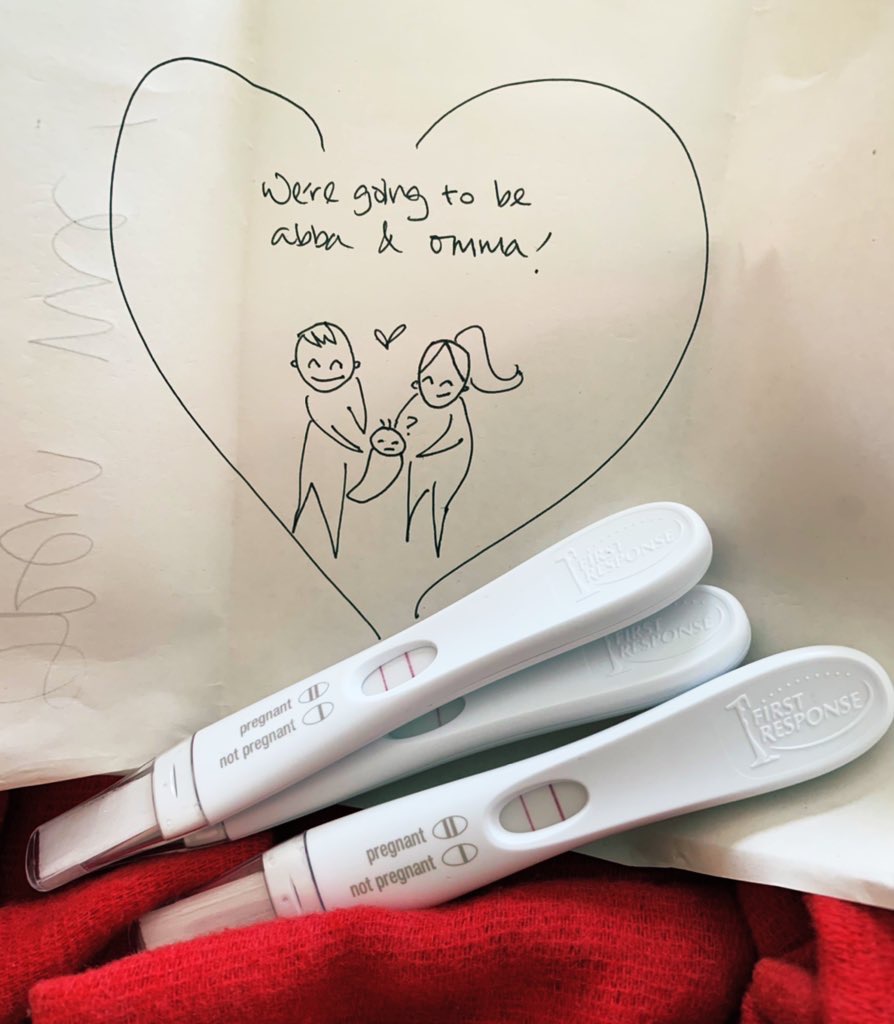
We’re going to be abba and omma!

The day I told David we’re having a baby, I waited till evening time, right before dinner, when David was done with work for the day. I felt like I had an itch all day, watching the clock tick till dinner time, my mind constantly wandering to the three positive pregnancy sticks hidden in my bathroom drawer.

Later, I tore out a page from my notebook and drew a little doodle of David and me holding a little baby with the words “We’re going to be abba and omma!” Then I folded that piece of drawing into a little envelope, and wrapped it around the three pregnancy sticks. I placed that into a kraft box that once held my 2022 planner (ironic, now that I think of it). And then I waited.

I made air-fried Brussels sprouts, sweet-glazed salmon, and mashed potatoes with gravy for dinner. At around 6 pm David stomped up the stairs, complaining about how tired and busy he is, per usual. Heh heh heh, I thought, knowing that soon he’ll be busier and more tired than ever. He then complained that we’re having salmon for dinner, and I told him to shut up and eat what’s placed before him. Practicing being a stern mom, you know. And then I slid out that Kraft box and placed it next to his dinner plate.

“Ooh, what’s this?” David asked.

“I got a little something for you,” I told him. “Open it!” I sat next to him as he opened the box.

He thought it was a present from Mexico City, so he got confused when he saw the folded paper, rattling with something plastic inside it. He opened the “envelope,” and froze when he saw the white pregnancy sticks with the pink lines. He stared at it for a few seconds, not understanding. Then he very slowly opened the folded piece of paper and read it. He whipped his head to me in shock: “WHAT?” He thought it was a joke, because we had joked about me being pregnant before.

I giggled at his shock. “Yeah, I’m pregnant!”

He stared at me, speechless.

“Seriously, it’s not a joke. I’m really pregnant. And I think I’m pretty far along, maybe 16 weeks.” I pressed my overalls to my belly: “See?”

He touched the little bump on my lower abdomen, and his eyes widened. “Wow,” he breathed. And then he looked up at me, his eyes shining, his mouth dropping and stretching into a shocked, amazed grin. I wish I had captured that expression on camera, but I’m also glad that private, unforgettable moment is ours to share alone. He looked like a child himself, full of wonder and awe of this world, of life. Then he asked, “How do you feel?”

Tears welled in my eyes and I felt like I was burning up in a flame of confusing emotions. “I don’t know,” I said. “How do you feel?”

“I’m excited!” David said. “And also in shock.” He flapped his hands. “I just need time to process this. This is a lot!” He turned down to his dinner, which was getting cold. “Well!” he exclaimed, “Our lives are going to change!” He continued sitting in a daze, then said, “I don’t think I can eat dinner anymore!”

He did. He finished every bite of the salmon he complained about, but he ate without tasting, mechanically shoving food in his mouth while his mind tumbled into a completely new world– our world. Our world with a child. Can we imagine? No, we can’t. We don’t even know how to begin.

We decided to call my parents that night. But when I asked him if he wanted to call his dad that night as well, David’s face turned red. “I don’t…I don’t…” he stammered, words failing to describe the pain of a sudden realization that he would never, ever be able to call his mother to tell her the good news. Every muscle in his face scrunched into grief as he tried to hold back his tears, and I cried again watching him weep, watching him thinking of his mother, missing her, longing for her.

“I know,” I said quietly, and wrapped my hand around his clenched, shaking fist.

We sat in the hush of so much unspoken, inexpressible emotions and thoughts that didn’t need to be uttered, because we thought and felt them together.

And then, inevitably, we talked logistics. All the unromantic, boring, mundane worries about health insurance (I’m in between jobs, I don’t start work until March 1, when does my health coverage kick in? How much is prenatal care out of pocket?), where to put the nursery, what to do about childcare once the baby is born, what’s the next step, how do we know the baby is healthy?

Oh life. Oh humanity. Every great joy and celebration, weighted down into the mud of this world’s dreary realities.

We finished dinner and went for a walk. I called my parents on speaker, and though it was past 10 pm their time, they picked up almost immediately. “We miss you David!” abba boomed from the dinner table: “We always think about you!”

“Thank you,” David said, and we nudged each other, mouthing, You tell them. No, you tell them! I decided David should break the news. “So…” he began. “We have something to tell you.”

My parents went quiet, though I could still hear abba chewing his late dinner.

David started telling the story of how when I was at Mexico City, a guy at the gym approached me and asked, “You’re pregnant, right?” But he didn’t get any further in his story, because the moment my parents heard the word “pregnant,” they flipped out.

“Aaaaah? PREGNANT?” omma interrupted.

“Eeeeeh? PREGNANT?” abba yelled in the background.

So they didn’t get to hear the whole story of how the guy at the gym made me suspect I was pregnant, as the word “pregnant” clanged and dinged and buzzed and donged in their brains.

I jumped in to explain in Korean, as briefly as I could, that I had just taken the pregnancy test the night before, and abba, still in his stupefied daze, heard the words “positive” and “test” and screeched, “Eeeeeh? You have COVID?”

David looked at me, mirth dancing in his eyes, and voiced exactly what I was thinking, “Where in the world did you get COVID from that?”

I barked at abba to pay attention and dig his ears, because he’s clearly not listening properly, while omma laughed and shushed abba to keep quiet for a second.

They were overjoyed, of course. “I’ve been praying for this every single day!” omma cried, to which I felt a pinch of annoyance. I always get triggered when my parents tell me they’re praying something for me, because often it feels more like a pressure to conform to their wishes rather than a blessing. And then omma proceeded to compare me to Sarah in the Bible: “You know, you’re just like Sarah! She was a dried-up old prune, but when God decides to open up the womb, lo and behold, nothing can stop Him!” Thanks, omma.

Abba told us in his broken English, “Don’t think you are parents-to-be. You’re not mother-to-be, or father-to-be. You already parents. You already mom and dad.”

That was hard to imagine. I mean, I had only just discovered I’m pregnant less than 24 hours before, and David had found out about an hour before. It was hard to wrap our mind around the fact that we had created a little kid we’ve not yet met before, this tiny growing thing inside my womb, who had been so patiently waiting for us to acknowledge its existence. We didn’t even know if it’s a boy or a girl, how far it’s along, when it’s due. We don’t have a name for it, we don’t know if it’ll look more like David or me, if it’ll like kimchi or tacos, if it’ll have my brains or David’s heart. It is a blank canvas, and someone else is the painter, gradually adding in hues of color and blobs of shapes, and we can only wait and see, wait and hope, wait and pray.

What helplessness, to be parents. How do you prepare for it? You can’t. It just happens, and you just let it happen, I suppose. And take it one step at a time, letting the seasons wane and shift in their own timing, realizing more and more that you have little control, and learning to accept that, to walk alongside that.

We did not prepare for this baby, could not prepare for it. But we’re already parents. We are abba and omma! And so we make room for imagination to grow, for out-of-control situations to happen, to expect the unexpected– perhaps for the rest of our life. And if there’s any way I can prepare for this baby, it’s to get excited for that.

A fool for a mother

Well, shocking things happen. And one of the biggest shock of my life is…I’m pregnant.

To be precise, I’m 25 weeks and one day along as of today, and I only just found out three weeks ago, on February 1. As omma said to me, after her initial scream of shock and delight, “Well! I’m shocked you’re pregnant, but I’m not shocked that of all people who won’t discover they’re pregnant until month 6, it’ll be you. This is just another Sophia thing.”

A “Sophia thing” is me, once again, having to eat my words. From when I was as young as 10 years old, I had loudly and proudly proclaimed that I never want to get married. Of course, not having babies went along with my rejection of marriage, and it was all part of that whole package. I wholeheartedly embraced my self-identity as an independent, free, unshackled woman, while also acknowledging that I would probably be a terrible wife and mother. And I kept my word for two decades.

But then I got married. When I told abba I’m dating David (I was 29 at the time), he kept pinching himself: “Is this real? Am I dreaming? My daughter has a boyfriend?” My brother took pains to remind everyone at our virtual wedding (darn you to sheol, Covid) that he had never expected his older sister to get hitched, because didn’t she swear up and down the river that she’s going to die happily single?

Even as a married woman, during inevitable discussions with friends and family about having kids, I once again, with my loud and proud mouth, declared I don’t want kids. “It’s not that I reject having kids,” I told my parents one night, after they once again reminded me that they’re praying for grandchildren, “I just have little desire. If it happens, it happens. If not, I’m totally fine. Stop trying to dictate my life with your prayers. I never asked for them.” What I didn’t tell them, since it’s none of their business, is that David and I never used contraceptives, and though we weren’t trying, we weren’t…not trying.

If it happens, it happens. If not, it doesn’t. No biggie. That was my philosophy that I repeated over and over to myself and others. As we approached our second-year anniversary, we began discussing what to do when I turn 40 and am still not pregnant. Will David be OK completely giving up all hopes of having children? I checked again and again with David that he would be OK, that it would not hurt him or our marriage should I be infertile. As for me, I thought I’ll be fine, maybe even a bit relieved, to not have children. We made plans to spend a year living abroad should we be childless. Maybe London. Or Tokyo. Or Bangkok. We made long-term plans to travel to South Korea, Southeast Asia, East Europe. There was no room for little Davids or Sophias in our imagination for our future together– or rather, there was no capability to imagine such a possibility. The idea of bearing our child seemed fantastical to me, impossible to imagine without a hurried dismissal.

You see, I did not think I could or would get pregnant. I struggled with anorexia from age 16 to about age 23. Being hospitalized twice, dropping to my lowest weight at 52 lbs and hovering around 60 lbs for about three years, meant my body and development took a thrashing, and that included my menstrual cycle. I did not have a period for more than nine years. And even after I got it back, kind of, with the help of birth control pills prescribed by an ob/gyn, I was never regular. I would sometimes go several months without a period– and even then, the flow, manipulated through hormone pills, wasn’t normal. An abnormal cycle, an abnormal body, was more normal to me. I warned David before we got married that we might have difficulties conceiving. “Don’t worry, I have really strong sperms,” he bragged, with all the aplomb of a male ego. I rolled my eyes and told him to be serious. No, seriously: Will he be OK without children? David sobered up and thought about it for a moment. “I’ll be bummed,” he said finally, “But I’ll be OK. Lots of married couples don’t have children. We’ll get through it.”

Meanwhile, as one by one my friends’ bellies swelled, and they disappeared from my social calendar the moment their babies were born, as every parent with young children complained about the cost and sacrifices of parenthood, my conviction that I don’t want kids solidified and hardened like wet cement under the dry LA sun. I barely have enough time to read as it is. If I had a little one running and screeching around the house, when would I ever find time to read in peace? When would I have time to travel any time I want, wherever I want? Is parenthood really worth sacrificing the things that I value so much? Not likely, I told myself.

I was proud, oh so proud. But I was also scared. I feared disappointment, and the bitterness and resentment that inevitably clings to disappointment like barnacles. Better not to hope, not to expect, not to desire. Just as it took me a long, long time to finally express my desire for a spouse to God, to even write those shameful (to me) words in my journal, I didn’t dare voice any desire for children to God. If it happens, it happens. But that mentality wasn’t anchored on trust and submission to God. It was chained to fear and pride. It was not as free-minded as it sounds. It was a form of control, of twisting my thoughts and feelings to fit an expected outcome.

I know that now. And as much as I’m in shock that I did conceive, and I’m already in the last stages of second trimester, I’m even more shocked that…I want this baby. I’ve wanted this baby.

When I took the pregnancy test at 11 pm on February 1, after David had gone to bed, and saw the two pink lines appear on the white stick– I felt like I was in a dream. Wait– is this real? No way in hell. What? WHAT?! It just didn’t feel real, and my mind couldn’t compute those two pink lines indicating that I’m pregnant. I was so shocked and stupefied that I couldn’t even make a sound, not even a little gasp or a strangled scream. I just stared at the stick in silence, while my mind imploded in slow-motion.

Just to be extra-sure– after all, there have been cases of false positive tests– I took another pregnancy test. Five seconds later: Two pink lines.

Oh man, oh dear, oh sweet God Holy Spirit Jesus Christ, oh Lord, HOW? By then the reality slowly sunk into my consciousness, but my emotions were still delayed, paralyzed by shock. I was numb, frozen.

I took a third pregnancy test, since you can never be too certain. This one for some reason took a longer time to show results, and one of the pink lines was fainter than the other, but it was unmistakably two lines. Well, statistically, three false positives seemed very unlikely.

Wow. WOW. I am pregnant. We’re having a baby!

And I realized something surprising after this third test: As I waited for the lines to show, I was holding my breath, hoping, hoping, hoping it is positive. I didn’t even recognize that hope at first, so immunized was I to my own secret desires. But by the time I clutched the three positive tests in my hand, I felt a wave of relief and wonder and gladness break through and gush out from the dam that I had erected for so long.

That night, I dreamed of different scenarios of telling David the news. In each scene I was nervous, but excited. And in the final one, I broke down and wept so hard that I jostled awake to find myself gasping from choked sobs onto my wet pillow. I felt so many emotions in the dream that I had reined in under a tight leash in real life– wonder, awe, fear, thrill, and most of all, joy.

I had not known. I honestly had not known I desired a child. But God knew. And for whatever reason, He opened my womb and answered that desire with a yes. One of the first words I muttered, when speech found me again, was: “Why, Lord?” Why me? I am the most undeserving mother of all. I know friends who struggled with infertility and miscarriage after miscarriage. A friend had just lost her unborn baby to a miscarriage on Christmas Eve night. She spent Christmas bleeding and cramping and crawling. Two close friends had two consecutive miscarriages, and I saw the pain and loss that they too suffered. Another friend just turned 40, and she’s still single and childless, and mourns each passing day. These living stories around me shamed me. I, the proud loud idiot, loudly and proudly rejecting marriage and children, received both on a golden platter. This is a privilege, a blessing that I had not asked for nor expected, and did not deserve.

My next three words: “Oh, poor baby.” This tiny unborn baby, growing and kicking inside a clueless mother who, even while it was developing a beating heart and 10 toes and ears, had to listen to her plan a life without children. I beat my foolish mouth, over and over again. “By the mouth of a fool comes a rod for his back,” Scripture says, and I resolved to never again utter such foolish things before God and others, for I had been unknowingly exposing all my shame and foolishness to the world. Yet instead of a rod, God gave me a surprise, wonderful, beautiful gift: A life. A precious, living, breathing, new life formed by God’s breath and spirit. My baby has a fool for a mother, but God protected this child, and opened my eyes to my foolishness– not with punishment, but with gentle yet firm grace. What a Gospel.

Oh God, how sweet, how undeserving is your grace and mercy. How amused you must be at my foolish words and ways, watching me cling to my own plans when you know you have greater plans for me. How patient you are with my persistent, concrete-hard pride and stubbornness, how gentle you are in breaking me down and molding me. Your hands are strong and steadfast, loving and skillful, sweet and intimate. I yield to you, undone and remade.