

As Tov is now 3, David and I have been discussing more about how to intentionally instill a living faith in our children, and that got me thinking about how I was raised as a Christian.
I grew up as a pastor and missionary’s kid, so my parents were very intentional about developing our faith. We spent about as many hours playing in church as at home. We had family worship time at home, with my father strumming the guitar as we sang Korean hymns from black-leather, zip-up Korean Bibles that included about 500+ classic translated hymns. I engaged in a lot of cat fights with fellow PKs and broke a couple of glasses that way. We were required to sit in the front row while my father preached for two hours, which meant everyone behind me could see my head nodding away, and I knew I’d get a scolding from my father on the way home.
All that intensive training to be a devoted Christian, and by God’s grace, and through my parents’ fervent prayers for us, I am today a committed, Bible-believing Christian. I thank my parents for that, but mostly, I thank God, knowing how much of a child’s faith is out of the parent’s control.
Still, if I have to confess: I don’t always love to pray. I never did, actually. Growing up, I really did not like reading the Bible; I didn’t like going to church; I didn’t like participating in worship; and I especially hated the children’s worship time, absolutely detested those perky Sunday teachers forcing us to stand up and do silly dances and hand motions when I’d rather be tucked in bed reading and sucking on chocolate mints.
I also remember the week-long church retreats in Korea that my parents registered us in. Koreans can be kind of extra, and the prayers there were definitely…dramatic. Korean Christians do a lot of simultaneous prayers, which means everyone prays out loud together. Today I see a lot of value and beauty in that kind of communal prayer setting, but even as a kid with a sensitive BS meter, sometimes all I saw was a bunch of adults competing to one-up each other on passion and zealousness for God. It was mostly a lot of ahjummas with the ubiquitous Korean perm, lifting their arms up, beating their breasts, wailing, hollering, weeping, screaming “Ju-Yeo! Ju-Yeo!” or “Lord! Lord!” in Korean. And I remember watching some littler kids looking around stupefied, and then starting to cry themselves, and nobody paid heed to them, because that was just the kind of response one was supposed to have in the presence of God.
All these religious rituals of prayer and worship and Bible-reading felt onerous to me. At times it felt performative. Mostly it felt burdensome, like doing worksheets after school or eating broccoli because it’s “good” for me and because my parents said so. I still remember the shame I felt when my father glared at me from the pulpit because I couldn’t keep my eyes open, or the family worship that erupted into tears and bellows as my father boxed our ears because we weren’t paying attention and showing proper devotion to God.
Now as a mother of two still very young children, I feel the impendence of this terrible, tremendous, awesome burden of Deuteronomy 6: 5-9:
Love the Lord your God with all your heart and with all your soul and with all your strength. These commandments that I give you today are to be on your hearts. Impress them on your children. Talk about them when you sit at home and when you walk along the road, when you lie down and when you get up. Tie them as symbols on your hands and bind them on your foreheads. Write them on the doorframes of your houses and on your gates.
My parents certainly did this for us, quite literally. They truly loved God with all their heart, mind, and strength. My father in particular also had a lot of zealousness, and the severity of an eldest son of an extremely traditional Korean household. He talked about God all the time. He preached to us from the dinner table, during the drive to church, after church, on family vacations, at random times during the day when he was struck with a conviction to teach us something Very Important, and we better sit up and listen with the respect due to him as our father but especially, to God.
We weren’t allowed to watch a lot of movies and shows. (Beauty and the Beast was evil, my mother told us, because it was too close to bestiality. Thankfully they relaxed on this a little as we got older.) We couldn’t listen to secular music, because Satan was a worship leader, and rock and roll is near satanic. We didn’t have much decor at home, because my parents had no time or aesthetic sense to design our house, but we did have a small wooden cross, a giant painting of (white-looking) Jesus and his disciples, and scripture verses in Chinese printed out on A4 paper and taped onto the bathroom wall at eye level from the toilet. When my parents visited our house, my mother commented with dismay at the lack of religious decor in our home, and I internally shuddered, because I now associate religious decor with the hideous, cheesy, ostentatious artifacts of the 90s and early 2000s. (I do appreciate a simple cross though. We have a small wooden cross in our house– gifted by my parents, of course.)
I don’t want to raise my kids exactly like the way my parents raised me and my brother. But they also did a lot of things well. They taught us that God is to be taken seriously. They taught us to take His Word with reverence, to the point where my father would get upset if we placed the Bible on the floor. They drilled into us spiritual disciplines such as going to church, tithing, and reading the Bible, and they themselves lived that out diligently and faithfully in their own lives. I never once doubted the existence of God, because I saw that God is real to my parents. God is not a political symbol, a cultural expression, a proud heritage of our forefathers– He is a real, living being. They placed this faith– love God and love others– first and foremost in their priority of values, and to this day, this value comes before all other common values such as wealth, comfort, popularity, health, ego, success, and vanity– and for that, I’m eternally thankful, because that shaped my own value system to this day.
My parents modeled what it looks like to be a Christian in real time, and as a missionary kid, I also heard a lot of testimonies from people all over the world whose lives were transformed by God, and I heard lots of biographies of missionaries who sacrificed everything to share the gospel. I had so much knowledge. I had so many examples of how to be a real Christian. I was proud of my parents, and I still am.
As I look back, however, I think something was also lacking. I don’t know if it’s lacking because of something deficient in the way my parents raised us, or if it’s because of my own sins and shortcoming. But what was lacking was joy. There were not enough joy and delight in the way my parents taught us faith. I didn’t find God very enjoyable or delightful. In fact, church services were stressful for me because I knew I would fall asleep and then have to face my father’s disappointment, and I absolutely dreaded family worship because I knew it’ll end with, again, my father’s anger and disappointment.
But what could I do about it? I told myself honestly that I simply did not love God enough, didn’t love Him like my father did, but I did not know how to make myself love someone I couldn’t see, hear, or touch, no matter how much my parents tried to discipline this apathy out of me. God felt like a distant cousin’s uncle, yet His presence was heavy and stifling, like a thick blanket over me, making it hard to breathe or move without feeling its fabric hanging over my face.
It didn’t help that my father was also my pastor, and our family was rather patriarchal and hierarchical, in which my father’s word was the ultimate authority, so it was confusing to me whether my father’s words was God’s Word, or a human father’s words. So much of God was channeled through my parents’ words, actions, and expectations that I couldn’t disentangle the two; it was like trying to hear God through a faulty landline buzzing and hissing with other people’s conversations. I suppose this is a very common issue among second-generation Christians, especially those whose parents are in ministry. There were just too many words, too much knowledge, too much theology, stuck in my mind like an apple core in a gullet, unable to be fully digested and absorbed into the heart.
And so. Now the responsibility of raising our children according to Deuteronomy 6:5-9 falls upon David and me. It’s our turn now, and that means we need to start with Deuteronomyu 6:5: “Love the Lord your God with all your heart and with all your soul and all your strength.”
When I really think about it, really sit and dwell on it in the midst of the chaos of early parenthood, I feel stabs of anxiety. I can go to church every Sunday, tithe a good amount, go to small group and discipleship groups, do my devotions, serve others, all that. But love the Lord with everything I have, to the deepest depths of my soul? Oh, dear. How much of my daily life reflects that? And my goal for our children is pretty lofty: I don’t want to them to just be good Christians; I want them to be better Christians than David and I. I want them to love God– truly, desperately, delightedly, joyfully love God, with all their heart and soul and might.
Now, how do I achieve that?
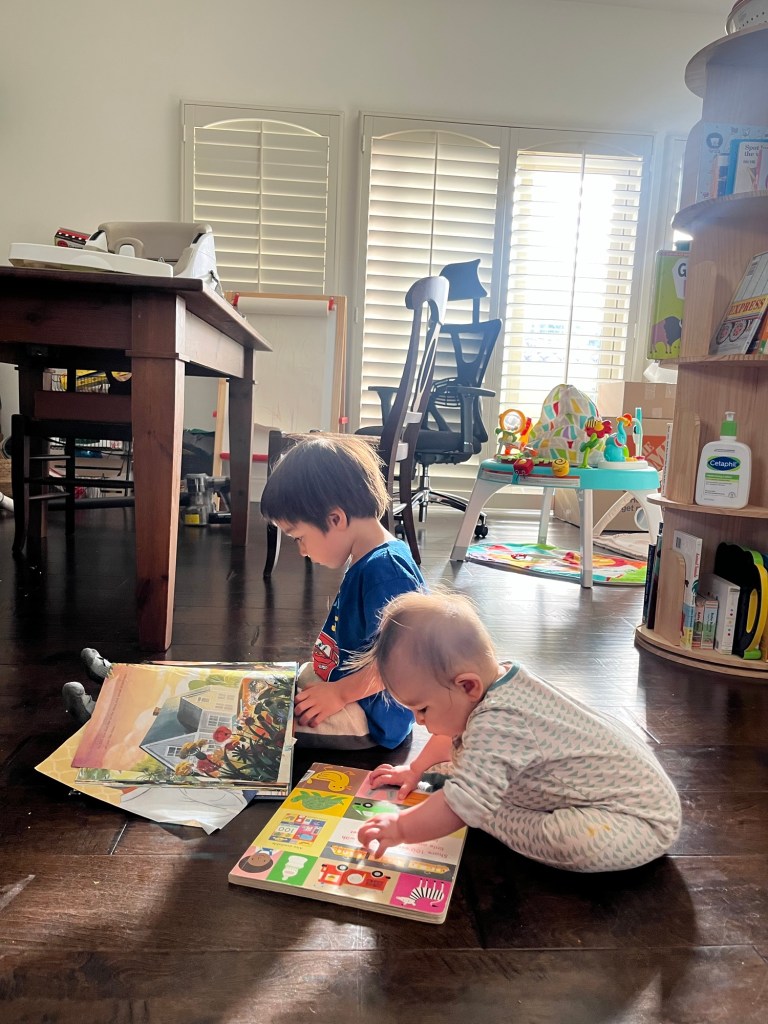
When Tov turned 3, I decided it’s time to be more intentional about setting healthy spiritual habits for our son. Every morning, during breakfast, we now have Bible time. It’s short and relaxed, especially because Tov has a hard time sitting still, and he’s only just begun being able to sit through a picture book.
Here’s how our Bible time looks like: We begin with a short prayer. Currently we are praying for gentle and kind hands, because Tov can be quite rough with his little sister. Then we read a short story out of a children’s Bible. (We started with The Tiny Truths Bible for Little Ones, which is really more on Tov’s level and he loves the cute pictures of angels in there, and now we’re going through The Jesus Storybook Bible, which I love but the artwork is not as engaging for Tov and the narrative is profound but seems a little over Tov’s head.) Then I read a short passage out of my Be Thou My Vision liturgy book, which is definitely way over Tov’s level, but the purpose of it is just to get Tov habituated with the language and posture of liturgy, and it’s really for me, because I’m part of this Bible time, too. Then depending on the story we read in the Bible, I play a song for him so he can get the wiggles out. For example, when we read about Abraham, I played the song “Father Abraham” for Tov, and he turned on the karaoke mic to sing (scream) along and ran to his room to get his guitar so he can have a proper jam session. We end with a brief lesson on an alphabet letter.
All this is maybe 15 minutes, at most. That’s the longest I can hold his attention at a time, and I don’t want to push it in case Bible time becomes more burdensome than enjoyable. Even within that short 15 minutes, it’s controlled chaos: I’m often telling Tov to sit down instead of climbing onto the table, being interrupted by Woori who’s flinging food everywhere, and reminding Tov to eat his breakfast. For now, at least, I was surprised by how easily Tov adopted Bible time into his daily routine, and even asks for it every morning.
Fifteen minutes of Bible time, but then there’s a long stretch of all the other hours when my children are also learning about God through David and me– and that’s the terrifying part. These kids are always watching you, learning from you, including things that you weren’t even aware of, things you don’t want them to learn. Everything is a teaching moment. And I wonder: Is God real and loving and lovable and awesome to them, based on how David and I live our lives? Sometimes I think they’re just too young to even understand the concept of God. But then, I also wonder at what point they will being to understand, and what they’ll absorb and learn until the day I realize that they do understand. It doesn’t matter when they understand. We have to start living our faith out authentically, today.
Two nights ago, we had a teaching moment come by, and it would have passed us if not for the fact that I lost my cool in front of Tov.
Tov had pooped in his little potty in the bathroom, and as he left the room to ask me to wipe him, he pushed the lock inside and then slammed the door shut. So now there his poop sat, steaming in the little pink plastic Baby Bjorn potty, out there in the open air, and I could not get to it. I could smell it from behind the door as I fiddled with the knob.
David was out for a work dinner, so it was up to me to figure out how to open this door. Google told me to straighten a hair pin and poke it into the lock until I hear a click. I did that and I heard no click. I jammed and rammed and jiggled and wiggled the damn hair clip, hearing the metal scratch at metal, while Tov, in a great state of excitement, tried to “help.”
“I’ve got an idea,” he told me, poking his finger in the air, and ran around the house ransacking drawers and cabinets, bringing me a bandaid, a cheese knife, multiple masking tapes, batteries, a wine opener, even a Covid test. He shoved each item into my face, talking up a storm, while I wrestled with the locked door, the fumes of his stool bruising my nostrils. It was just too much sensory overload for me, and I let out a frustrated roar as I violently shook the door knob.
Tov immediately burst into tears. “I don’t like that!” he cried, fat tears running down his red cheeks. He grabbed my face and held it. “Don’t do that! I don’t like that!”
I felt ashamed of my behavior. It wasn’t Tov’s fault. He had shut the door because I had previously told him to do so, as I didn’t want Woori climbing into the toilet and licking his potty.
“Hold you, hold you,” Tov cried, trying to climb onto my lap. I hugged him and apologized. “Omma isn’t angry at you,” I told him. “I’m just frustrated. I don’t know how to fix this. I’m trying, but it’s not working.”
He understood what this means, but he was also puzzled, because every time his toy stopped working or something broke or his Yoto went out of juice, we knew how to “fix” it. What did it mean that his mother couldn’t fix this door?
And then God convicted me: This was a great teachable moment. An opportunity to make faith come alive, in ways that Tov can understand.
“Let’s pray,” I told Tov. “I can’t fix this. But you know who can? God! Can you pray to God?”
Tov bowed his head, put his hands together, and mumbled something with God and Jesus in it and declared, “Amen!”
“Amen,” I echoed. “OK! God is going to fix this!”
OK, God, you heard him, I prayed silently. It’s all up to you now. You’re not going to let a little boy down, will you?
So I continued wiggling with that hair pin in the lock, trying to conjure up that magical “click,” but to no avail. I was losing faith. I mean, did God really care about a stupid locked door? Does Tov even understand what he prayed about, who he prayed to? This lock is probably faulty. Maybe I’ll just wait till David gets home and he’ll either figure it out or we’ll have to break the door. And then I reminded myself that I needed faith, even just for the sake of my child’s faith. Surely God cares about Tov. Surely He’s listened to this prayer, however trivial it is.
“Your omma has less faith than you,” I remarked to Tov. And then I prayed, Come on, God. I may have little faith, but a young boy’s faith is on the line. Please please don’t fail him!
Woori began to whine. It was past her bedtime. I nursed her and put her down. Then David reminded me via text that we may have some tools in the toolbox that’s small enough to fit the lock.
I dragged the toolbox out. I tried with a small screwdriver that fit into the lock, but no matter how much I jabbed, there was no click. I tried another. Nope. Then another. And there it was– that gorgeous sound, click! And the door swung open to a gentle whoosh of poop fumes.
“Oh my God! Tov! Tov!” I exclaimed to my son. He came sprinting over. “What, what omma, what?”
“Look!” I yelled. I almost said I fixed it, and then caught myself– “I– God fixed it! Look!”
Tov opened the door and entered the bathroom with open-mouthed amazement and wonder. We high-fived in glee. Then I went in to clean his poop.
“Who fixed the door?” I asked him later, as we got ready for his bedtime routine.
“God!” he beamed.
Oh, I never felt prouder of our son.
It was a pretty silly, insignificant event. People unlock locked doors all the time. It doesn’t take a genius. But that event transcended into something that fed into the eternal soul of a child who learned that nothing is too small or silly for God’s attention. And that child was me.
That’s it, though. So much of parenting is reminding ourselves that we are daughters and sons of God first, omma and abba second. God commands us to talk to our children about Him when we’re sitting at home or walking on the road or lying down or getting up, because we also–especially so– need to hear it, as guardians of young, impressionable, moldable, wonderfully and fearfully made souls.
When I think back to how I was raised as a Christian, I have a lot of gratitude and compassion for my parents. They were both the first Christians in their family. They were first-time parents and first-time Christian parents. They discipled us the way they knew how, which was very traditional, formal, and rigid. But they did it out of genuine love, love for both God and their children. That love set the foundation from which God added brick and mortar, curtain rods and wallpaper. God honored their love and prayers, and sprinkled so much grace over their mistakes. And over the years, my parents grew, too. They are not the same people they were when they were raising toddlers. They too were son and daughter of God first, parents second, and they are continuing to grow and change to this day.
I felt immense peace that night. It’s not that my sense of duty and responsibility to raise my kids in the Lord has in any way diminished. It’s just that I felt a little wind in my sails. Oh, so this is what it’s like: I invite my children into my growth process as a Christian, as a daughter of God. We don’t have to have it all figured out right now. We just need to have our sails up and ready, so that when that gentle wind of the Holy Spirit blows, we take off in the right direction, with our kids aboard us. And putting our sails up can start as simple as a 15-minute Bible time in the morning, with Tov hopping up and down on his seat, while Woori spread banana paste on her hair.




 Writing for Sophia