
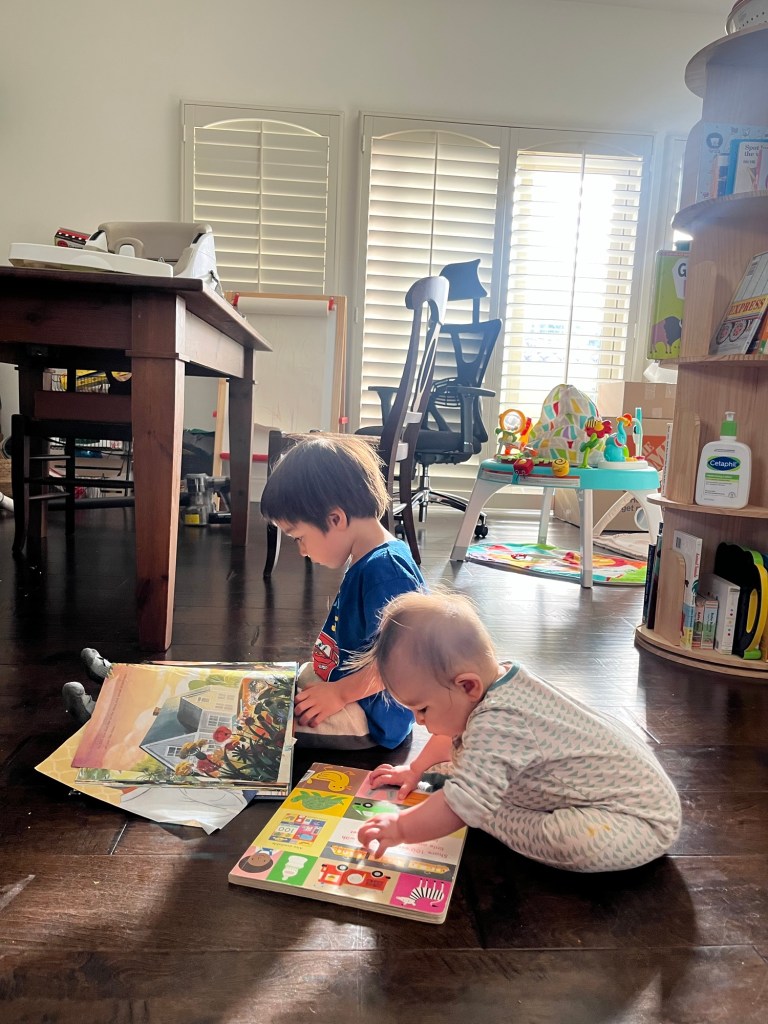
When Tov was first born, I started imagining.
I imagined how our son will grow up, what his personality will be like, what interests and passions will drive him, who he’ll hang out with. Would he be into sports? Music? Art?
That’s what makes the Korean tradition of doljabi so fun, but also laced with anticipation: What destiny will my 1-year-old pick? As parents of young, not-yet-formed human beings, we have the power to present to our children certain life opportunities, but absolutely no control over which path they will pick, and that’s what makes doljabi a fun, light-hearted way to play-pretend. We lay out only the desirable options for our children’s doljabi, but ultimately, our 1-year-old babies will grab whatever their heart fancies.
I remember for my niece’s doljabi, my sister-in-law refused to include a ball because she didn’t want her daughter to go into sports. I didn’t want to offer sports as an option either, but David would be apoplectic if Tov didn’t like baseball, so I reluctantly allowed him to include a baseball, comforted by the fact that neither of us has athletic talents, so most likely, neither will our children. Our doljabi was not very traditional. Because I would love for Tov to become a journalist like me, I added a reporter’s notebook into his doljabi options, and I also included a globe because I wanted him to be well-traveled and globalized in his worldview.
Tov chose the globe. I rejoiced, even as I knew all this is just a game designed to please the parents’ ambitions for their child, nothing more. Even then, I thought, “I don’t care what Tov chooses to be when he grows up, as long as he’s just like his name– a good person, full of God’s goodness. I will be content with whatever he chooses.”
That was then, when Tov was still very young and malleable. Now that Tov is 3, I realize I might be more ambitious than my professed noble goal for my son. I know it, because I have been fighting some rather strong disappointment that my son– my wonderful, adorable, good son, who is indeed so much like his name– does not seem to be much literary-inclined.
Often with firstborns, there are childhood stories that parents repeat to prove their firstborn is special (these kinds of stories seem to diminish with the younger siblings, interestingly enough). For me, apparently I was about 2 when my parents searched all over the house for me until they finally found me hidden behind a pile of books. I had been “reading” for hours, completely engrossed. There’s another story that apparently prove my unique brightness. According to my parents’ folklore, as a child I had very curious, observant eyes. I would stare at things and people with intensity, as though analyzing them in deep thought, and I remember my parents constantly admonishing me to stop staring at strangers.
Now that I think about this, I don’t think it proves anything about my specialness or intelligence; it sounds like I was a pretty creepy child indeed. But all that to say, my parents told these stories proudly to anyone who would listen, which showed a value they upheld and instilled in me: Intellect.
I too uphold this value. I value minds that think and read and create. I admire people who are well-read, who can quote literary giants, who can discuss Dostoevsky and Kierkegaard and C.S. Lewis. If I’m completely honest, I probably uphold that value higher than any other virtues such as goodness, gentleness, self-control. And that value system is becoming more blatantly obvious as I watch Tov grow from a baby to a boy, as I take him to the library and offer to read him books, but he’d rather just run and climb between the bookshelves. Or when five seconds after I pointed out the letter “A” to Tov, he’s already forgotten what it is. My literary ambitions for my child is even more abundantly clear when I meet other kids similar to his age who love reading, have a strong grasp of language, and can recite entire books front to back. I can’t stand those kids. I hate them, really.
One evening, I was trying to read a book with Tov, when as always, he kept grabbing the page from me and interrupting me, fixating on that one page with the picture he likes. “What’s that?” he asked, for the fifteenth time.
“Oh my God, Tov, can I just finish this book!” I cried, losing my patience, yanking the book away and startling the poor little boy, who just wanted to look at the orange ball again and again.
At that moment, so many thoughts were flicking through my head, all poking at perceived flaws in my son: Why can’t Tov just sit through a book? Why does he only want to read this one stupid book? Why doesn’t he like books? Are we letting him watch too many stupid firetruck shows on YouTube? Why hasn’t he learned his letters yet? I’ve been trying to teach him his ABCs for months now! Is it the screen time? My niece could memorize the entire Brown Bear book by his age; why can’t he? God, we need to stop letting him watch shows, it must be rotting his attention span!
Oh, the slash of terror: What if…God forbid, my son never likes to read? What if my son is not very intelligent? What if…Good God!– my son becomes an atrocious writer? And, to my self-dismay, what I felt then was shame. Shame, that my flesh-and-blood might not carry this value that I hold so dear. Shame, at the thought of my son struggling with math and spelling and grammar.
And then, of course, I felt instant shame at my shame. Is this what I’m really all about? I, a professed Christian, called to set apart from the world, has allowed secular standards to infiltrate my value system, and it’s going to impact my parenting and shape my children. But is it not an instinctual, parental desire to create my child to my own likeness?
I wrestled with this thought for months.
I don’t think that wanting my children to love and read books, to have deep critical thinking skills, and to cultivate a rich intellectual mind is a bad thing. I know it’s a worthy and good goal to try to instill these values into my children’s education, which will serve them well in life, and raise them as solid citizens of the world.
It’s also healthy and natural for me to want to share my passions and interests with my own children. Just like David can’t wait to take our children to their first baseball game, I can’t wait to read the Harry Potter books with my children, and also The Good Earth, Jane Eyre, East of Eden, The Brothers Karamazov, and discuss them together.
What I struggle with is how much I want it. How much it’s insidiously tied to my own ego, ambition, and identity. And how disappointed, frustrated, and mad I fear I’ll get if they fail to meet my standards.
People say Tov looks like me, which pleases me, because I think Tov is a very handsome boy— no bias at all. And maybe, if I’m brutally honest, I’d like people to also say Tov is sharp and intelligent because that too reflects well on me. Because those are values I hold high and dear. Because I want Tov to fit my ideals of a worthy person, and create him according to my image, when he has already been wonderfully and fearfully made in the image of God.
As a parent, I have the responsibility to raise my children to be the best person they can be, to stretch their weak points and cultivate their strong points. But it’s also my responsibility– and joy– to get to know and understand who they already are as a person, and delight in how God created them, just as they are. There’s a fine balance between accepting who my child is, and recognizing that they have more potential, and then pushing them lovingly and firmly towards it. It’s this fine balancing act that make my head twirl and my heart clench. Man, parenting requires so much wisdom and discernment. There’s just so many life-altering decisions and judgments that I feel, at this current moment, so ill-equipped to make. Lord, help me.
Tov is still only 3. I have yet to see all the hidden parts of Tov. He has yet to emerge from his chrysalis, yet to fully spread his wings. He might still learn to love books. Or he might not. My brother was raised the same way I was, with the same parents, and he is still not a reader, but he has many other interests and capabilities that I don’t have.
So what can I do?
I still want to do what I can to foster a rich intellectual life for my children. So I plan to take Tov and Woori to the library once a week. I can keep surrounding them with books, keep reading with them, and let them see me read.
And also: I can just relax and enjoy who they are.
That’s easy enough. Tov truly is a wonderful person. He is kind and empathetic and sweet and resilient and curious and fun. He loves his little sister, loves his umma and abba, loves his teachers and friends, loves laughing and rolling and the color pink and fire trucks and Lightning McQueen and listening to music and collecting rocks.
I adore 3-year-old Tov. He makes my heart so full. And I’m so proud to be his umma.
 Writing for Sophia