
Our Woori, My Woori

Before we had Tov, before I even realized I wanted a child, I had a name for my firstborn.

I got the idea for Tov’s name while reading A Church Called Tov by Laura Barringer and Scot McKnight. I learned what the Hebrew word “Tov” meant then, and I fell in love with it, thinking, “If I had a child, I’d name him or her Tov.” And then I rolled my eyes– yeah, right, like I’d ever become a mother.

Just like Tov, I had a name for my secondborn before she was conceived.

At the time, I was working on a reported piece for Christianity Today about the modern-day challenges of finding community, and it quickly became more a personal essay because the piece was born out of my own frustrations and desire for community. In that essay, I was frank about my shortcomings and the mistakes I made that made community more challenging, and one thing became clear to me: I’m incredibly individualistic.

I’ve always been a very independent person; even as a kid I couldn’t wait to grow up, leave my parents’ house, and forge my own path. Since young, I’ve always been drawn to the western culture and celebration of individualism. It just felt right and natural to me, to emphasize self-autonomy, self-reliance, self-identity. I looked down on the Asian concept of collectivism, dismissing it as unenlightened, suffocating, and oppressive.

Over the last few years, as I study the Bible more and understand more about the nature of God, I’ve come to realize how some characteristics and consequences of individualism are actually unbiblical and toxic. God Himself is Three in One, and through perfect unity and community He created humankind, saying, “Let us make man in our image, after our likeness.” God didn’t call us into an individual relationship with Him; we are called into the Body of Christ to worship and fellowship together in community.

When Jesus Christ came to earth in flesh, he dwelt in a collectivist society, and one of the first things he did when his ministry started was to build a community. He then called us to build the Church– again, community. When he taught us to pray, he didn’t teach us to call out “My Father,” but “Our Father.”

The early churches met and broke bread together every day, sharing their possessions and wealth. The immediate work of the Pentecost was to break down the barriers between languages and cultures, and later creating unity between Gentiles and Jews under one Body and one Spirit. So much of the Spirit’s work is about reaching out to others, reconciling people, and loving people well. The fruits of the Spirit all have to do with our relationship with others.

If God Himself is communal, existing in community and encouraging community, then I need to change the way I think about myself in relation to others, and the change the way I view and participate in community.

That’s how I came to really appreciate the Korean word “woori” (우리), and how unique and pervasive it is in the Korean culture. In direct translation, woori means “we” or “our” or “us,” but the word contains a much deeper Korean concept of self and others. It evokes a sense of community, unity, oneness. Korean culture values community over the individual, expressed through the way Koreans frequently use “our” rather than “my.” That’s “our house,” for instance, or “our husband,” or “our school.”

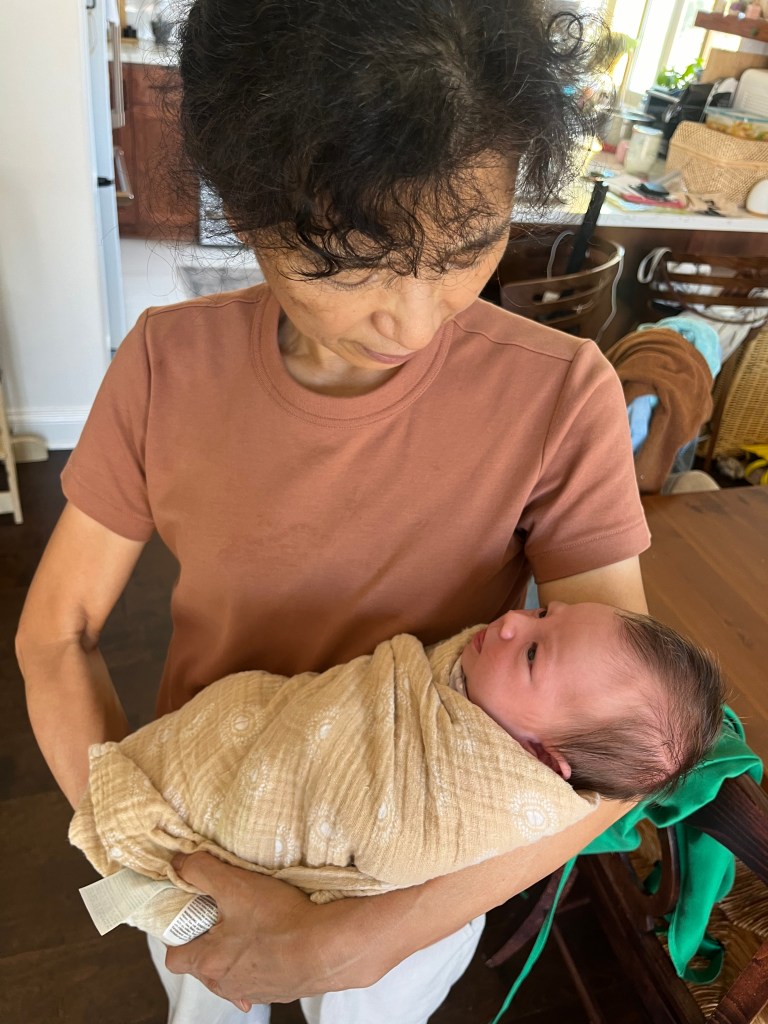
I really took notice of the Korean concept of “woori” after Tov was born, when my parents would ask, “How’s woori Tov?” “Let us see woori Tov!” “Aigo, why is woori Tov so handsome? Must have grandpa’s eyes!”

Despite becoming so westernized in my thinking, I also realized how Korean I still am, when I felt a twinge after I heard my husband refer to Tov as “my son” rather than “our son.” I felt like I got cut off from the picture. On the other hand, even when David wasn’t around, I referred to Tov as “our son.” That just felt innately right to me.

That Korean use of “woori” might feel jarring for people from a more individualistic mindset. My friend, who just gave birth to a beautiful daughter, recently told me that she had to correct her mother when she cooed at her granddaughter, “There’s my J!” “No,” my friend told her mother firmly. “She’s not your J. She’s not your daughter. She’s my daughter. Mine.” I understood where my friend is coming from. She has a history with her mother, and she’s setting boundaries early. It’s what modern-day therapists and psychologists advise, too: Set boundaries with people for self-care and happy relationships. Only you get to decide what is acceptable and not, what’s your limit. Communicate that clearly to others, especially family, the source of your deepest triggers.

Meanwhile, the word “boundary” as used in this context doesn’t even exist in the Korean language. They literally have to use the English word “boundary.” Koreans might say “don’t cross the line,” but I believe that statement is a modern saying that didn’t become mainstream in Korean society until recently.

I actually think there’s something beautiful and right about my parents calling my children “woori.” It reminds me my children are not my own, that they’re part of a rich and long heritage, that they belong to not just a biological nuclear family but a more timeless, expansive family. I love my children dearly, but my and my husband’s love for them is not the only love that will shape, edify, and enrich them.

And that’s why, about a year ago, as I revised my thoughts on individualism, as I prayed for community, as I took notice of the obstacles I put up between me and a vibrant community, I thought, “If I have a second child, I think I’ll name him or her Woori.”

Several months later, I found out I was pregnant. And on August 19, 2024, I held our daughter in my arms and wrote on her birth certificate, “Woori Grace Lee-Herrmann.”

For all my philosophizing of Woori’s name, the practice of living it out is much harder and messier. I may recognize the good in my Korean heritage’s communal culture to the point of naming my daughter Woori, but there are still aspects of it that make me instinctively recoil and hesitate. Just like there are aspects of the individualistic society that are unbiblical and unhealthy, there are parts about the collectivist society that’s also unhealthy and twisted, and I still struggle to judge what is right and biblical, and what is not.

I am, by nature, still a very individualistic person. I live in an individualistic society steeped in individualistic culture. My Instagram feed is full of expert parenting advice on setting boundaries with your parents and in-laws, on how to raise kids with good self-esteem, a strong sense of self-identity, and a bold voice to express one’s rights and needs– all good things, great things. But some of those things are foreign to my very Korean parents, and we butt heads over our two very different cultural contexts.

If you have an Asian parent, you’ve probably gotten your fair load of unsolicited advice. My parents frequently tell me how to parent our children, which I oftentimes receive as passive-aggressive criticism.

“You have to make sure you wash his hands properly,” my mother would say after Tov developed strep throat, as though we let Tov roll around and sleep in dirt. When we FaceTimed during dinner, she would let out little shrieks as Tov dug into his pasta with his hands, sauce dribbling down his forearms. “Wipe his arms! Wash his hands!”

When she saw a photo of our nanny showing Tov a picture on her iPhone, she immediately texted to remind us not to give any screen time to our child.

When she saw how easily distracted Tov is, she hinted at the possibility of ADHD and exhorted me to train him to focus on one task at a time, even though he was still barely a toddler.

She compared Tov’s speech development with my niece’s, sent videos instructing me how to teach a delayed child to speak, and suggested I send him to a speech therapist.

She reminded me over and over again that a baby needs to sleep in complete silence and darkness. She complained about the loud washing machine downstairs, the loud noises outside, the loud work meetings in David’s office, and other auditory disruptions that will certainly stunt my children’s brain development, disregulate their emotional stability and perhaps that’s why Tov’s so delayed in speech and so unfocused?

Each time this happened, grenades popped off inside me. “Aish, Omma, just stop nagging!” I would snap at her, and my father would jump to her defense. “No parent nags less than we do!” he snapped back. “You don’t know how good you have it.” And then he preached about the Bible commanding us to honor our parents. “Let us live according to the Bible,” he said. “Blessed are those who let their parents nag.”

“Pretty sure that’s not in the Bible.”

“Oh, woe is our generation,” my father lamented. “We are the most pitiful generation ever. When we were young, we could not say a word back to our elders. We had to respect and tiptoe around them. Then we have children, and times have changed. Our children now disrespect us, and we have to tiptoe around our children. We served those above us and now we serve those below us, and nobody serves us!”

“So you want me to tiptoe around you, kowtowing and saying ‘yes, yes’ to everything you say?” I retorted back.

My father shook his head, as though shaking his head at the entire spoiled, entitled, and disrespectful generation to which I belong. “Truly, the end times are coming. Culture is changing too fast. So let’s just do as the Bible says. Honor your parents.”

“Honoring your parents doesn’t mean we just have to keep quiet when you’re vexing us,” I said, getting more and more heated. “The Bible also says, do not vex your children.”

Here’s the thing: I really, really like the concept behind “woori.” I really appreciate the values of community, unity, and sacrificing self for the common good. It’s so ideologically charming and pleasing, like the idea of sipping tea in an old English cottage with a thatched roof– until you realize those quaint, pretty roofs can be annoying to maintain, vulnerable to fungal attacks, fire, and bug infestation.

I like my parents calling my children “woori” until the actual practices of it grate against all my individualistic impulses and preferences. I don’t like people telling me what to do, even if it comes in the form of harmless advice and suggestions that I can always choose not to follow. I love it community when my parents help watch Tov so David and I can go on a date, or when they say nice things about them, but I get triggered when my mother worries over Tov or Woori, or mutters the mildest hint of criticism, and I get even more triggered when my father starts preaching at me with Bible verses. I like the “woori” concept only when it benefits me and requires little effort or sacrifice from me: You can love my kids, but from a distance, saying only positive things, and God forbid you care enough to suggest what you think might be best for them. That’s the opposite of what “woori” is.

I don’t intend to obey everything my parents say. I’m an adult, and they raised me to be independent and mature, capable of making my own decisions. But at the very least, I can listen to their unsolicited advice and their preaching without getting snappish, even if they annoy me, and be genuinely thankful that someone else cares so much about my children to worry and nag about the details of their upbringing, things that most people don’t even bother thinking about because our children are not “woori” children.

Woori’s name was a gift from me to her– a prayer, a blessing, and a benediction that she would never lack community, that she will seek and find and form a community wherever she goes, breaking and sharing bread with all kinds of family.
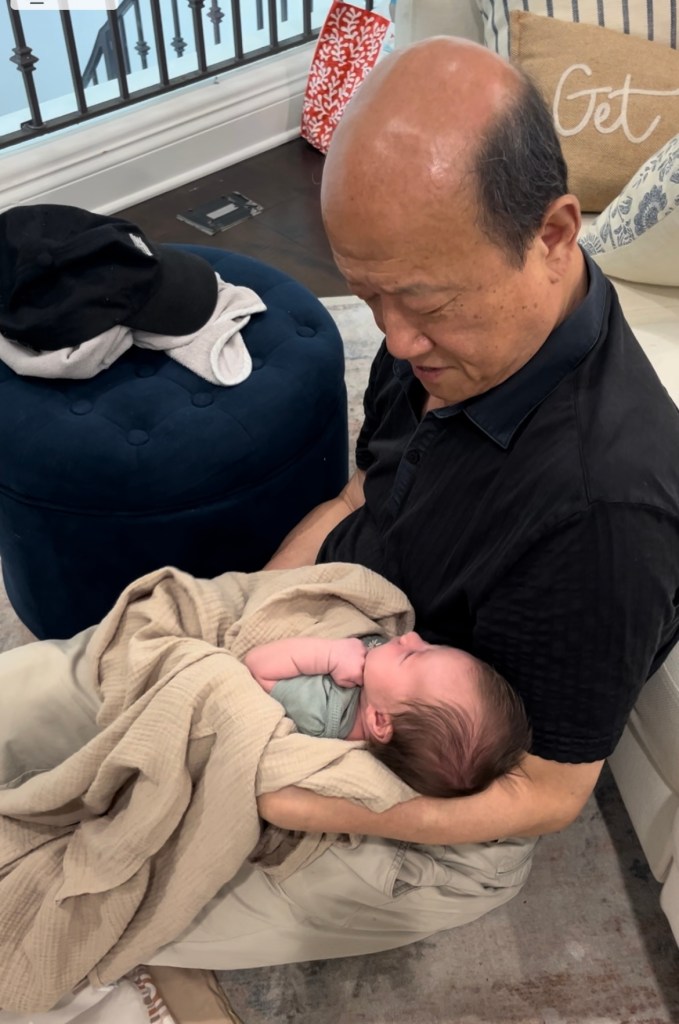
But Woori’s name is also a prayer and a blessing for me, too, as Tov’s name has been for me. Both our children’s names embody an important, essential characteristic of God. In my pursuit to know God more, to meet him the way Moses did– speaking to him face to face, “as a man speaks to his friend” (Exodus 33:11)– I see the image of God in my own children, even as they reflect my image: Woori Tov, and woori Woori.

Tov meets Woori

I remember the day of my first date with David.

It was my first official date ever, really, the first time a man had formally asked me if he could take me out for a date, instead of that annoyingly ambiguous “Want to grab a bite to eat?” that could mean so many things.

We were to meet at 6 pm, but I started getting ready at 5 pm. There really was no need– it took 10 minutes to do my very minimal makeup and another 3 to change from sweats to jeans– but it was the anticipation of getting ready for something exciting and slightly nerve-wrecking. I felt like a high school girl getting ready for the dance.

I felt similarly the morning after I gave birth to Woori. She was dozing deeply next to me in her hospital bassinet, and the morning sun was starting to pour golden pools through the window blinds. It had been less than 12 hours since she was born, and I hadn’t had more than 20 minutes of uninterrupted sleep. My head was light, and my heart was fluttering.

David called to tell me he’d be visiting with Tov at 9 am. By then, I hadn’t even yet announced to any of my friends that I had given birth. Only our family knew (and unfortunately, all of David’s business clients), but Tov did not know.

We had been prepping him months before Woori’s birth, of course. I told Tov repeatedly that there’s a baby in my belly. “Where’s the baby?” I’d prompt him, and he’d smile and point at his own belly. He did not get it.

A friend bought Tov a book called “You’re a Big Brother.” I pointed at the pictures in the book. “Look, there’s omma. There’s abba. There’s Tov. And there’s…baby!” He loved that book. We read it over and over again, and I kept pointing to the characters in the book: “Omma…abba…Tov…baby!” And then later I’d ask him, “Where’s Tov?” hoping he’d point at the boy, but he’d always point at the baby in the crib. He thinks he’s still the baby in the family.

As the due date approached, people asked me how Tov feels about becoming a big brother, and I told them he has no idea. “He’s in for the shock of his life,” I joked, but I guess it’s not a joke. He is in for the shock of his young life. Never ever has he not been the center of attention since he was born. He was the baby of the home, the emperor and prince. Guests came and cooed at him, not anyone else. And now, someone was about to take his place.

I wondered how Tov will react to meeting his little sister. I was nervous, but more curious and excited, just like how I felt that evening waiting for David to show up at my apartment gate. Will he show interest in her? Will he completely ignore her? Will he break down into jealousy? Will he be thoroughly confused by the appearance of a stranger who never left?

The minutes ticked down. I ate the hospital’s very bland breakfast and saved the blueberry muffin bottom for Tov (the hospital menu claimed it was homemade blueberry muffin, but it was a package from Otis Spunkmeyer). I watched Woori sleep. I tried not to get annoyed as nurses barged in every 5 minutes.

And then around 9 am, I heard him. He’s a very loud boy. I heard his running footsteps from down the hall. Several minutes later, the door opened, and Tov stomped in with David behind him.

Oh, I missed this boy. It’s only been 17 hours since I last saw him, but a whole world had changed since then. My balloon stomach had deflated. I don’t have to drink decaf coffee anymore. Another Lee-Herrmann was in the birth records. And our family dynamics will never be the same.

“Hi, Tov!” I greeted, and he bounded over to me like a kangaroo with a huge grin. I gave him a big hug and kissed him. I purposely delayed introducing him to the baby; I wanted time for him to adjust to seeing me in a strange new room, to greet him properly and make him feel like he’s the star attention.

“Look what we have for you!” I said, and whipped out a wrapped gift that the women in my discipleship group had bought for Tov. They had thoughtfully written “Especially for Tov” on the wrapper.

“Woooow!” Tov exclaimed, and immediately demanded, “Open, open!”

We opened the gift. It was a digital book about animals. While we tinkered with it, David went over to Woori and bent down to look at her, and that’s when Tov noticed the baby.

“Tov! You want to come meet her? Yeah, that’s your little sister!”

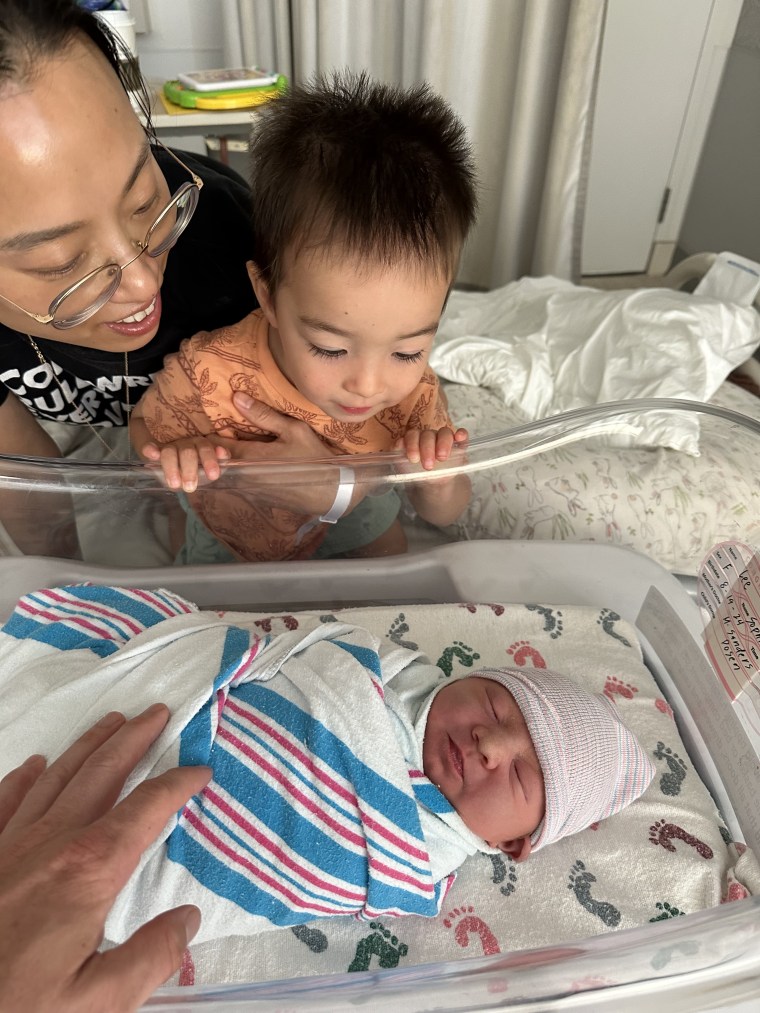
I took off his shoes and lifted him up onto the bed. He crawled towards the bassinet and peered over to gaze at the tiny pink face, whose eyes were closed in peaceful slumber, her head covered in that classic newborn pink-and-blue striped hat.

“See Tov, that’s your little sister. Her name is Woori.”

“Bebe!” Tov cried, pointing. Then he got distracted and pointed at the clock on the wall: “Cuckoo!” And then his interest got drawn to the baby again. “Bebe!”

That first moment was about as anticlimax as expected. He was constantly distracted, either by the clock or the packaged blueberry muffin or the new toy, and most especially, the bassinet, which he insisted on climbing into and lying spread-eagle as though he himself is the baby.

And it was also as sweet and precious as I had hoped for. When he did remember the baby, he was enthralled. He pointed at her eyes. He pointed at her nose. He patted her on the head. He pressed his forehead onto hers. He kissed her forehead, her nose, her cheeks, over and over again, delighting in the act. It was sweeter than my first kiss, more precious than my engagement ring, more satisfying than my first byline.

I wanted to hold this moment with both palms and cradle them into the deepest groove of my heart. I wanted time to pause, and replay slowly, over and over, that moment when my firstborn met my secondborn, and my whole family bunched together in that morning glow like a fresh-picked bouquet, pure and crisp and new.

Even as I was pregnant with Woori, feeling her kicks and seeing her little figure on the ultrasound, I couldn’t imagine loving her as much I as love Tov. People with multiple kids told me your heart grows. Bitterness and anger corrode the heart, but there’s always space in the human heart for more love; in fact, the more love it fills, the bigger and stronger and healthier it gets.

My heart is the biggest and strongest and healthiest it’s ever been.

Lord, you are so good.

God, please help Woori suck

Woori is five days old today. As I write this, she’s sleeping on her tummy on her play mat, while David builds a mini lego set with Tov.

If you visited us right now, our day would seem pretty peaceful and calm. There’s the soft ocean breeze blowing through the open windows. The gentle snores of a blissfully slumbering newborn. A contented toddler and a present father. A woman smelling sweet from breastmilk, sitting at her desk with a coffee mug and chocolate-covered pretzels, click-clacking on her keyboard. Ah, isn’t the newborn days just wonderful?

NOT.

Two hours ago, I was fighting back tears because I was so overwhelmed. Three hours ago, I was slightly freaking out that I was going blind, because it had been four hours since a white film had covered my vision, powdering everything I saw, giving me a headache.

Five hours ago, I was at a lactation support group, watching other mothers nursing and weighing their babies after to measure how much they’ve consumed. “Up 40 grams!” Jennifer, the lactation consultant pronounced, and the women cheered. Another woman’s five-week-old baby had consumed 5 whole ounces– that’s 150 grams, that overachiever.

Meanwhile, it took 30 minutes for me to finally get Woori to stop wrestling and grunting and finally suck on the breast for 20 minutes. “Oh, I can hear her swallowing a lot,” Jennifer remarked encouragingly. We weighed her after, I holding onto my breath with anticipation.

“Oh. 8 grams,” Jennifer said in a dismal voice. “Ah, she tricked me! I thought it would be more than that.”

What the freaking hell, Woori!

Six hours ago, David was yelling at Tov because he was having a roll-on-the-floor-with-snot-smearing-his-shirt kind of meltdown, simply because he did not want to wear pants. Six hours ago, I was holding Woori and watching David fly off his handle, feeling a little gratified, remembering all the times when I had lost patience with Tov, and David’s response was that I didn’t try hard enough to control my temper.

And then 12 hours ago, I was up in the wee morning, light-headed from sleeplessness, having finally finished bottle-feeding Woori 2 ounces of pumped breastmilk and formula after trying for 30 minutes to get her to breastfeed. That took more than an hour, and now I had to dry the pump parts, still wet from the last pumping session, so I can pump again before crawling back to bed.

It’s been anything but peaceful and calm.

We are on a crazy feeding plan for Woori because she refuses to breastfeed. She’s maybe successfully breastfed only three times since she was born, and even then, as the weighing scale today informed me, she barely even put 10 ml of milk inside her. So every three hours, round the clock from morning through night, I have to try to get her to practice breastfeeding, then bottle-feed her, then pump. That takes at least an hour and a half, which means about an hour later, I have to repeat the process all over again. There is no time to rest. The moment I fall asleep, my iphone blares an alarm, reminding me it’s time to feed again, and I wake up bleary-eyed and brain-fogged, a zombie with swollen, aching boobs.

Speaking of boobs. I had never once experienced the kind of engorgement I have this time round. Tov was born premature so he had a hard time latching properly, and he fed very slowly, but with the help of a nipple shield, at least he would still breastfeed.

Not Woori. This girl knows how to latch. There’s no problem with her tongue. She’s a lustily healthy baby. Two lactation consultants and a pediatrician examined her and pronounced her physically capable of breastfeeding. No, little stubborn girl just don’t wanna. When I finally jam a nipple into her mouth, she grunts and twists her head and even worse, sometimes bites down and then twists, which releases a string of obscenities from my mouth. And then she dares complain when milk sprays her in the face.

Unsurprisingly, I’ve been suffering from clogged ducts, hard swollen lumps measuring 2 inches all around the breasts that finally loosened up only after two days of continuous, painful massaging while pumping.

And that brings us to my cloudy vision. This morning, I put on my contact lens, and as we were driving to the lactation support group, my eyes started fogging up. I thought something had gotten into my contact lenses. Everything I saw had white halos. When we got home, the first thing I did was take off my contact lenses, but the cloud did not lift.

“I can’t see,” I told David, as he was wrestling with Tov to get him into the tub to wash off what he’d randomly vomited in the car.

I poured eye drops into my eyes, rubbed, blinked. Still cloudy.

“I still can’t see!” I said, starting to get a little panicky. Meanwhile, the clock was telling me it was time to feed Woori again in 35 minutes, and I still haven’t had lunch, or pumped from the last session. And now I was going blind???

“It’s probably from lack of sleep,” David said, seeming irritatingly unconcerned.

“I’ve never had this happen before,” I said. The more I blinked, the more I closed my eyes, the foggier my vision became. I called the optometrist to get my eyes checked, and they made a 3 pm appointment for me.

I pumped. I forgot to eat lunch. I lied down in bed and closed my eyes for 20 minutes in a restless sleep of anxious dreams. Then my alarm clock went off: Time to feed Woori.

As I tried to unsuccessfully get Woori to breastfeed again, fighting through pain and stickiness and frustration, my vision started clearing. Huh. I guess David was right. My body was telling me I’ve hit an exhaustion point I’ve never reached before.

And even as I write this, Tov has skipped and galloped over to me several times, once again butt-naked, breaking my writing flow. He’s climbed onto my lap, rubbed his naked butt on my pants, and stolen three of my chocolate-covered pretzels. He’s claimed he needs to poo-poo, a clever manipulation to steal my attention for 20 minutes while we pointlessly sit at the potty, his butt and penis completely dry, but he thoroughly entertained while I read and sing to him.

But that’s newborn days for you. There’s chaos, fatigue, frustration, mind-numbing repetitive rituals, boredom. And then there’s precious rare moments of peace, beauty, wonder, thankfulness, sweetness, like the third time Tov ran over to me while I was writing, and then stopped to kneel down beside his little sister and nuzzle his face into hers. Or when Tov is napping, and David comes to lie down next to Woori who’s also sleeping, and gaze at her little wrinkly, piglety face. Or when I’m pumping while holding Woori to my chest, inhaling her natural fragrance, feeling her warmth match mine. Such moments are so fleeting, so glorious, a ray of heaven shining into the pit of hell, blasting all darkness and doom away.

So ask me how I’m feeling, five days in. And I’ll say: tired and thankful, frustrated and content, bored and delighted, a seemingly contradiction of emotions that actually meet and rise into this extraordinary, one-of-a-kind symphony of postpartum. It’s life on earth.

This is a time when no prayer seem trivial or silly. I’m not praying for world peace, or justice, or souls saved. My prayers are brief and simple but earnest, as real and raw as cracked nipples and toddler tantrums and a newborn baby who refuses to suck on the breast.

It’s the prayer David prays every evening during dinner these days: “Oh God, please help Woori suck.”