
-
Our Woori, My Woori
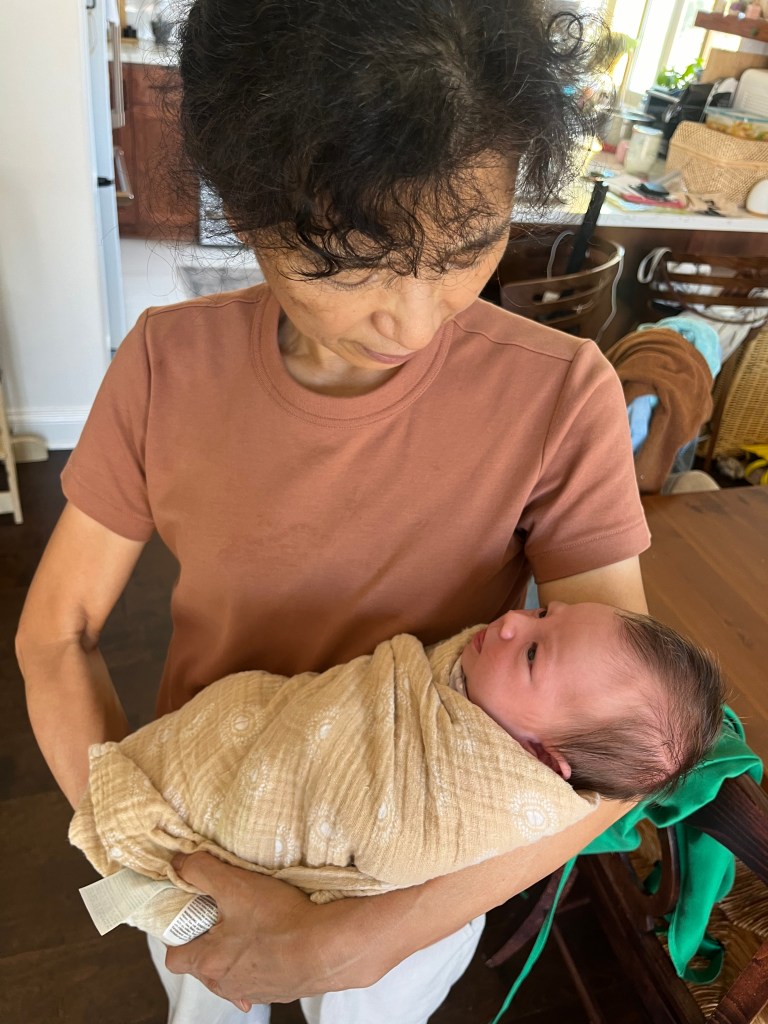
Before we had Tov, before I even realized I wanted a child, I had a name for my firstborn.
I got the idea for Tov’s name while reading A Church Called Tov by Laura Barringer and Scot McKnight. I learned what the Hebrew word “Tov” meant then, and I fell in love with it, thinking, “If I had a child, I’d name him or her Tov.” And then I rolled my eyes– yeah, right, like I’d ever become a mother.
Just like Tov, I had a name for my secondborn before she was conceived.
At the time, I was working on a reported piece for Christianity Today about the modern-day challenges of finding community, and it quickly became more a personal essay because the piece was born out of my own frustrations and desire for community. In that essay, I was frank about my shortcomings and the mistakes I made that made community more challenging, and one thing became clear to me: I’m incredibly individualistic.
I’ve always been a very independent person; even as a kid I couldn’t wait to grow up, leave my parents’ house, and forge my own path. Since young, I’ve always been drawn to the western culture and celebration of individualism. It just felt right and natural to me, to emphasize self-autonomy, self-reliance, self-identity. I looked down on the Asian concept of collectivism, dismissing it as unenlightened, suffocating, and oppressive.
Over the last few years, as I study the Bible more and understand more about the nature of God, I’ve come to realize how some characteristics and consequences of individualism are actually unbiblical and toxic. God Himself is Three in One, and through perfect unity and community He created humankind, saying, “Let us make man in our image, after our likeness.” God didn’t call us into an individual relationship with Him; we are called into the Body of Christ to worship and fellowship together in community.
When Jesus Christ came to earth in flesh, he dwelt in a collectivist society, and one of the first things he did when his ministry started was to build a community. He then called us to build the Church– again, community. When he taught us to pray, he didn’t teach us to call out “My Father,” but “Our Father.”
The early churches met and broke bread together every day, sharing their possessions and wealth. The immediate work of the Pentecost was to break down the barriers between languages and cultures, and later creating unity between Gentiles and Jews under one Body and one Spirit. So much of the Spirit’s work is about reaching out to others, reconciling people, and loving people well. The fruits of the Spirit all have to do with our relationship with others.
If God Himself is communal, existing in community and encouraging community, then I need to change the way I think about myself in relation to others, and the change the way I view and participate in community.
That’s how I came to really appreciate the Korean word “woori” (우리), and how unique and pervasive it is in the Korean culture. In direct translation, woori means “we” or “our” or “us,” but the word contains a much deeper Korean concept of self and others. It evokes a sense of community, unity, oneness. Korean culture values community over the individual, expressed through the way Koreans frequently use “our” rather than “my.” That’s “our house,” for instance, or “our husband,” or “our school.”
I really took notice of the Korean concept of “woori” after Tov was born, when my parents would ask, “How’s woori Tov?” “Let us see woori Tov!” “Aigo, why is woori Tov so handsome? Must have grandpa’s eyes!”
Despite becoming so westernized in my thinking, I also realized how Korean I still am, when I felt a twinge after I heard my husband refer to Tov as “my son” rather than “our son.” I felt like I got cut off from the picture. On the other hand, even when David wasn’t around, I referred to Tov as “our son.” That just felt innately right to me.
That Korean use of “woori” might feel jarring for people from a more individualistic mindset. My friend, who just gave birth to a beautiful daughter, recently told me that she had to correct her mother when she cooed at her granddaughter, “There’s my J!” “No,” my friend told her mother firmly. “She’s not your J. She’s not your daughter. She’s my daughter. Mine.” I understood where my friend is coming from. She has a history with her mother, and she’s setting boundaries early. It’s what modern-day therapists and psychologists advise, too: Set boundaries with people for self-care and happy relationships. Only you get to decide what is acceptable and not, what’s your limit. Communicate that clearly to others, especially family, the source of your deepest triggers.
Meanwhile, the word “boundary” as used in this context doesn’t even exist in the Korean language. They literally have to use the English word “boundary.” Koreans might say “don’t cross the line,” but I believe that statement is a modern saying that didn’t become mainstream in Korean society until recently.
I actually think there’s something beautiful and right about my parents calling my children “woori.” It reminds me my children are not my own, that they’re part of a rich and long heritage, that they belong to not just a biological nuclear family but a more timeless, expansive family. I love my children dearly, but my and my husband’s love for them is not the only love that will shape, edify, and enrich them.
And that’s why, about a year ago, as I revised my thoughts on individualism, as I prayed for community, as I took notice of the obstacles I put up between me and a vibrant community, I thought, “If I have a second child, I think I’ll name him or her Woori.”
Several months later, I found out I was pregnant. And on August 19, 2024, I held our daughter in my arms and wrote on her birth certificate, “Woori Grace Lee-Herrmann.”
For all my philosophizing of Woori’s name, the practice of living it out is much harder and messier. I may recognize the good in my Korean heritage’s communal culture to the point of naming my daughter Woori, but there are still aspects of it that make me instinctively recoil and hesitate. Just like there are aspects of the individualistic society that are unbiblical and unhealthy, there are parts about the collectivist society that’s also unhealthy and twisted, and I still struggle to judge what is right and biblical, and what is not.
I am, by nature, still a very individualistic person. I live in an individualistic society steeped in individualistic culture. My Instagram feed is full of expert parenting advice on setting boundaries with your parents and in-laws, on how to raise kids with good self-esteem, a strong sense of self-identity, and a bold voice to express one’s rights and needs– all good things, great things. But some of those things are foreign to my very Korean parents, and we butt heads over our two very different cultural contexts.
If you have an Asian parent, you’ve probably gotten your fair load of unsolicited advice. My parents frequently tell me how to parent our children, which I oftentimes receive as passive-aggressive criticism.
“You have to make sure you wash his hands properly,” my mother would say after Tov developed strep throat, as though we let Tov roll around and sleep in dirt. When we FaceTimed during dinner, she would let out little shrieks as Tov dug into his pasta with his hands, sauce dribbling down his forearms. “Wipe his arms! Wash his hands!”
When she saw a photo of our nanny showing Tov a picture on her iPhone, she immediately texted to remind us not to give any screen time to our child.
When she saw how easily distracted Tov is, she hinted at the possibility of ADHD and exhorted me to train him to focus on one task at a time, even though he was still barely a toddler.
She compared Tov’s speech development with my niece’s, sent videos instructing me how to teach a delayed child to speak, and suggested I send him to a speech therapist.
She reminded me over and over again that a baby needs to sleep in complete silence and darkness. She complained about the loud washing machine downstairs, the loud noises outside, the loud work meetings in David’s office, and other auditory disruptions that will certainly stunt my children’s brain development, disregulate their emotional stability and perhaps that’s why Tov’s so delayed in speech and so unfocused?
Each time this happened, grenades popped off inside me. “Aish, Omma, just stop nagging!” I would snap at her, and my father would jump to her defense. “No parent nags less than we do!” he snapped back. “You don’t know how good you have it.” And then he preached about the Bible commanding us to honor our parents. “Let us live according to the Bible,” he said. “Blessed are those who let their parents nag.”
“Pretty sure that’s not in the Bible.”
“Oh, woe is our generation,” my father lamented. “We are the most pitiful generation ever. When we were young, we could not say a word back to our elders. We had to respect and tiptoe around them. Then we have children, and times have changed. Our children now disrespect us, and we have to tiptoe around our children. We served those above us and now we serve those below us, and nobody serves us!”
“So you want me to tiptoe around you, kowtowing and saying ‘yes, yes’ to everything you say?” I retorted back.
My father shook his head, as though shaking his head at the entire spoiled, entitled, and disrespectful generation to which I belong. “Truly, the end times are coming. Culture is changing too fast. So let’s just do as the Bible says. Honor your parents.”
“Honoring your parents doesn’t mean we just have to keep quiet when you’re vexing us,” I said, getting more and more heated. “The Bible also says, do not vex your children.”
Here’s the thing: I really, really like the concept behind “woori.” I really appreciate the values of community, unity, and sacrificing self for the common good. It’s so ideologically charming and pleasing, like the idea of sipping tea in an old English cottage with a thatched roof– until you realize those quaint, pretty roofs can be annoying to maintain, vulnerable to fungal attacks, fire, and bug infestation.
I like my parents calling my children “woori” until the actual practices of it grate against all my individualistic impulses and preferences. I don’t like people telling me what to do, even if it comes in the form of harmless advice and suggestions that I can always choose not to follow. I love it community when my parents help watch Tov so David and I can go on a date, or when they say nice things about them, but I get triggered when my mother worries over Tov or Woori, or mutters the mildest hint of criticism, and I get even more triggered when my father starts preaching at me with Bible verses. I like the “woori” concept only when it benefits me and requires little effort or sacrifice from me: You can love my kids, but from a distance, saying only positive things, and God forbid you care enough to suggest what you think might be best for them. That’s the opposite of what “woori” is.
I don’t intend to obey everything my parents say. I’m an adult, and they raised me to be independent and mature, capable of making my own decisions. But at the very least, I can listen to their unsolicited advice and their preaching without getting snappish, even if they annoy me, and be genuinely thankful that someone else cares so much about my children to worry and nag about the details of their upbringing, things that most people don’t even bother thinking about because our children are not “woori” children.
Woori’s name was a gift from me to her– a prayer, a blessing, and a benediction that she would never lack community, that she will seek and find and form a community wherever she goes, breaking and sharing bread with all kinds of family.
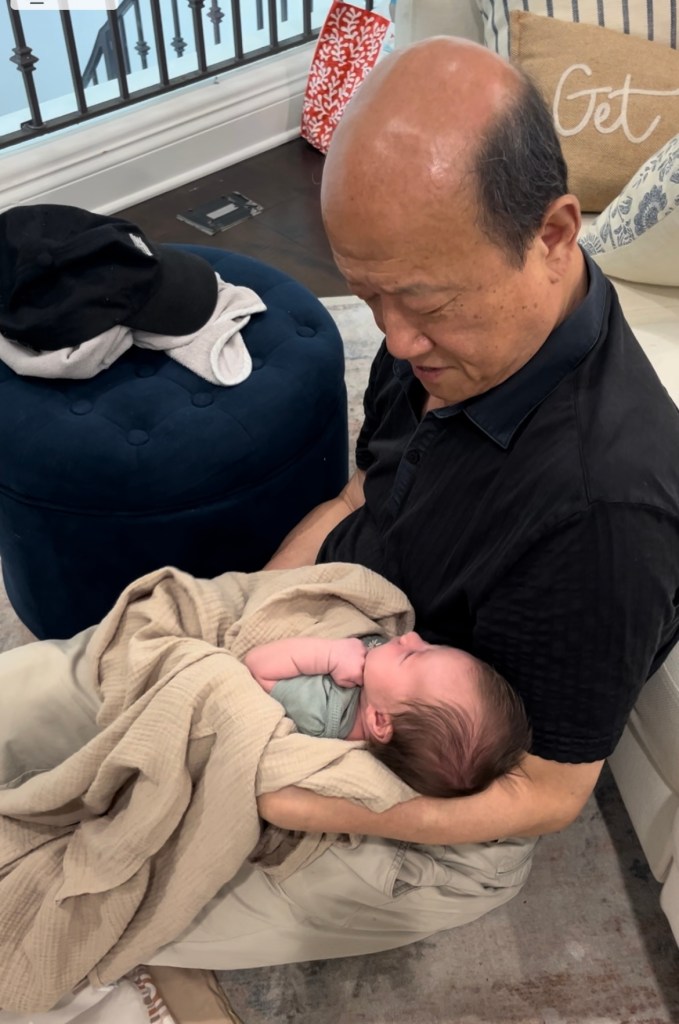
But Woori’s name is also a prayer and a blessing for me, too, as Tov’s name has been for me. Both our children’s names embody an important, essential characteristic of God. In my pursuit to know God more, to meet him the way Moses did– speaking to him face to face, “as a man speaks to his friend” (Exodus 33:11)– I see the image of God in my own children, even as they reflect my image: Woori Tov, and woori Woori.
-
Tov meets Woori
I remember the day of my first date with David.
It was my first official date ever, really, the first time a man had formally asked me if he could take me out for a date, instead of that annoyingly ambiguous “Want to grab a bite to eat?” that could mean so many things.
We were to meet at 6 pm, but I started getting ready at 5 pm. There really was no need– it took 10 minutes to do my very minimal makeup and another 3 to change from sweats to jeans– but it was the anticipation of getting ready for something exciting and slightly nerve-wrecking. I felt like a high school girl getting ready for the dance.
I felt similarly the morning after I gave birth to Woori. She was dozing deeply next to me in her hospital bassinet, and the morning sun was starting to pour golden pools through the window blinds. It had been less than 12 hours since she was born, and I hadn’t had more than 20 minutes of uninterrupted sleep. My head was light, and my heart was fluttering.
David called to tell me he’d be visiting with Tov at 9 am. By then, I hadn’t even yet announced to any of my friends that I had given birth. Only our family knew (and unfortunately, all of David’s business clients), but Tov did not know.
We had been prepping him months before Woori’s birth, of course. I told Tov repeatedly that there’s a baby in my belly. “Where’s the baby?” I’d prompt him, and he’d smile and point at his own belly. He did not get it.
A friend bought Tov a book called “You’re a Big Brother.” I pointed at the pictures in the book. “Look, there’s omma. There’s abba. There’s Tov. And there’s…baby!” He loved that book. We read it over and over again, and I kept pointing to the characters in the book: “Omma…abba…Tov…baby!” And then later I’d ask him, “Where’s Tov?” hoping he’d point at the boy, but he’d always point at the baby in the crib. He thinks he’s still the baby in the family.
As the due date approached, people asked me how Tov feels about becoming a big brother, and I told them he has no idea. “He’s in for the shock of his life,” I joked, but I guess it’s not a joke. He is in for the shock of his young life. Never ever has he not been the center of attention since he was born. He was the baby of the home, the emperor and prince. Guests came and cooed at him, not anyone else. And now, someone was about to take his place.
I wondered how Tov will react to meeting his little sister. I was nervous, but more curious and excited, just like how I felt that evening waiting for David to show up at my apartment gate. Will he show interest in her? Will he completely ignore her? Will he break down into jealousy? Will he be thoroughly confused by the appearance of a stranger who never left?
The minutes ticked down. I ate the hospital’s very bland breakfast and saved the blueberry muffin bottom for Tov (the hospital menu claimed it was homemade blueberry muffin, but it was a package from Otis Spunkmeyer). I watched Woori sleep. I tried not to get annoyed as nurses barged in every 5 minutes.
And then around 9 am, I heard him. He’s a very loud boy. I heard his running footsteps from down the hall. Several minutes later, the door opened, and Tov stomped in with David behind him.
Oh, I missed this boy. It’s only been 17 hours since I last saw him, but a whole world had changed since then. My balloon stomach had deflated. I don’t have to drink decaf coffee anymore. Another Lee-Herrmann was in the birth records. And our family dynamics will never be the same.
“Hi, Tov!” I greeted, and he bounded over to me like a kangaroo with a huge grin. I gave him a big hug and kissed him. I purposely delayed introducing him to the baby; I wanted time for him to adjust to seeing me in a strange new room, to greet him properly and make him feel like he’s the star attention.
“Look what we have for you!” I said, and whipped out a wrapped gift that the women in my discipleship group had bought for Tov. They had thoughtfully written “Especially for Tov” on the wrapper.
“Woooow!” Tov exclaimed, and immediately demanded, “Open, open!”
We opened the gift. It was a digital book about animals. While we tinkered with it, David went over to Woori and bent down to look at her, and that’s when Tov noticed the baby.
“Tov! You want to come meet her? Yeah, that’s your little sister!”
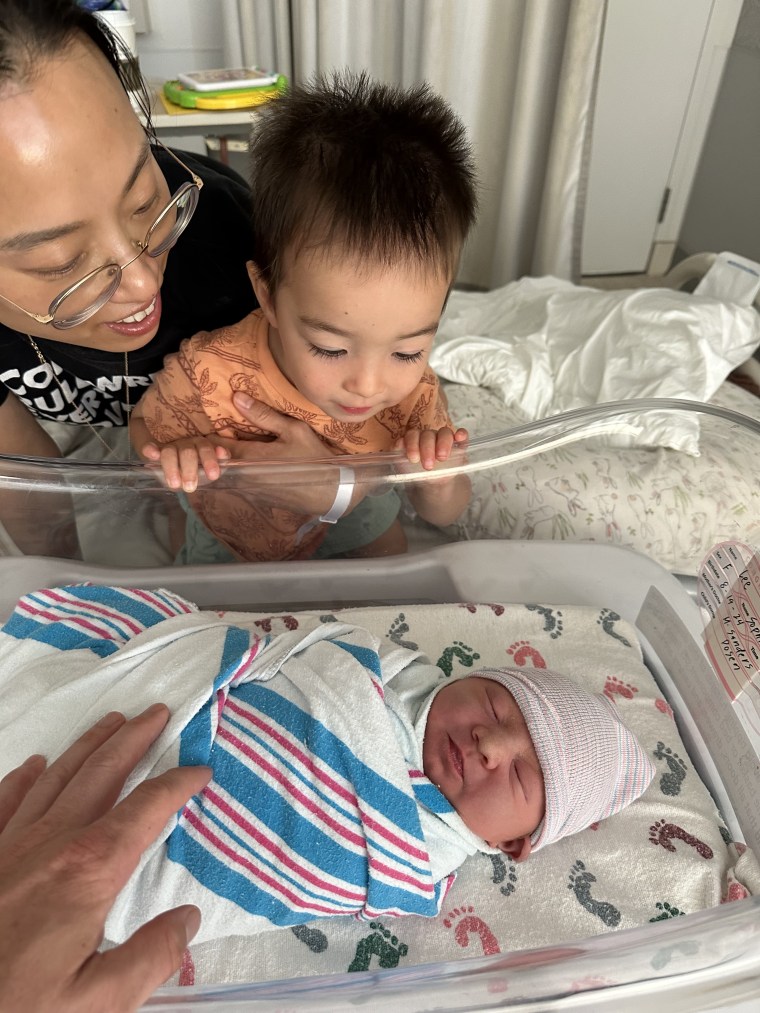
I took off his shoes and lifted him up onto the bed. He crawled towards the bassinet and peered over to gaze at the tiny pink face, whose eyes were closed in peaceful slumber, her head covered in that classic newborn pink-and-blue striped hat.
“See Tov, that’s your little sister. Her name is Woori.”
“Bebe!” Tov cried, pointing. Then he got distracted and pointed at the clock on the wall: “Cuckoo!” And then his interest got drawn to the baby again. “Bebe!”
That first moment was about as anticlimax as expected. He was constantly distracted, either by the clock or the packaged blueberry muffin or the new toy, and most especially, the bassinet, which he insisted on climbing into and lying spread-eagle as though he himself is the baby.
And it was also as sweet and precious as I had hoped for. When he did remember the baby, he was enthralled. He pointed at her eyes. He pointed at her nose. He patted her on the head. He pressed his forehead onto hers. He kissed her forehead, her nose, her cheeks, over and over again, delighting in the act. It was sweeter than my first kiss, more precious than my engagement ring, more satisfying than my first byline.
I wanted to hold this moment with both palms and cradle them into the deepest groove of my heart. I wanted time to pause, and replay slowly, over and over, that moment when my firstborn met my secondborn, and my whole family bunched together in that morning glow like a fresh-picked bouquet, pure and crisp and new.
Even as I was pregnant with Woori, feeling her kicks and seeing her little figure on the ultrasound, I couldn’t imagine loving her as much I as love Tov. People with multiple kids told me your heart grows. Bitterness and anger corrode the heart, but there’s always space in the human heart for more love; in fact, the more love it fills, the bigger and stronger and healthier it gets.
My heart is the biggest and strongest and healthiest it’s ever been.
Lord, you are so good.
-
God, please help Woori suck

Woori is five days old today. As I write this, she’s sleeping on her tummy on her play mat, while David builds a mini lego set with Tov.
If you visited us right now, our day would seem pretty peaceful and calm. There’s the soft ocean breeze blowing through the open windows. The gentle snores of a blissfully slumbering newborn. A contented toddler and a present father. A woman smelling sweet from breastmilk, sitting at her desk with a coffee mug and chocolate-covered pretzels, click-clacking on her keyboard. Ah, isn’t the newborn days just wonderful?
NOT.
Two hours ago, I was fighting back tears because I was so overwhelmed. Three hours ago, I was slightly freaking out that I was going blind, because it had been four hours since a white film had covered my vision, powdering everything I saw, giving me a headache.
Five hours ago, I was at a lactation support group, watching other mothers nursing and weighing their babies after to measure how much they’ve consumed. “Up 40 grams!” Jennifer, the lactation consultant pronounced, and the women cheered. Another woman’s five-week-old baby had consumed 5 whole ounces– that’s 150 grams, that overachiever.
Meanwhile, it took 30 minutes for me to finally get Woori to stop wrestling and grunting and finally suck on the breast for 20 minutes. “Oh, I can hear her swallowing a lot,” Jennifer remarked encouragingly. We weighed her after, I holding onto my breath with anticipation.
“Oh. 8 grams,” Jennifer said in a dismal voice. “Ah, she tricked me! I thought it would be more than that.”
What the freaking hell, Woori!
Six hours ago, David was yelling at Tov because he was having a roll-on-the-floor-with-snot-smearing-his-shirt kind of meltdown, simply because he did not want to wear pants. Six hours ago, I was holding Woori and watching David fly off his handle, feeling a little gratified, remembering all the times when I had lost patience with Tov, and David’s response was that I didn’t try hard enough to control my temper.
And then 12 hours ago, I was up in the wee morning, light-headed from sleeplessness, having finally finished bottle-feeding Woori 2 ounces of pumped breastmilk and formula after trying for 30 minutes to get her to breastfeed. That took more than an hour, and now I had to dry the pump parts, still wet from the last pumping session, so I can pump again before crawling back to bed.
It’s been anything but peaceful and calm.
We are on a crazy feeding plan for Woori because she refuses to breastfeed. She’s maybe successfully breastfed only three times since she was born, and even then, as the weighing scale today informed me, she barely even put 10 ml of milk inside her. So every three hours, round the clock from morning through night, I have to try to get her to practice breastfeeding, then bottle-feed her, then pump. That takes at least an hour and a half, which means about an hour later, I have to repeat the process all over again. There is no time to rest. The moment I fall asleep, my iphone blares an alarm, reminding me it’s time to feed again, and I wake up bleary-eyed and brain-fogged, a zombie with swollen, aching boobs.
Speaking of boobs. I had never once experienced the kind of engorgement I have this time round. Tov was born premature so he had a hard time latching properly, and he fed very slowly, but with the help of a nipple shield, at least he would still breastfeed.
Not Woori. This girl knows how to latch. There’s no problem with her tongue. She’s a lustily healthy baby. Two lactation consultants and a pediatrician examined her and pronounced her physically capable of breastfeeding. No, little stubborn girl just don’t wanna. When I finally jam a nipple into her mouth, she grunts and twists her head and even worse, sometimes bites down and then twists, which releases a string of obscenities from my mouth. And then she dares complain when milk sprays her in the face.
Unsurprisingly, I’ve been suffering from clogged ducts, hard swollen lumps measuring 2 inches all around the breasts that finally loosened up only after two days of continuous, painful massaging while pumping.
And that brings us to my cloudy vision. This morning, I put on my contact lens, and as we were driving to the lactation support group, my eyes started fogging up. I thought something had gotten into my contact lenses. Everything I saw had white halos. When we got home, the first thing I did was take off my contact lenses, but the cloud did not lift.
“I can’t see,” I told David, as he was wrestling with Tov to get him into the tub to wash off what he’d randomly vomited in the car.
I poured eye drops into my eyes, rubbed, blinked. Still cloudy.
“I still can’t see!” I said, starting to get a little panicky. Meanwhile, the clock was telling me it was time to feed Woori again in 35 minutes, and I still haven’t had lunch, or pumped from the last session. And now I was going blind???
“It’s probably from lack of sleep,” David said, seeming irritatingly unconcerned.
“I’ve never had this happen before,” I said. The more I blinked, the more I closed my eyes, the foggier my vision became. I called the optometrist to get my eyes checked, and they made a 3 pm appointment for me.
I pumped. I forgot to eat lunch. I lied down in bed and closed my eyes for 20 minutes in a restless sleep of anxious dreams. Then my alarm clock went off: Time to feed Woori.
As I tried to unsuccessfully get Woori to breastfeed again, fighting through pain and stickiness and frustration, my vision started clearing. Huh. I guess David was right. My body was telling me I’ve hit an exhaustion point I’ve never reached before.
And even as I write this, Tov has skipped and galloped over to me several times, once again butt-naked, breaking my writing flow. He’s climbed onto my lap, rubbed his naked butt on my pants, and stolen three of my chocolate-covered pretzels. He’s claimed he needs to poo-poo, a clever manipulation to steal my attention for 20 minutes while we pointlessly sit at the potty, his butt and penis completely dry, but he thoroughly entertained while I read and sing to him.
But that’s newborn days for you. There’s chaos, fatigue, frustration, mind-numbing repetitive rituals, boredom. And then there’s precious rare moments of peace, beauty, wonder, thankfulness, sweetness, like the third time Tov ran over to me while I was writing, and then stopped to kneel down beside his little sister and nuzzle his face into hers. Or when Tov is napping, and David comes to lie down next to Woori who’s also sleeping, and gaze at her little wrinkly, piglety face. Or when I’m pumping while holding Woori to my chest, inhaling her natural fragrance, feeling her warmth match mine. Such moments are so fleeting, so glorious, a ray of heaven shining into the pit of hell, blasting all darkness and doom away.
So ask me how I’m feeling, five days in. And I’ll say: tired and thankful, frustrated and content, bored and delighted, a seemingly contradiction of emotions that actually meet and rise into this extraordinary, one-of-a-kind symphony of postpartum. It’s life on earth.
This is a time when no prayer seem trivial or silly. I’m not praying for world peace, or justice, or souls saved. My prayers are brief and simple but earnest, as real and raw as cracked nipples and toddler tantrums and a newborn baby who refuses to suck on the breast.
It’s the prayer David prays every evening during dinner these days: “Oh God, please help Woori suck.”
-
Woori’s birth story
This post is for our secondborn, Tov’s little sister, Woori Grace Lee-Herrmann.

Woori Grace Lee-Herrmann was born on August 19, 2024, at 7:39 pm, on a Monday in which I had planned to make no-cook tomato capellini for dinner using the sun-burst heirloom tomatoes we picked at the farm.
I did not get to taste that pasta, but I was told Tov ate very well that night.
But this post is about the birthday of Woori, and to tell that, I need to start on Sunday, the day before.
For weeks before Sunday, I had been having some pretty nasty contractions, some up to level 4 pain. Some nights, I woke up convinced I was going into labor from painful contractions, only for them to subside by morning, and every morning I rolled out of bed surprised and annoyed that I was still freaking pregnant.
It wasn’t just because I was suffering from the discomfort of contractions, cramps, backaches, and sciatica. Tov will be starting school on Sep 3, and I was worried that he’d have to deal with this huge transition mere days after his sister is born. That’s enough big changes in his life within the month. So I had been chugging about five cups of raspberry leaf tea each day, hoping to trigger the labor process, but all that happened were a frustrating series of false alarms.
On Sunday, I had a level 5 contraction during our family afternoon walk that lasted at least 20 minutes straight, my uterus clenching as tight as an Olympic gymnast’s abdomen, refusing to loosen until I finally sat down on the edge of somebody’s flower bed and rested.
Then that night, around 11 pm while I was snacking on homemade sourdough banana bread, I felt a wetness that imprinted a damp spot in my sweatpants. The last time I had gone into labor, it had started with my water breaking as well– not a gush like in the movies, but a small, clear steady trickle that very quickly rolled into intense contractions. Could this be it? I put the banana bread down and started walking around the house, wincing from the back and leg pain. But no more trickle, no building contractions. Ugh. Of course. Another false alarm. I returned to my banana bread.
The next morning, on Monday, I woke up 38 weeks and 6 days pregnant, irritated that I’m rolling out of bed with a watermelon belly once again. “Come on, Woori,” I grumbled. “You can come out now.”
I decided to start the week assuming Woori wasn’t coming any time soon. I made a pediatrician appointment for Tov to get his lymph node checked. I filled the inflatable pool and let Tov splash about the backyard. I refreshed my sourdough starter and baked sourdough Irish soda bread. I texted my neighbor and a friend to plan playdates for Tov. I made plans to do an inventory of the deep freezer and pantry so I can stop buying things I already have. I put Tov down for a nap, crushed tomatoes to make the pasta sauce for dinner, and headed down to the gym to work out.
During my workout, I felt wetness again. It certainly wasn’t urine. And it was too watery to be discharge. But from my last experience and everything I’d read on ruptured membranes, shouldn’t the leak be constant, rather than sporadic? It’s probably a false alarm, wistful thinking on my end, I thought. But it wouldn’t help to message my ob/gyn, just in case, so I texted a message to the ob/gyn office, marking it “non-urgent.”
An hour later, they responded. They told me to go to the hospital to get myself evaluated. “That would be the safest thing to do,” they wrote.
Eh. Seems like a lot of fuss and work for something that’s probably nothing. Besides, it was soon time to take Tov to the pediatrician.
I texted David what happened. “I think I’ll go probably after dinner,” I wrote.
“Why don’t you go now?”
“I have to take Tov to the pediatrician in 5 mins.”
David offered to take Tov instead, which gave me time to take a shower, do my skincare routine, and get dressed to go to the hospital. I briefly considered finishing packing my hospital bag, just in case, but decided against it. Nah. Too much work.
At 3:30 pm I drove leisurely to the hospital, listening to a podcast on book recommendations and munching on chocolate-covered pretzels, ignoring the cramps and contractions that were by then too familiar. I felt silly. I wasn’t leaking anymore. It was nothing. I was wasting time.
Thankfully, check in was swift. A nurse greeted me within five minutes of waiting, and ushered me into a room. She hooked elastic bands around my belly to monitor the baby’s heart rate and my contractions. When she saw I was having a contraction, she pressed her hands on my stomach and looked down at me in surprise. “You said you’ve been having contractions for weeks? Did they always feel this tight?”
“Yep,” I said.
“These are really strong contractions,” she said.
While we waited for the test results on whether I was indeed leaking amniotic fluids, she told me what’s likely to happen. If I test positive for amniotic fluid, I’d be admitted immediately and induced, because that means I’m at risk of infection. If I test negative, I’d be admitted or released depending on the dilation of my cervix, and whether I choose to be induced anyway.
I tested positive. And surprise! I was already 5 cm dilated.
The nurse looked at me with arched eyebrows. “Oh, you’re not going home.”
And for reasons I cannot understand, after all that impatience to give birth, my immediate reaction was, “Oh crap. But I need to go home and make that pasta.”
The nurse saw the expression on my face and she softened. “How are you feeling about this? You feeling OK?”
I couldn’t tell her about the pasta. She wouldn’t understand that I’d been really eager to put those $16 heirloom tomatoes from the farm to good use and make sure Tov eats it. Instead, I told her I needed to call my husband.
I called David and told him what happened. “Good thing I didn’t wait till after dinner,” I said.
“I had a feeling since yesterday,” he said. “That’s why I offered to take Tov to the pediatrician.”
I gave him detailed instructions on how to finish making the pasta. The plan was to call Mimi, Tov’s former nanny, to come help watch Tov until my cousin got off work and take over until the baby was born. David would feed Tov, take him for a walk, put him down to bed, and then head over to the hospital around 8 pm.
While David called Mimi and my cousin, the nurse wheeled me to a labor & delivery room. It was about 4:15 pm then. She called the ob/gyn on call and he recommended I get induced right away, as my water had broken nearly 18 hours ago by that point. They wanted me to have the baby in my arms by 11 pm that night. I told them I wanted to wait before being induced. From everything I had read, induction makes the labor process even more intense and painful, and I had been hoping to have an unmedicated birth so I can still move about freely before and after birth.
So the nurses left me in my room and I bounced on a grey yoga ball, waiting for a spontaneous labor to happen.
Praise God, I didn’t have to wait long. It was like my body knew it was game time. The random contractions I had been having for weeks started picking up in pain and intensity. They were a level 5 pain, and within half an hour, a level 6. The nurses came to check in on me once in a while, offering an epidural. By 6 pm, they were at least a level 7.
“Am I officially in labor?” I asked a nurse when she came in to readjust the monitor.
She shrugged. “I suppose you can say that?” She looked at the chart. My contractions were still irregular and inconsistent, ranging from 3 to 6 minutes apart. But I was having a harder time breathing through them. I told the nurse my husband isn’t coming until 8 pm. Would that be too late? “Oh, you will have time,” she assured me.
I texted David anyway. “Come here around 7 pm? I’m definitely in labor.”
He FaceTimed me so I could instruct him on which skincare products to pack into my suitcase. I might be in excruciating pain, but I need my Skinceuticals CE Ferulic serum.
He arrived at a little past 7 pm with my suitcase. By then, no position and breathing could keep me relaxed. Every contraction seized my shoulders and curled my toes. I know this pain. I remember this pain. It was the same pain I felt two years ago as we sped up the 405 at 4:40 am on May 4, 2022, the day Tov was born, while I clutched to the side of the car, fetal-positioned in agony.
But this time, I knew what to expect. I knew the pain would get worse. It meant I was transitioning into delivery, like the guillotine at the end of a torture session: sweet, cutting relief.
A new nurse knocked then and entered. A new shift was beginning. She introduced herself, asked about our birth plan, started typing things into the computer. Meanwhile, I gripped onto the bed with both hands and groaned. “I feel pressure,” I gasped.
“Oh, OK,” the nurse said, floundering. She started explaining that because my water had broken, she was hesitant to do too many cervical checks, which increases the risk of infection. She talked about getting an epidural, but I’d need to be able to sit still to get it, she said, eyeing me uncertainly as I twisted the bedsheets in the midst of a whooper of a contraction.
“You don’t have to get an epidural if you don’t want to,” David told me, which I believe he learned from a YouTube video titled “Support Tips for Birth Partners for an Empowered Birth.”
I was only half-listening. “I feel a lot of pressure,” I repeated.
The nurse slapped on a pair of gloves. “OK, we can do a cervical check now,” she said.
I was a 10. Now the nurse looked and sounded frantic. Nothing was ready, nothing was prepared. “Don’t bear down yet,” she yelped, paging her ob/gyn and her team to bring in a table or whatever it was they needed. It was all background noise to me by then.
I knew what was going to happen then. I was no longer moaning but bellowing. As I felt another contraction, this one so familiarly uninhibited and powerful, like a tsunami of pain and force, I flipped over, got on my knees, grabbed the headboard of the bed, and let my body go.
Fluids gushed out, like guts from a fish. Then a searing pain.
I heard someone– David? The nurse?– screaming, “I see the baby!”
Another contraction. Another ripping pain. And it was over. Shouting, but not from the baby. A hatter patter of activity– thundering footsteps, squeaking wheels, exclamations and mutterings and orders.
Then I heard the cry. Woori. They laid a sticky, wailing purple little thing into my arms. I pulled her to my thudding chest, adrenaline and blood still pumping through my veins. I did it. It was done. And the delivery itself couldn’t have been more than 4 minutes. She had come even faster than Tov.
As my cousin marveled, “Faster than Uber Eats.”
Or as my friend in London remarked, “Faster than Yuriy (her husband) pooping.”
About 15 minutes later, the ob/gyn strutted in, very late to the show. I could have had this baby at home. Oh well.
About thirty minutes later, everyone left the room, leaving David, Woori, and I to enjoy silence together. The sun was setting, and the room was shimmering blocks of shadows. I had finally wound down, and only then did I properly look down at my daughter to meet her.
She was beautiful. She had a full head of light brown hair, like Tov did, and bright blue-grey newborn eyes that peered up and around in surprise. She refused to grab hold of our thumbs like Tov did. Perhaps she’s got an independent streak, like me, but from her tiny semiformed features, I saw a petite, prettier David, with his furrowed brows and expressions.

My second child, and I’ll never get over how beautiful, how sacred, how astonishing it is to meet the child you’ve carried in your womb unseen for nine months.
Woori Grace Lee-Herrmann. 7 lb 1.1 oz, 19.45 inches. Welcome to the family, our Woori. You came just in time.
-
They turned him into a teenage punk and I’m not OK
I’m currently 37 weeks pregnant.
It’s the longest I’ve been pregnant, though I recognize that’s a silly thing to say, as this is “only” my second pregnancy, and perhaps my last, depending on whether David’s threat to get a vasectomy plays out or not.
At 37 weeks pregnant, I am sleeping surprisingly well, despite waking up a few times at night to pee. The baby is sitting so low in my pelvic region that the ob/gyn has a hard time finding her heartbeat. And because this baby is essentially crushing my bladder like juicing a lemon, every drop of liquid I consume is squeezed out of me in about five minutes. I have a dull, throbbing ache on my lower back that fires shooting pain down the front of my leg if I stand still, which makes cooking, grocery shopping, even showering painful and uncomfortable.
Really, my symptoms aren’t that bad, but already I am over it. I have new respect for women who have carried their child (or children) for more than 41 weeks. I am more than ready to push this baby out. You can come out now, baby! Out out out!
But then, other times, I wonder: What’s the rush? Am I really willing to trade backaches and leg pain for weeks of sleep deprivation and soreness and exhaustion? And also…just as I couldn’t imagine Tov as a human being before he was born, I still have a hard time imagining my unborn daughter as a real person– someone with her own personality and voice, her own features and desires, someone with whom I will fall in love as fiercely as I did with Tov.
When Tov was first born, I was emotionally numb. I didn’t feel that overwhelming sensation of love, of claiming him as mine. It took a few days for my emotions to finally awaken, for me to look at his red, scabby little face and think, My son. It is really hard for me right now to imagine loving my second as much as I love my firstborn, though I’m sure that love will come just as powerfully and unconsciously. Even so, there’s a part of me that’s mourning a little, because I know I won’t have as much time and energy for Tov once this baby is born. He’s growing up so fast, and I’m not even ready for that.
I think that’s why I felt this sharp pang of sorrow when Tov came back from the kids hair salon one afternoon with a drastically different haircut.
Tov has dark, straight, thick hair that falls in shiny curtains around his face. The last time we cut his hair was in May, and since then, his bangs have grown past his eyes, and he looked like a young Justin Bieber. David took him recently to a kids hair salon and asked for a trim. Just a TRIM, he said. Instead, the woman picked up a buzzer and shaved off all his locks down to a fuzzy crew cut within three minutes.
I had just finished showering when David arrived with Tov. I turned to greet my son as he walked into the bathroom, sucking on a cherry Tootsie Roll Pop, and I could barely recognize him. Gone was my cute Asian boy with a bowl-cut acorn hair. In sauntered a teenage punk with a buzz cut. He now looks more impish than cute when he smiles, more like he’s about to go set the woods on fire than draw on our white couch with a blue marker. He went to the hair salon my sweet little Tov; he came back a stranger.
I was horrified. I was upset. But mostly, I am sad.
It’s been five days since his haircut and I still can’t get used it. I think the fact that I’m already anticipating so many changes and transitions to our lives, to Tov’s life, makes me react more strongly to his new look. I love this 27-month-old Tov as much or even more than the 24-month-old Tov and the 12-month-old Tov, and I will love the 30-month-old Tov who will by then be a big brother, but I miss all those old Tovs, too.
Looking at Tov’s suddenly grown-up face reminds me of all the great changes to come: the day he loses his little boy’s voice, the day he loses the baby fat in his cheeks, the day he sprouts whiskers and fur on his legs, the day he no longer runs to hug me around the legs, or cackle when we play “peekaboo,” or giggle at the silliest things, or worship me, or cry about things that don’t matter like not having his truck in his crib, or collect acorns and pinecones in his blue bucket, or cuddle with me in bed watching Miss Rachel sing “Wheels on the Bus.”
This new face fast-forwards me to a strange, unknown, grown-up Tov. Will he still look up to me with adoration, or find me annoying and ignorant and old? Will he still want to hang out with me, or prefer spending all weekend and holidays with his friends and eventually, disappear to create his own family? Will he still be sweet and affectionate and cheeky and bright, or will he be moody, troubled, angry, resentful, envious, unpleasant? The reality is, he will be all of those things at some point, and there’s nothing I can do about it, except intentionally enjoy and be grateful for each season I have with him.
It’s the greatest tragedy of parenthood, that we devote everything we have into creating and raising a life only to set it out into the cruel world.
I can birth two dozen babies, and I’ll nestle them into my chest as soon as they enter the world with a shriek, but the moment they learn how to walk, every one of them will learn how to scamper away from me, away into independence, away into their own lives and worlds of which I have little say and control.
If that’s the greatest tragedy of parenthood, the greatest challenge is to somehow be at peace with that fact, and entrust them into the Lord’s hands.
-
Why won’t you just EAT
Two Sundays ago, we got together with two church families for our first book meeting, in which we discuss Jonathan Haidt’s The Anxious Generation. We thought the easiest way for us to be able to meet and chat was to hang out poolside, letting our young kids aged 9 months to 6 years old to splash around at the pool while we snack on fruits and sunbutter sandwiches and talk about the impact of social media and screen time on young minds.
We had a good discussion, but I also felt myself feeling rather agitated and frustrated– not because of the content, or the company, which was wonderful, but because I was watching my friends’ toddlers, both several months older than Tov, hang out close to the snack table while Tov was way more interested in splashing in the pool.
By then I knew that Tov had skipped breakfast, had eaten one mini dried fruit bar in the car after church, and then had consumed nothing else. Meanwhile, these two other healthy toddlers, both bigger and chunkier than skinny Tov, grabbed fistfuls of blueberries, downed a bottle of juice, and chomped on not one, but three, four pieces of sunflower butter sandwiches. All the while, Tov was expending all the calories he didn’t ingest by scampering and jumping around, totally disinterested in the food.
“Tov, you want to eat something?” I called out to my son, and he shook his head and said his new favorite word to every question: “No.”
Eventually he came by my side to the snack table, drenched and sunburned, and I was able to get him to eat some watermelon, on which he nibbled a few squirrely bites and then handed the rest of the chewed-up chunks to me.
“Try some sandwich,” I begged, holding out a small piece, and he shook his head, “No.”
He licked on some blueberries, spat some out. Nibbled on some watermelon, and then tossed most of it onto the table. The sandwich I had offered to him sat crusty and dry before me.
He was driving me INSANE. He’s got to be hungry by now! He’s eating 1/5 of what other kids his age eat, and using up three times the energy! Why the heck wouldn’t he just freaking EAT!
I had been noticing Tov’s declining appetite for a couple weeks by then. Because he still was his happy and energetic self, I didn’t worry much at first. He’s always been a good eater; some days he ate less, but he naturally ate more the next day. He’s been getting pickier about what he eats, but that’s pretty normal for toddlers his age, and I just did what the experts advised: Keep offering new foods, including vegetables and meat he won’t touch, but don’t ever pressure him. Simple breezy easy.
And then one day of not eating became three days, and then a week, and then two weeks, and by the time we were at the pool for our book club, I was observing every morsel touching his lips like a hawk. I was starting to do what the experts told me not to do: I was starting to stress, and the stress steamed off my pores like fresh-boiled potatoes, burning both me and Tov and others around us.
I told our nanny that he hasn’t been eating, and she shrugged. “He’s never been a breakfast person,” she said.
I gritted my teeth. “He’s not eating lunch either.”
“I don’t like fat babies,” she said. “He looks fine to me.”
“The doctor said he’s pretty underweight,” I said, feeling an irritation heating up into a volcanic rage. She sees how little he’s eating, doesn’t she? He’s not eating breakfast, he’s not eating his snacks, he’s barely touching his lunch. “He’s not really been eating much for dinner, either.”
“Oh!” our nanny said, starting to look concerned. “I didn’t know he’s not been eating dinner either. I didn’t know it was that bad.”
From then on, she made a concentrated effort to get Tov to eat. She chased him with a piece of bread in her hand, going, “Mmmm! Bread! You want some bread?” and it turned into a game for Tov, who ran in circles around the living room giggling, and of course refusing to even taste the by-then soggy, wretched-looking, wholly unappetizing bread. In the end, she would put him down for a nap with his stomach empty, his breakfast and lunch plates still full and congealing and attracting fruit flies.
A week after that poolside hangout, his appetite dropped even lower, if that was even possible. He didn’t even want his milk. He had a low-grade temperature and was clingy, simply wanting to be held and rocked. I took him to the doctor, and turns out, he has strep throat. His pediatrician said the back of his throat is swollen, which makes sense why he completely lost his appetite, but she said it doesn’t really explain why he’s been eating so little for the past few weeks. That just might be normal toddler behavior, she said. She put him on antibiotics and Tylenol/ibuprofen, and said he should be feeling better in about three days.
The next day, after a full day of not eating again, our nanny tried to wake him up from his nap, and he barely stirred. She rubbed his back, stroked his cheeks, called out to him, but he lay like a stone in his crib, eyes shut tight. She got frightened and called me and David. When David picked Tov up from his crib, his head lolled backwards, limp, but thankfully, he later woke up crying, and we were able to get him to drink some water and milk.
I took him to the pediatrician again, and we found out not only does he have strep throat, he also developed hand foot mouth disease. He had no sores or rashes on his body, but there were two painful-looking white ulcers on his tongue and uvula.
“No wonder he’s not eating,” the pediatrician said, eyes filled with pity. “He’s in a lot of pain.”
I felt my heart break, held the poor boy close. “Oh, I’m so sorry, Tov.”
Even then, I could not break from my obsession with making sure he eats something. I ran to Whole Foods and Trader Joe’s and paid too much money buying things that I rarely let Tov eat: popsicles, juice, sweetened yogurt drinks, ice cream, soft white bread– anything that would be cooling and easier to eat. What kid doesn’t like popsicles and ice cream?
Well, Tov.
He licked the popsicle but then let the rest of it melt into a bright purple puddle. He would not even touch the bread. He took a few sips of the juice and then left it sitting on the table. He spilled the yogurt drink into another bowl and smacked his hand into the pink liquid, splashing the sticky substance everywhere.
My friends and the internet gave me advice on how to get a sick, low-appetite toddler to eat or stay hydrated, and I got frustrated because I had already tried it all. None of them works.
How does he not like popsicles? One friend exclaimed.
Because, I thought, he’s torturing me. He’s being a stubborn ass. He won’t even try it because he knows how much I want him to eat, and that makes him even more stubborn not to.
Stubborn…like his mother? one friend joked.
Ha ha. Touche.
But it was really eating at me. I was worried, but my love and worry for Tov stormed out in the form of rage. I wanted to throw a tantrum. I wanted to scream every time Tov said “no” to anything I offered him. I wanted to smash things when Tov left his plate untouched, when he squeezed the juices out of his watermelon without bringing it anywhere close to his mouth, when he spit out whatever I was able to put into his mouth.
And at times, I did throw a mini-tantrum. My voice sharpened. My face turned smoky. “Fine, just starve!” I exclaimed at him. I smacked his plate over the trash can to dump his food out and flung the dirty plate into the sink. I stormed into my room and banged the door shut before I completely erupt in front of Tov. I retreated to my desk, my body shaking with frustration and anger.
“Mama gone,” I heard him tell our nanny.
I sat at my desk, trying to return to work, but heart and mind swimming with mad, pulsating emotions and thoughts: Why won’t he even try to eat? What if his eating is always going to be like this, because I’m pressuring him too much? What’s wrong with him? What’s wrong with me? Why am I so angry? Why am I acting like a bitch? What if he senses my displeasure and frustration, and gets scared of me? What if he develops an eating disorder because of me?
I knew Tov is sick. I knew it probably was uncomfortable for him to eat. He did nothing wrong, but for whatever reason, a part of me still blamed him, thinking it was a behavioral issue, for the simple reason that he was not doing what I wanted him to do. I could not bend his will to mine. He was his own person, and no matter how much I wanted to force something that I know is good for him on him, he ultimately makes the decision.
I got a bitter taste of parenthood then. So much of parenthood is accepting the fact that I cannot control my kid, cannot control the situation, and often, cannot even control myself. It’s also acknowledging how selfish I am. Even my love is selfish, and can oppress my kid in self-serving ways. I want Tov to eat for his sake, but also for my sake. I want to feel the relief. I want to be appeased. I want to feel the satisfaction of feeding my kid well.
It bothered me, how selfish I am even as a mother. I’d always thought with motherhood comes this supernatural, self-sacrificing, all-giving, all-encompassing holy love. A mother’s extraordinary love is fabled in the news and social media and novels and poetry and songs. I have a powerful, instinctual love for my child, but it’s also a broken kind of love. It’s a love that can get twisted, can oppress, can consume, because the lover herself is a broken person.
I thought about this a lot this week, praying through it, asking God for help and patience. I also repented.
Last night, before I went to bed, I crept into Tov’s room while he was fast asleep on his stomach, his little fist crooked beneath his chin. I stroked his unruly hair, his smooth cheek, his sweet eyelashes. Even though he was deep in sleep, he subconsciously sensed my presence, and he stirred, reached out, and grabbed my hand. My love might be broken, but he was still made to receive my love, and my love I will give, though Lord help me, purify and sanctify this love I have for him.
I sat next to Tov’s crib, holding my precious son’s hand, and felt tears drip down my neck.
“I’m so sorry, Tov,” I whispered to him. “Omma is so sorry.”
He breathed, in and out, in and out. And I sat there for a while, stroking his little hand, simply loving him for who he is.
-
Why do I want more kids?
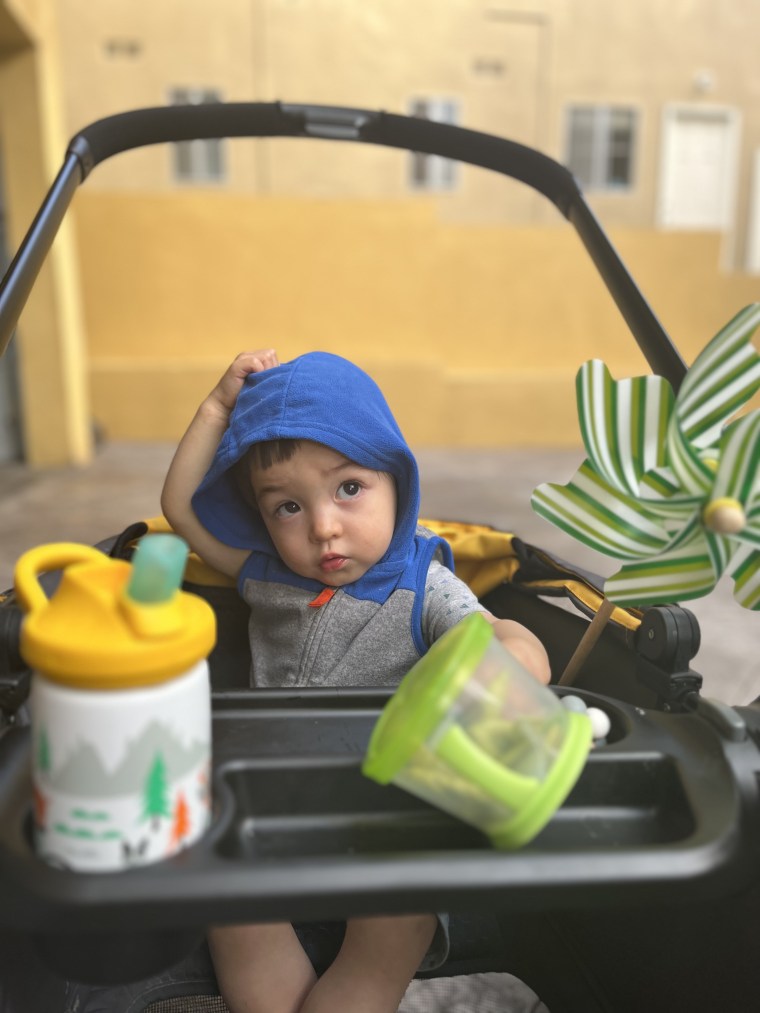
Last night I had dinner with two church friends. We are part of the same discipleship group, and we really are a good match: We all are boy moms with a son under 2, we are all working moms, and though we are very different in personality, we share similar values and sensibilities.
One is currently about 34 weeks pregnant, the other is already trying for a second child, and me? David and I aren’t trying, because we can’t–at almost 16 months postpartum, I still haven’t gotten my period back, and there are zero signs of ovulation. When I told my church friends that I was starting to feel anxious, wondering if I am infertile, one friend asked me, “You want more kids?”
“I want two more,” I said definitively, surprising myself. Before I had mentioned having three kids, but that was more like a half-joke. This was the first time I had seriously declared out loud that I want to expand my family. How I’ve changed. What is happening to me?
This is a weird period. It’s that season when everyone in a similar life stage as you are already pregnant with their second, or trying, or determinedly not because they have decided they are good with just one. I see more people in the first group. Just like when I found out I was pregnant and I started seeing pregnant ladies everywhere, I am now seeing women pregnant with their second everywhere– on social media, at church, in friend groups, at grocery stores– and what I feel isn’t jealousy or envy, but rather, waves of longing that roil inside me, a discomforting sensation that strangely feels a lot like nausea.
I tried to explain to David why I feel this way, and I found I didn’t really have the words. The desire is almost primal, as instinctive as wanting water. It comes especially when I’m with Tov, watching him burst out of his baby stage into the toddler stage, like a little chick flapping out of its shell, ready to hop and chirp and skip the moment it’s out into the world. Tov graduated from crawling to walking so suddenly, lifting himself overnight from his knees and hands to stomping around the house, his little feet going boom boom boom and his little hands already almost reaching the kitchen countertop and his energy as loud and rambunctious as his cackles of laughter. Almost overnight, too, two more teeth popped beside his two lower teeth. And just as suddenly, he was saying his first real word: “This! (pointing at the remote control he spies on top of his book shelf) This! This!” When he scrambles away from my arms to grab some other random obsession he spies, I see the back of his head, full of tufty brown hair that sprouted in the last several months.
As I watch Tov grow into a full-fledged boy, no longer a baby, I feel that wave of nausea-like sensation. I miss him. I miss his two-teeth goofy baby grin. I miss his army crawl. I miss his softer, gentler newborn cry. I miss his bald head with the hilarious patch of hair on the front. I miss the person he was two minutes ago. I am constantly missing him, nostalgic for the present even before it slips into the past. No, don’t go yet, I want to say. I haven’t fully enjoyed all of you yet.
It’s strange. I miss the previous Tov, but I love the current Tov more. My love for him keeps growing, yet so does the nostalgia.
Motherhood has radically changed my perspective on children. Psalm 127 describes children as arrows in one’s quiver, a heritage from the Lord, a reward. I never really got what that meant, and it’s still a surprising metaphor to me, likening children to arrows of a warrior, but like the assurance a warrior feels in battle with a fully-loaded quiver, Tov brings me assurance. Motherhood has secured my feet as I walk my life. It has sunken them into the earth with the weight of parental responsibilities, but also toughened them, strengthened them against the thistles and creatures in my path. I am less flighty, less idealistic, less dreamy as I was in my youth, but also more content, more secure, more assured, not because I now have the identity of a mother, but because that’s what happens, I think, when you love and invest in a God-given life that requires sacrifice of sleep, time, self-interest, comfort, and convenience.
I tried to describe that to David during our walk, but very inadequately. “Would you be sad if we couldn’t have any more kids?” I asked.
David made his characteristic “let me rustle my brain for a few seconds to think” noises and then said glibly, “No.” He gestured at Tov, who was looking up at us with wide eyes from his wagon. “I mean, look at him. He’s perfect. I’m content if it’s just Tov.”
Yes, he’s perfect. So wouldn’t one or two more of this perfection be even more wonderful?
“I would like to have a second kid, but I can’t imagine having another kid, just like I couldn’t imagine having Tov before we had him,” David said. He was also getting anxious thinking about the added burdens and stresses of expanding our family. As of now, he was just grateful to have Tov, he said, mentioning friends we know who are struggling with infertility.
I am too. Grateful. Because before we had Tov, I found children annoying and inconvenient. Because after we had Tov, I found he can indeed be annoying and inconvenient, but even when he’s waking me up from a deep sleep, or disrupting my plans, the feeling of wellness and fullness when he reaches for me far supersedes those irritations. Because less than two years ago, I envisioned a future free of all this, planned for it, and then God surprised me with something I never asked for.
But am I content? Why this slow-burbling anxiety that I won’t be able to have another?
I don’t think it’s bad that I desire more children, when the Bible itself declares that “happy is a man whose quiver is full of [children].” As always, the human heart is complex, stitching complications into good and healthy fabric. The desire for more is natural, God-made, healthy, but I’m punching holes into that desire with fear and distrust that essentially questions the character of God: I’m grateful to God for giving me this unexpected gift, but I can’t help wondering…maybe God will intentionally withhold more such gifts to me because I hadn’t wanted them in the first place.
Because sometimes I see God as an exacting judge. “Well,” I imagine Him pronouncing, in his judicial robes, “I’ve given you this measure of happiness, so that you’ve learned your lesson for poo-pooing motherhood, but now I’m sentencing you to the same measure of sadness, so you once again learn your lesson for poo-pooing motherhood. That’s what you get for being selfish, but see, I’m being rather generous, since I could have never given you a child at all.”
Or I imagine him as an ambitious coach. “OK, Sophia,” I imagine him huffing, blowing his whistle, “You’ve run 200 laps. But here are 200 burpees you need to do, because it’s good for you, it’ll make you stronger to experience the pain of infertility, because then you can truly bless them all, the mothers and the childless! For the good of the Kingdom, go go go!”
What a twisted vision of God. All my life, God has shown me boundless grace and compassion and empathy, and has even given me a glimpse of how far and wide and deep his father’s heart is through my own mother’s heart, and yet, at only 16 months postpartum, before even the first real roadblock to fertility, I let the serpent plant a seed of doubt in my heart: Did God really…? Is God really….?
If God really is the all-compassionate, all-loving, all-knowing Father he’s revealed to me, can I not just rest in that? Rest not just in the hope that he will answer the desires of my heart, but rest also in the hope that even if my heart’s desires aren’t fulfilled, he will surprise me yet again with something just as unexpected, just as wonderful, something just as intricately and uniquely designed to pull me down to my knees in worship, exalting him for who he is?
In a way, David is right: We should be content. We should be grateful. But I noticed that I was already trying to precondition my heart to be “content” with Tov by listing all the benefits to having only one child: We can devote all our resources and time to Tov; we don’t have to look for a bigger house; I don’t have to worry about how having more kids will impact my career; my body won’t sag and stretch more from more childbearing (though I’m sure it will from aging). I was reciting this list to myself to in a way brainwash myself into “gratefulness” and “contentedness.” But that’s not genuine contentedness. That’s distracting myself from my discontentedness.
What does it look like to be truly content, even as I allow myself to desire and ask for more?
-
Keeping score
I am in Nairobi, Kenya, as I write this. It is the last day of my six days here, though if you add up the travel days, I would be away from home for a total of eight days.
It is hard to be away from Tov. I missed him from the moment I stepped into the Uber that took me to the LAX airport. But there are ways to mitigate that ache, thanks to technology. I can watch him sleep at real time through the baby camera; I can FaceTime him; I can rewatch old videos of him on my phone. What’s harder and unmitigable, is the burden these travels put on David and me. It puts a strain on our marriage.
There are a pair of traditional Korean wooden ducks in our home. On our wedding day, I carried these ducks instead of a bouquet of flowers, and when people asked me what they mean, I told them the ducks symbolize commitment, longevity, and loyalty in marriage. If the ducks are facing each other, that means all is well in our marriage. If the ducks are facing opposite away from one another, that means we’ve had a quarrel, and you better pray for us.
Currently, the ducks are neither facing each other nor away from one another. They’re both angled so that they’re wing-to-wing facing the same direction. I placed them that way, because I felt it captured where David and I are in our marriage in this season of our life: We are not at odds, but neither are we quite “together” the same way we used to be before we had a child. We rarely have time where it’s just him and me, with optimal energy and undivided attention to each other. We’ve only been on one date since Tov was born. Our daily evening walks are usually quite stressful when Tov is fussing. We don’t sit together at church anymore, because one of us has to hold Tov so he doesn’t disrupt the service. We are always tired, like an old, outdated iPhone that can never be fully charged. By the time I put Tov down to bed at night, David is zoning out, and I’m either zoning out myself or catching up on work that I’ve missed.
This is co-parenting. We share a son, and we share the responsibilities of keeping him alive and raising him well. All our attention and energy and priorities are directed at him, and less so at each other.
Yes, yes, I know going on regular dates is very important, blah blah. I know of couples with young babies who go on resort vacations and ski trips. Well, we are not that couple. We simply do not have the energy or interest to go on a “vacation” in which we pay thousands of dollars just to do the same thing we do at home, only with more stress. People have kindly offered to babysit Tov, but with his separation anxiety, I feel bad asking anyone to watch him when I know he’ll be screaming for hours, and it would grieve my heart to know that anyone would have to “tolerate” Tov.
The first year of parenting has been rough for David and me in terms of figuring out how to partner together so that the burden of parenthood doesn’t fall disproportionately on one person. That’s probably a modern dilemma, now that typically both wife and husband work. But even so, the vast majority of the time, the burden of parenthood does fall heavier on the woman, if only because of biology. That’s been piling up irritation and resentment inside me– not just towards David, but toward the entire male species. Subconsciously, I’ve been keeping score of all the times I’ve felt like I’ve been taken for granted, unappreciated, stretched, and neglected. And David feels the same when I’m gone on work trips for long stretches of time.
Which brings me here to Nairobi. I could feel David’s fatigue when his text messages to me became increasingly brief and curt. From his position, it probably felt like he was breaking his back solo-parenting while his wife is in some exotic place galavanting with the giraffes. Everything is off at home when I’m gone, and Tov feels it. He doesn’t sleep as well and he gets very needy. It makes parenting extra hard. From my position, I’m just doing my job. I’m not in Kenya to play. I think of David and Tov all the time and don’t even have much interest in going on a safari trip because they’re not here with me. Does he want me to quit my job? And why does it have to be me who sacrifices my career? Why do I have to feel like I have to “make up” to him when I return home, when I myself am tired and jet-lagged?
You see where my brain goes? And do you see where it begins?
I’ll speak for myself only: I keep score. There’s a tally in my brain– you did this much, I did this much. I did this much more, so you should be OK with doing at least this much. You do this much, I’ll repay with this much.
The greatest struggle in a marriage with a young child is this invisible tally. It makes parenthood almost transactional. We often bounce Tov back and forth like a basketball– here, your turn. OK, now it’s my turn. Here, you take him so I can do this, and later I’ll take him so you can do that.
It sounds pretty terrible to write it out like this. I am exposing the biggest issue in our family that we need to solve prayerfully, wisely, lovingly. There is no question both David and I love each other, and we love Tov with all our heart. We both want the best for Tov, and we want him to grow up in a thriving, healthy home. We do it well individually– but we’ve yet to figure out how to do it together as one family unit. We are the pair of ducks looking at the same direction, but not at each other. Our child is off to our side, not in between us.
This is something I’m praying about.
-
Tov is one

Tov is one. Well, he’s 13 months today. I’ve been wanting to write a post about his first birthday, but for all my good intentions of keeping this blog regularly updated, I’ve failed to do so because of time and energy and priorities…and also, how did time whoosh by so freaking fast?! How is my son already one? How is he no longer a baby, but almost a toddler?!
I often swipe through older pictures on my iPhone, and it’s so strange to look at pictures of when he was a newborn, a six-month-old, a nine-month-old, and not really recognize his face just several months ago. He was a pink tiny alien with scabby forehead and cheeks when he was a newborn, an apple-cheeked, double-chinned little nugget with bald spots when he was six months old, and even at nine months old, his face looked different– more baby, less little boy. And now he’s a 13-month-old busy body opening every cabinet, climbing into every box, banging and slamming spoons and kabochas, and chomping on everything he can find, including the wall.
He is still barely 20 pounds, but he is mini and mighty. His legs don’t have much meat on them, but those bones are thick and strong. He must do at least 300 squats a day, standing up to reach for me or bouncing his butt up and down to some beat only he can hear.
The weeks before and after his first birthday have been rough. He was non-stop sick, and more than two months since he first caught a viral infection, he was still runny-nosed and coughing. A week before his birthday, the poor boy had an eye infection and then a double-ear infection.

Fluids and gunk dribbled down his face constantly, and his face and body were breaking out into inexplicable rashes. He had no appetite and was eating more snot than food. He lost pounds that he didn’t even have. We were in and out of the clinic, checking his heart and lungs and temperature, and returning home with not much useful tips from the doctor other than to “watch him.”
Those days were brutal, but more so for me and David than Tov. Once his ear infection cleared up, the little boy was back to his happy, loud, busy self, exploring every corner and nub in the house until his energy levels dipped because he wasn’t eating enough. The sticky liquid dripping from his nose was more a nuisance than any serious ailment. But for his parents, every hacking cough shaking his little body pinched at our hearts: Oh, the poor, poor boy. The parents’ hearts are more fragile than the child’s body and spirit.
Tov also went through some weird sleep regression or separation anxiety phase around the same time. He started waking up around midnight every night as though he’s had a nightmare. His cries were different from his usual cries when he wakes up– this time, he was screaming as though terrified. He bolted up in his sleep sack, clutching the rails of his crib, sobbing and sobbing until I went in to calm him down. Some nights, all he needed was for me to stroke his head and lull him back to sleep. Other nights, he wouldn’t let me leave for hours. He would jolt up every few minutes to check if I’m still there, feeling around for me, and sobbing again if he couldn’t. Those nights, I had to sleep next to his crib with one hand through the rails.
I remember one particular night in which Tov woke up at midnight again and was in such a state of separation anxiety that he would not let go off my hand. I laid next to him in that awkward side-position with one hand in his death grip. It was pitch-dark in his room, but I could sense his presence, his warmth, his force of life– just a barely 17-pound baby, but man, how he marks his existence, how he’s shaken my world. Even in that moment, with my night disrupted and my body exhausted, his cries– which would have annoyed anyone else– softened my heart, like butter under the afternoon sun. What flowed out of me wasn’t irritation, but tenderness and deep, deep love.
I thought then about Diane Langberg’s book Redeeming Power: Understanding Abuse and Power in the Church. Langberg is a Christian psychologist and an early pioneer talking about trauma and abuse within the Christian world when such issues were either hush-hushed or considered secular, anti-biblical psychology. In that book, she defines what “power” is– how power can be a source of blessing when used the way God intended, how it is inherent to being human, and how every human being, as image-bearers of God, wields some kind of sacred power, however weak and vulnerable one may be. Power, when used right, can be beautiful and transformative.
Tov has power over me. When he cries in the middle of the night, when he coughs like a dying old granny, when his body breaks out into hives, all those things affect me and David as his parents. When he smiles and laughs, our hearts melt; we laugh and smile with him. When he’s sick and hurting, our hearts bleed; we drop everything and inconvenience ourselves to take him to the doctor.
“The power of the vulnerable infant to express her needs exposes the hearts of the more powerful adults,” Langberg wrote. “Over time, their habituated response to the infant shapes not only the personhood of the infant but the hearts of the adults. Our responses to the vulnerable expose who we are.”
I read this book way before I became a mother, but I highlighted that part in the book because the simple truth of this statement moved me. It reminded me of the nature of God’s relationship with us as His children. God is all-powerful, and He is the only one whose power is wholly good and just. And yet, we as mere human beings also have the power to touch God’s heart, to move Him, to grief Him, to gladden Him. That God will willingly and joyfully create such creatures who have the power to influence Him exposes who He is, and what divine power is.
For Tov’s dol (first birthday in Korean), I began preparing weeks ahead. I bought a 25-pound bag of flour and lots and lots of butter. I made multiple batches of three kinds of cookie dough and froze them. I ordered a dozen Amazon packages full of cake-making and party supplies that I’ll probably not use again. I looked up countless recipes looking for the best cake recipe, and tested them out so I can find the best lemon olive oil cake recipe. I watched dozens of YouTube videos on how to make a naked tiered cake.
It wasn’t just me. My parents spent thousands of dollars to fly out for his dol, and so did my father-in-law. My mother made a huge pot of japchae while my father tried in vain to put Tov down for a nap. My mother and I spent took much time trying to arrange flowers I had bought at Trader Joes that didn’t really work well together. The day off, David and my father-in-law hauled boxes and boxes of stuff to the park to set up for the party. David’s uncle and aunt and cousins all helped me assemble everything together while I barked orders and ran around like a stupid chicken all stressed and frazzled because Tov had been crying nonstop and everything was still in boxes when we had 15 minutes until the party starts.

To be honest, I did not have all that much fun. I wasn’t able to hang out with anyone very much because I had to hold Tov most of the time, which also meant I wasn’t able to eat much of the food I had prepared, either. I was cold and tired and over-touched and over-stimulated.
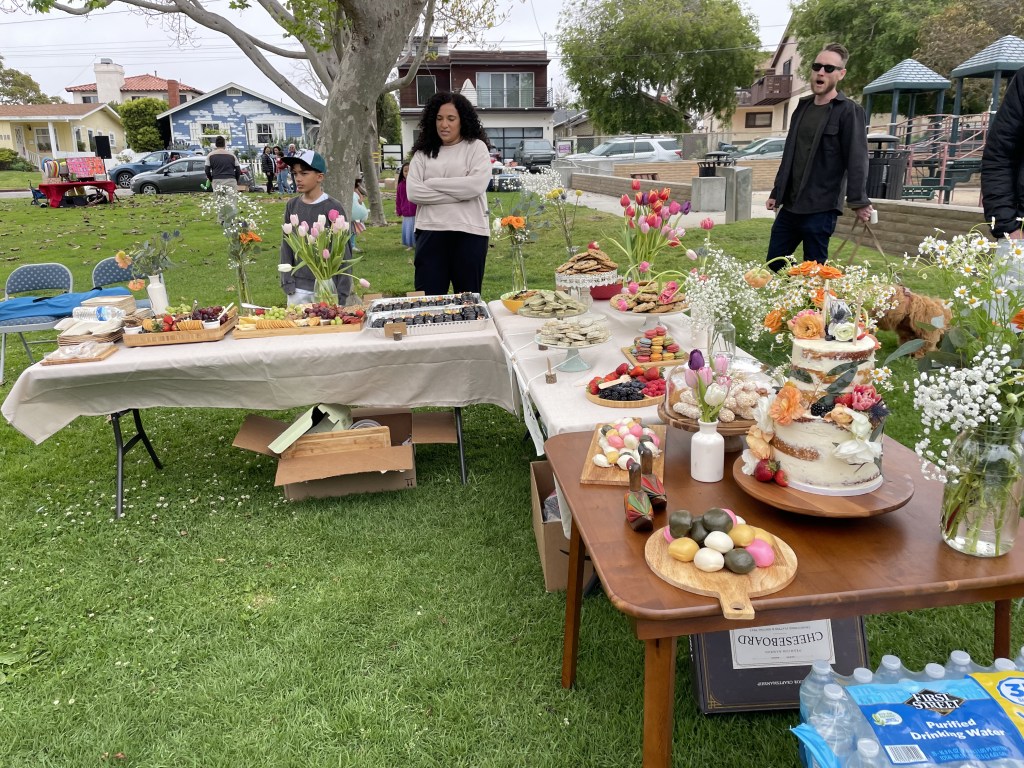
All this backbreaking work, for a one-year-old boy who couldn’t give a crap, who didn’t want to wear his traditional Korean hanbok, who cried and fussed because he missed his nap, and eventually passed out on David’s shoulder.
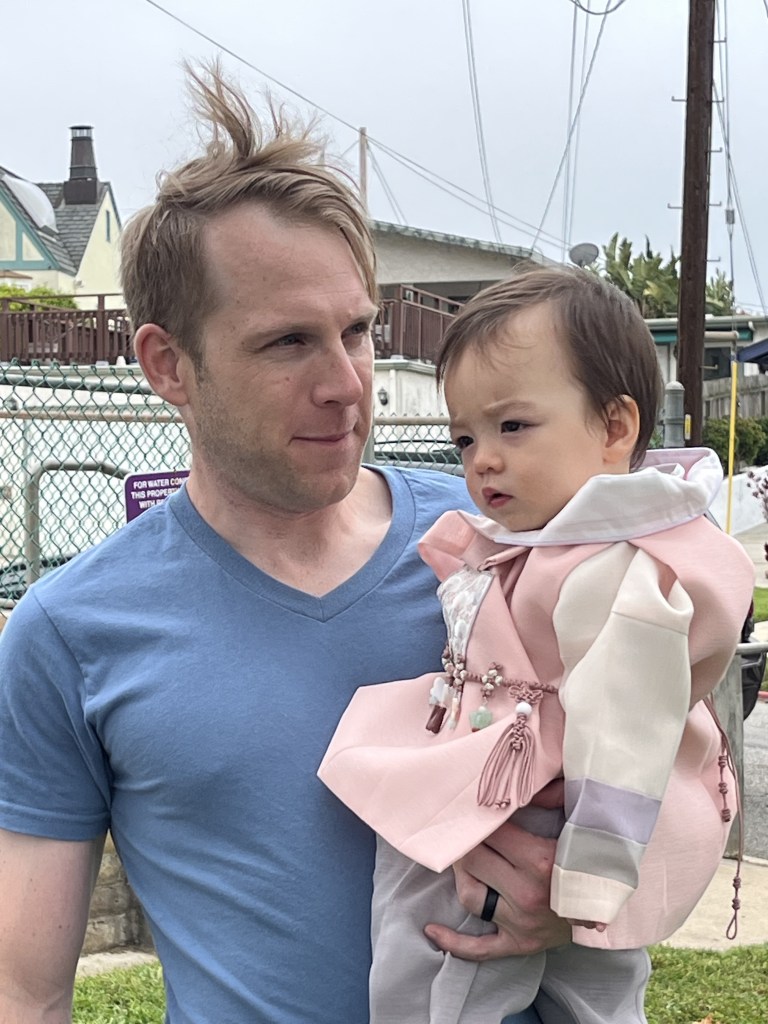
Oh, the things we suffer through for a child. Oh, the things a child suffers through for us adults.
But there was one redeeming thing to this whole affair: Except for Tov, we all willingly did it. People willingly sacrificed several hours of their Saturday afternoon to drive a far way down to us. Parents and grandparents willingly gave up time and money and energy to gift Tov a special celebration that he’ll not remember, but will hopefully bless him in immeasurable, invisible ways because it is a reflection of our love for him and each other.
Another redeeming factor: For his doljabi, Tov picked a globe! He shall be a globe-trotter! I was thrilled, though David was a bit sad he didn’t even give the baseball a glance. I cannot wait to take Tov around the world and let him see and experience the peoples and cultures I meet as a journalist.

Happy birthday, Tov. Even if you don’t remember the details of your dol, remember this: Even at that age, you had the power to bring together all these people to celebrate and bless you. That power is love. You still have it. You’ll always have it.
-
Little giant disrupters
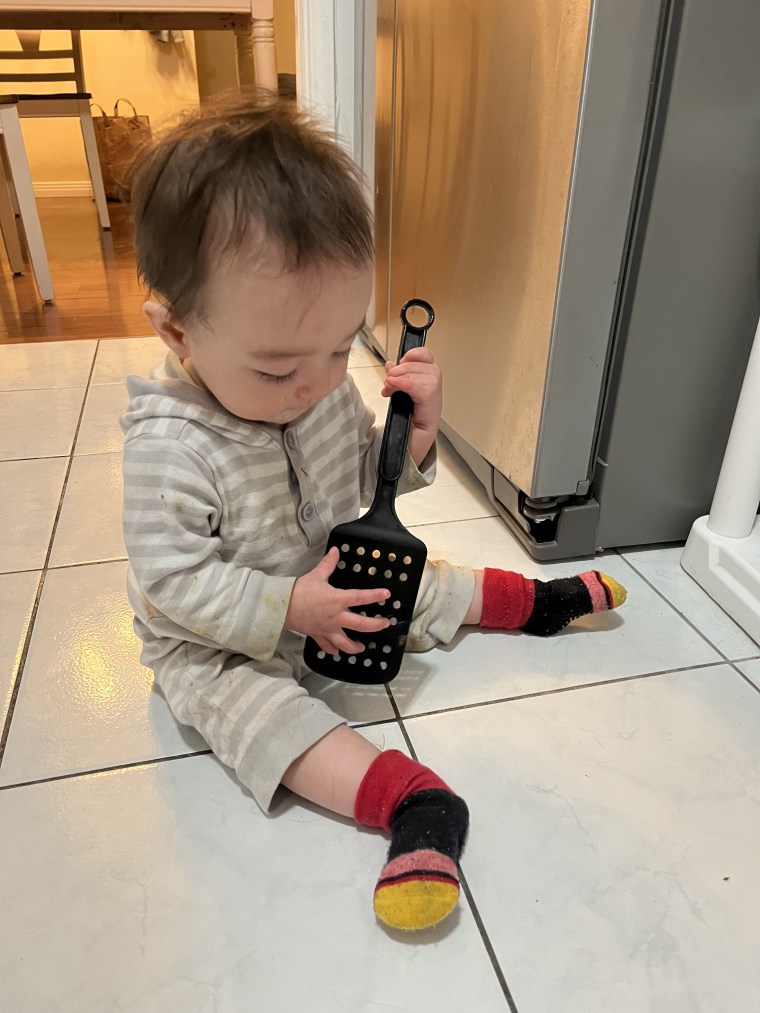
Tov is nine months old.
In the last several months, he’s found his hands and his feet. Instead of laying helpless and limp on the bed, he has learned to grab things, hit things, thump his foot on the floor. He’s also found his voice, and instead of simply crying when hungry, he has learned to yell, exclaim, babble, growl.
What all this means is that Tov has become very very loud. There was a time when we could wheel him in a stroller into church or a restaurant, and he’ll sit quietly in the stroller next to us, either drifting asleep or sucking on his pacifier. There really wasn’t much else he could do. Now he’s wiggling and flailing to get out of his stroller so he can explore the world. He wants to commando-crawl from corner to corner, and touch shiny and dangerous things. He wants to put everything in his mouth, including dirt and soiled diapers. He wants to smack his open palms on the floor, clang objects on tables, and exclaim “Aaaaah! AaaaaAAH!” at the bangs and booms he’s making. He wants to screech– not because he’s hungry or poopy or tired, but just for the sake of screeching, because listen to me, mama, did you know I have a voice?
Our little son is a 16-pound creature who makes as much noise as a boom box– doesn’t matter if we’re at a prayer meeting, or a Bible study, or a dinner party. There is no shushing him. (Those amazing baby shushers? They only worked for the first two months, if that.) Pacifiers are no longer self-soothers to suck quietly, but projectiles to fling across the room, or hit the nearest person with it.
We cannot take him anywhere without apologizing for the constant disruption. Those self-care mommy IG accounts often preach that mamas don’t need to apologize for our baby’s noises. But I do apologize, because there is no other honest way to say it: My son, my adorable son whom I love so much I could stare at his little head for hours, is a tiny-sized massive disrupter.
Back in my childless days, these disruptions would annoy the heck out of me. They disturbed my peace, my space, my concentration and comfort. One time when I was an intern at a church, a parent brought their infant into the church office. The parent put the infant down for a nap in a room and must have been busy at a meeting, because the moment the child woke up, he wailed and wailed.
“Waaaaaah! WAAAAAAAHHHH!” went the little disrupter, and the high-pitched screeches raked like a witch’s fingernails on my eardrums and gave me a splitting headache. I would have rather listened to Blink-182 blasting full volume on a boom box, because at least I could turn that off. There is no “off” button for a human baby.
Finally, a friend who has a grown-up son hurried over to pick the baby up and calm him down.
“Poor baby,” she sighed. “He was in distress.”
“I don’t understand why babies cry so much,” I complained. “I don’t think they’re in distress. They just want attention.”
My friend raised her eyebrows and looked at another friend who was with us. “Oh dear,” she said. “When Sophia has her own baby, we’ve got to run over, because she’s gonna need a lot of help.”
Well, I’m never going to have a baby, so that solves the problem, I thought to myself.
Joke’s on me. Now I’m the parent dragging her kid around and causing disruptions. Now it’s my kid wailing in distress in the middle of a Sunday service, or breaking dishes in restaurants. Now I’m the harried-faced, apologetic parent, while others stare or glare at us. It isn’t just my life that’s been disrupted– everywhere I go, my family was disrupting other people’s lives, and for the sake of everyone’s convenience, it was just so much easier to stay home and be antisocial.
Except we need community. Parents of babies especially need community, at a time when our world constricts and squishes into a vortex of baby talk, diapers, and feedings, when all our energy and love is poured out out out out out and we just need someone outside of us to pour an ounce back into us. That’s been our prayer topic as a family for this year: We need community. Not a “see you on Sunday after church for 20 minutes” kind of community, but fellow brothers and sisters in Christ in the neighborhood with whom we can regularly and intentionally practice our faith together, people with whom we meet up so often that they know what’s happened in our lives yesterday, instead of two months ago. Because our church is a little further out, we haven’t been able to find that kind of neighborhood community yet.
So recently we decided to join another church’s community group, which meets every Wednesday night at a coffee shop owned by a church couple. Even on a weeknight during traffic hours, the group is only about a 15-minutes drive away. The one pitfall is, the group meets between 6 and 8 pm. Tov’s bedtime is between 7 and 8 pm.
This Wednesday, we wheeled Tov in his carseat-stroller into the coffee shop, and almost immediately he was wiggling to get out of the stroller. We took turns carrying and bouncing him around. We gave him things to distract him. I took him to the corner so he can crawl on a rug.
There was no silencing him. He took a plastic communion cup and repeatedly smacked it loudly on the tabletop. Smack. Smack, smack, smack! He punctuated the smacks with a happy yelp: “Aaah! Grrrrr! Aaaaah!” When I took him aside so he can crawl in the corner, he bolted out of the rug, slid under people’s chairs, and tried to lick their shoes. I gave him toys, but they were wooden and the floor was concrete. He banged them on the hard floor– bang, bang, bang! And when I took those toys away, he squealed, then smacked the floor with his hands instead. Smack, smack, smack! I let him crawl for a while again, and he thumped his foot on the floor– thump, thump, thump! All the while exclaiming, “Aaaah! Aaaaah!”
By 7:30, those “aaah”s were no longer happy exclamations, but angry screams. He was overtired and hyperactive– refusing the bottle, refusing to be held, twisting his body and flailing all limbs and scrunching his face into exhausted, enraged howls. Time to go home.
“I’m so sorry,” I said.
“Sorry, sorry,” David said.
We quickly strapped the yowling Tov into his stroller and hurried out.
The coffee shop co-founder, one of the leaders of the community group, rushed out with us. “I just want you guys to know, it’s totally OK. You all are always welcome here,” he said. “I have three boys. We understand. We all understand. Don’t ever feel like you can’t be here.”
“Thank you,” I said, incredibly moved, but I couldn’t help adding, “I’m so sorry.”
Two things can be true at once: My son is disruptive; he will distract and inconvenience people. And! There is also space for him, for us.
We’ve been craving community because we needed someone to pour into us during times when we feel like we’ve been poured out empty. And one of the biggest way people pour into us is to scoot an inch aside and make room for our noisy family, and to reassure us, “It’s OK. You are welcome here. We understand.”
It’s a grace that I never once extended to others when I was childless and single, and perhaps that’s why I have trouble allowing that grace to myself. I feel like I don’t deserve this grace, because I couldn’t give it to others when they needed it. And you know what? I don’t deserve it. Yet people give it to me anyway. So I’ll receive it, a little shamefacedly, that undeserved grace that is the glue that holds together a community made up of people who need and give it.


hello, my name is Nayara. I’m Brazilian mother of two. I live in Maryland. My daughter’s name is Sophia. I am reading your texts one after other because for the first time I found someone describing what’s in my mind and my soul. Your blog came to me in a Google search response for my question: is my desire for more kids legit?
yeah, it’s weird to ask this to Google.
but wanted to let you know I enjoy reading your blog and we share many thoughts, fears and questions.
ill continue reading now , bye.
nayara
LikeLike
Thank you so much for reading, Nayara! I’m glad you can relate. 🙂
LikeLike