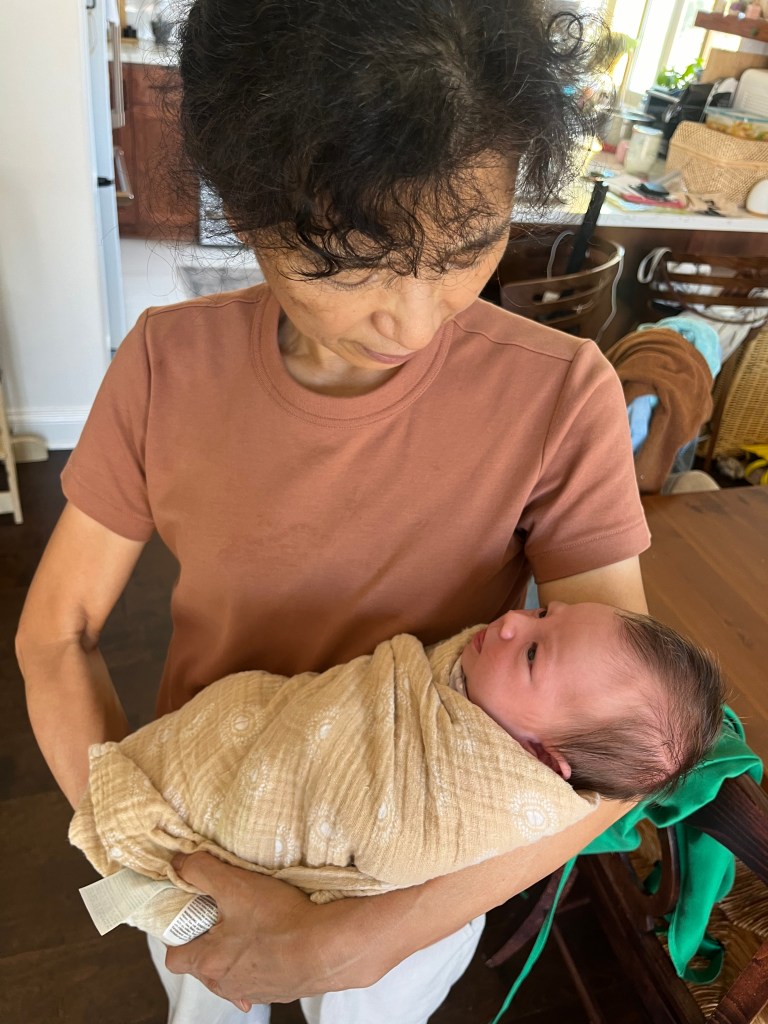

How we spend our Saturday with a toddler and a newborn

It is a well-known fact among working parents of young kids that weekends are now your work days. Your kids are not in daycare or school. In fact, your children have this innate ability to sense when it’s the weekend, because once Saturday morning rolls in, they somehow instinctively wake up before the sun even peeks out.

One day, when my children are much older and I have to shove them out of bed to wake them up, I might forget what these weekends are like, so I decided to record a typical Saturday for us with a 2-year-old and a newborn.

5 am: I hear Woori stirring. I climb out of bed shivering. My postpartum night sweats have been cooling down, but I still wake up with my hair and clothes kind of damp, and because we sleep with the windows open, it’s freezing.

I change into a dry T-shirt then stumble to the kitchen to grab my pump and warm up a bottle of refrigerated breastmilk. I bottlefeed Woori while I pump, nodding off to the sounds of her sucking.

5:30 am: I finish pumping. I throw the bottle and pump parts into the kitchen sink. Too sleepy to wash them. I swaddle Woori and place her back into her bassinet. Climb back into bed. She’s a little fussy still but I pass out and eventually, so does she.

6:30 am: Tov’s up! David gets up and turns on the TV for Tov. Saturday mornings, we allow Tov some screen time. He’s currently obsessed with a YouTube channel in which some brilliant guy’s making tens of thousands of bucks by creating videos of trucks and police toy cars driving around and getting into glorious accidents.

“Oh no!” Tov yells at the screen every time a truck crashes.

7 am: David heads downstairs to the gym to work out. Tov gets bored of his show so gallops over to my bed and starts making enough ruckus to awaken both Woori and me.

Welp, time to get up.

7:30 am: I make a matcha latte and try to nurse Woori while Tov literally climbs all over me. He grabs my hand and tries to drag me to his room, but I’m still feeding Woori. He begins whining.

Then he suddenly remembers he has a little sister and grins at her. “Aaaaaay!” He says, rubbing his hand all over her face while she’s trying to feed. Poor Woori. She tolerates a lot from her big brother.

I try to listen to a devotional podcast called The Daily Liturgy (my favorite) while nursing, but with Tov yelling and running all over the place and grabbing at me, I am so distracted that I have to rewind over and over. I also fall asleep while breastfeeding despite all the noises Tov’s making. As soon as the podcast is over, I forget everything except “His steadfast love endures forever.” Or something like that. Amen.

8:30 am: I try to eat breakfast. It almost always includes three soft-boiled eggs. The problem is Tov loves cracking and peeling eggs. As I’m peeling the eggs, he scampers over and asks for an egg to peel, too.

I give him an egg. He screams and cries. He wants a different egg. Fine. I give him another egg. He seems content with that one. He peels it but doesn’t eat it. It rolls on the floor, coating itself with dirt and crumbs.

Usually Tov doesn’t eat breakfast, so we stopped offering it to him unless he asks for something. But today he seems hungry, because he ate most of my eggs.

9 am: I try to give Woori some tummy time. She screams. I try to give her some face time, attempting to get her to smile. She shoots me an expression of pure disgust. Babies are delightful.

9:30 am: David trots up sweaty from his workout. It’s my turn to work out now. This is Mr favorite part about weekends now— I can leave Woori with David and get a full workout, instead of cutting it short because Woori decided to take a 15-minute nap, which is almost every day.

10 am: Welp, never mind. Woori is screaming her head off and David can’t get her to settle down because his man boobs are useless, so I cut my workout short and rush up to nurse her again. I’m kind of resentful that my husband got a 90-minute workout while I got barely 30 minutes.

11:30 am: Shower. Woori is perky and content now so she lies without fussing on her changing pad on the floor while I rinse off and do my morning skincare routine.

12:30 pm: I don’t know where the time has gone. We are dashing about preparing snacks, changing diapers and pull-ups, getting ready to leave.

We have a special treat for Tov today. We are going to Irvine Park Railroad! It’s a kids amusement park that offers train rides and paddle boats. I saw it on Instagram and we knew Tov would love it.

Problem is, Tov doesn’t know that we have a whole wonderful afternoon planned for him. We have to physically wrestle him to get him ready.

While David puts Woori into her car seat, I’m trying to cajole Tov to go down the stairs with me while I struggle with two heavy bags filled with essentials for baby and toddler. He wants me to carry him. I hoist him up on my other shoulder and say a little prayer for protection for my bad back. I have a feeling it’s only a matter of time before I hurt my back again.

1 pm: We somehow managed to all pile into the car. Both kids are strapped into their car seats. Tov has snacks. Woori is throwing a fit. She’s tired and hates the car seat.

We start driving east towards Irvine while Woori shrieks and yowls her displeasure. And then Tov starts screaming as well because he spotted David drinking a can of Waterloo sparkling peach drink and he wants it too.

The GPS says it’ll take us 2 hours to reach Irvine Park Railroad. Thankfully, Woori eventually tires herself out and pass out. Tov passes out too. So do I.

2:30 pm: We are getting close to the railroad park, only to discover that every entrance into the park has a half-mile-long line of vehicles waiting to get in. GPS says it’ll take us 40 minutes just to move 0.8 miles. WTF.

Turns out, it’s pumpkin patch season. We chose the worst possible time to come here. We jettison our plan and scramble for Plan B. We decide to turn around and go to Heritage Park in Irvine instead.

3 pm: I find a public library in which I can nurse Woori, while David takes Tov for a romp around the park. Pretty much every single person I see in that park is Asian. If I see a white person, 10/10 they are married to an Asian.

David and Tov find a water play fountain by the lake. Tov gets soaked. He is the only one splashing. The other kids are apparently not allowed to get wet. They eye Tov from their safe dry spot with envy.

We change Tov into dry clothes and look at the clock. 4 pm and more than an hour away from home. What the heck is there to do in Irvine?

4:30 pm: We head to Spectrum Center, a massive outdoor shopping center. Maybe we can get some coffee and a nice dinner? So exciting. Things we could have done at home without the waste of time and gas money.

Spectrum Center is packed as well. Lots of young couples and families. But Tov is the only child insisting on dunking half his body into every fountain in that center. And there are a lot of fountains. They’re beckoning to Tov from every corner. How can he resist? How can he not run screaming “Wawa!!!” to every fountain and dip his forearm into the pool?

When he’s not chasing fountains, he’s insisting on pushing Woori’s stroller, getting upset when we try to steer him away from people, bushes, and poles. When we finally snatch the stroller away from him, he flings himself onto the floor, prostrating like a professional mourner and wails. Fat globes of tears roll down his cheeks.

After 40 minutes of this, we’ve finally had it. Forget dinner! We are returning home!

5:15 pm: But first, coffee. We stop by the Citibank Cafe since David gets a discount with his credit card. He gets a coffee, I get a matcha latte. Tov points at a sugar-crusted almond croissant. He orders, “This!”

I order him a zero-sugar protein strawberry yogurt instead. He polishes it off.

My stomach growls. I realize I haven’t had time for lunch and Tov had eaten most of my breakfast.

We sit down for 5 minutes at the cafe but Tov, high on yogurt, hops and skips and yoddles and climbs all around as though the cafe is his personal play gym. I see a young Asian couple give him the stink eye and then glare at us.

I was you just five years ago, I want to tell that couple. Just you wait.

I grab Tov by the hand and we leave.

It takes us another 20 minutes to make it to the parking lot because Tov kept grabbing for Woori’s stroller and then running off with it as though drunk and drugged.

We speed home in roads that are surprisingly low traffic (prime dinner time), playing obnoxious Cocomelon songs to keep Tov quiet, and make it home by 7.

7 pm: I am ravenous by that point, but Woori is also starving so I run up with her to feed her again, but I also really need to pee, so I set her down on our bed and then rush to the bathroom.

As I leave the bathroom, I hear a BOOM!

Woori had fallen off the bed and when I run over, she’s on the floor with her head bang on the hardwood floor, screaming. I must have put her too close to the edge, and as she was jostling about, she must have slid off the bed covers.

“Oh my God! Oh my God!” I yell, scooping her up to check on her.

David sprints over to see what’s going on. “What? What happened?”

Woori is startled but otherwise seems OK. Babies have pretty sturdy heads. My heart, however, takes a good 10 minutes to finally slow down as I rock her and nurse her. Meanwhile, Tov climbs up and down my legs while I feed Woori.

Stomach growls again. I really need to eat something.

7:45 pm: We have leftover eggplant pasta for dinner. I wolf mine down over the kitchen counter while holding Woori with one arm.

We clean up while Tov makes more messes. It’s a never ending cycle.

8:30 pm: Bedtime for the kids. Our favorite time of the day! Cue hallelujah songs.

We bathe them both. David puts Tov down, while I put Woori down. Tov passes out the moment his head touches the mattress, but Woori wakes and cries a few times and needs me to rock her back to sleep.

9:15 pm: Me time. Me time. ME ME ME ME TIME!

Also the time when I consume the bulk of my calories. When I don’t have to shovel food into my mouth because the baby is crying. When I can sit and enjoy each bite while reading a novel. When no grubby little hands are grabbing for me, demanding attention. When my brain is not aching from overstimulation. When my ears are at rest because it’s all…quiet. Aaaah.

And because this time is so precious, I drag it for as long as possible. Which is why…

1:30 am: Go to bed. I am so exhausted the marrow of my bones are aching.

But this is the real reason why I’m sleep-deprived. I can’t blame the newborn. She’s a wonderful sleeper once she settles into the night. Every day, given the choice between recharging from more sleep or recharging from more quiet time, I choose the latter every single day. Hands down.

And just like that, a Saturday is gone.

What did I used to do on Saturdays before I had kids? Sleep in? Movie nights? Concerts? Dinner out with friends? All that seems like a distant dream a long long time ago from a land far far away.

And yet. Maybe one day I’ll read this post and remember it with fondness.

Nah. Who am I kidding. Definitely not.
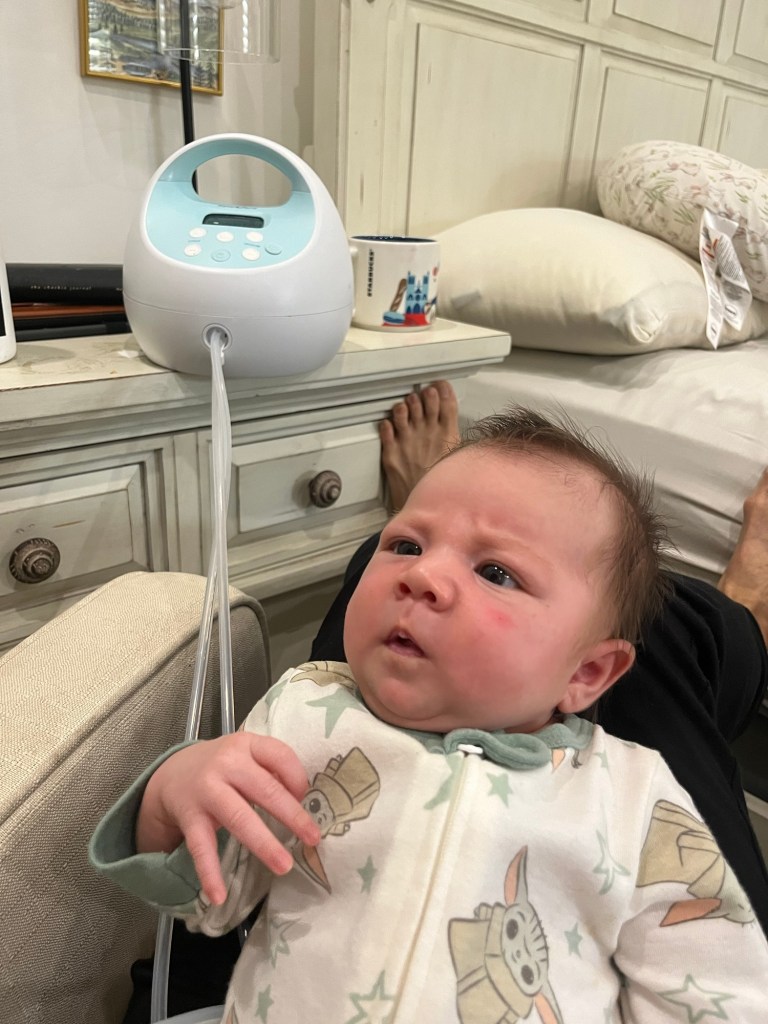
How nursing with Woori is going (It’s not)

I would love to follow up my last post with a post about how I’ve become calm and collected, gentle and lowly like Jesus, but no. I have been experiencing major mom rage, and a lot of that has to do with how nursing is going with Woori.

Probably because at this stage of infancy, all I ever do is feed this baby. All day long. No sooner have I finished nursing, bottle-feeding, then pumping, do I have to start the process all over again.

Woori is 5 weeks today. Which means we’ve been stuck in this hell cycle of triple feeding for five weeks. I would go five more weeks if there were signs that she’s improving, that one day I can exclusively breastfeed her without worrying if she got enough, worrying about pumping, worrying about my milk supply.

But then I go to a lactation support group, weigh her after a 45-minute nursing session, and find out she had sucked only 1 ounce.

Forty-five minutes, and we get 1 measly freaking ounce. I guess that’s better than 8 ml (0.27 ounce), which was what she ingested the first time I joined the lactation support group. But still. I want my 45 minutes back!!!

“She’s…at least getting better,” the lactation consultant Mary said pityingly. She asked me how much I’m pumping.

Two to 5 ounces, I said, depending on time of day.

“So it’s not your milk supply,” she said. “How many times do you pump a day?”

Eight, I told her. Almost every feeding session.

“Well, I’m worried about you. That’s not sustainable,” Mary said.

Nope, it is not.

Mary suggested going to an occupational therapist. But for some reason, the thought of going to another appointment with a specialist that might not work, that might be another waste of time, money, and hope, felt overwhelming to me.

“I just worry about you,” Mary repeated. “What you’re doing is not sustainable.”

I fought to blink away tears. Up till then, I’d been pretty stoic about this triple feeding process. I complained some, but it was a routine I did, day by day, without thinking too much about it. But it was wearing me down. And when I came to this lactation support group, I had had hope that Woori was finally nursing much better. So to see that number— 1 ounce— felt crushing. I wanted to throw myself on the floor and weep.

“Let’s try again,” Mary suggested.

So I went back to the nursing pillow, and tried to rub Woori awake, but she was drowsy from all the calories she spent nursing without getting much calories in return. We stripped her down. We turned a fan on her to keep her awake. She squirmed and pushed but I kept her plastered on me.

Thirty-five minutes later, we weighed her again. She had just under another ounce of milk.

Two hours, 2 ounces. A baby at her age needs about 20-24 ounces a day. That’s 20 to 24 hours of nursing I have to do to get her what she needs, if I were to exclusively breastfeed.

Unsustainable, indeed.

Two evenings ago, I lost it.

We had just finished eating dinner, and as always, David wanted to go for a walk. That’s been our daily routine since we met, but since we’ve had Woori, more often than not, David has been going out for a walk with Tov while I stay home with Woori, nursing and pumping.

This evening, I really wanted to go for a walk too. I had been cooped up at home all day. I had not been able to get my regular workouts in that week because Woori’s naps have shortened to barely half an hour, and when she’s up, she wants to be held. And then of course there’s her feeding schedule.

But come 6:30 pm, I was still stuck in the chair nursing Woori. I had passed out, so I couldn’t tell if Woori had even been sucking or simply suckling.

David stuck his head into the room. “Are we going?”

I opened my bleary eyes. “I don’t think I can go,” I said. I still needed to pump, and it was getting late, and our walks are usually almost an hour long.

So David got ready to go for a walk with Tov without us.

We were alone at home. Again. Man, I really wanted to go out for a walk.

By then I had maybe been nursing for a good 45 minutes. Surely she’s gotten something out of this, I thought.

But no. As I lifted Woori up and walked around the house, she began sucking on her fingers— cues that she’s hungry.

I groaned— a deep, guttural burst of livid frustration. How. HOW! How is she STILL freaking hungry?! Did my milk ducts dry up? What the heck have we been doing for the past 45 minutes?!

In a whoosh, I felt rage boiling out of me like fresh hot lava. I felt resentment that David got to keep all his routine— a 90-minute workout every morning, walks every afternoons and evenings, hot coffees, work and conversations with adults— while I was chained to this never -ending cycle of feeding a baby who had a piss-poor suction. I could feel the hours we spent trying to nurse flattening my butt into a Swedish pancake, all my hard-earned muscles softening like butter. I felt fat. I felt unproductive. I felt utterly demoralized and discouraged and deflated.

I burst into angry tears. And then, because tears were not enough, I picked up the first thing I saw— a big-ass plastic dump truck filled with blocks that a very kind friend had gifted Tov that day— and hurled it across the room. Red and yellow blocks scattered across the floor. That was still not enough, so I kicked his plastic fire truck across the room, too, and it somersaulted in the air and skidded next to the other giant truck.

I calmed down a little then. Or rather, guilt and shame tampered my rage. I felt bad that Tov’s toys had to bear the brunt of my lack of self-control. I checked on them and was relieved they weren’t broken.

Then I warmed up 4 ounces of pumped breastmilk and bottle-fed Woori. Sure enough, she gulped that thing down as though I haven’t just spent the last three-quarters of an hour trying to feed her. I could have cried again.

At that moment, I remembered what a woman had told me after helping watch Woori for an hour: “She’s so easy! All she does is sleep and eat and poop!”

I knew she meant it as a compliment or something. But when I heard it, I felt triggered and irritated. I thought, Of course she’s easy, after you’ve golfed all day and shopped at a farmer’s market and all you do is hold her for an hour in the evening. Of course she’s easy, when that bottle you’ve fed her was squeezed from someone else’s dairy farm. Of course she’s easy, when you get to hand her off so you can go home and sleep when you like, for however long you’d like.

I knew I wasn’t being fair. But I wasn’t in a mood to feel gracious and rational. I felt like my struggles were belittled. And then, on the flip side, I belittled myself: What are you whining about? Why is this so hard? It’s so easy. Just suck it up.

I dried my tears and gulped down my frustrations and picked up Woori and spoke to her gently. Something will have to change, and we’ll figure it out together.

Later, while I was bathing Woori, I heard David and Tov return from their walk. Tov stomped up the stairs to greet his new truck. “Argh! Oh nooo!” I heard him exclaim to see his dump truck turned upside down and all the blocks skittered across the room. I felt guilty, but also tickled at his dramatic reaction. I heard him gather all his blocks again and put them where they belong into the dump truck.

He pushed that truck into the bathroom where I was bathing Woori, and he greeted cheerfully, “Hi!” He had no idea the tantrum I had thrown just 20 minutes before. I pulled him close and kissed his cheeks, penance for throwing his toys, though he had no idea what I had done. If only all the moments of my mom rage could be as easily remedied as picking up plastic blocks.

An hour later, I was back in my nursing chair with Woori, restarting the process again.

Of course, all this could end if I stopped being stubborn and just gave up on breastfeeding. I’m keeping this cycle going because at the end of the day, I still have the privilege of choice. I told myself I’ll keep on going for as long as I can, and maybe that breaking point is coming.

I hired a personal lactation consultant who lives nearby to come visit me. It’ll be the fourth lactation consultant I’ve seen. She’ll visit me next week, and maybe it’ll help, maybe it won’t.

But I need a new plan. Tov’s toys don’t deserve my mom rage.

Our Woori, My Woori

Before we had Tov, before I even realized I wanted a child, I had a name for my firstborn.

I got the idea for Tov’s name while reading A Church Called Tov by Laura Barringer and Scot McKnight. I learned what the Hebrew word “Tov” meant then, and I fell in love with it, thinking, “If I had a child, I’d name him or her Tov.” And then I rolled my eyes– yeah, right, like I’d ever become a mother.

Just like Tov, I had a name for my secondborn before she was conceived.

At the time, I was working on a reported piece for Christianity Today about the modern-day challenges of finding community, and it quickly became more a personal essay because the piece was born out of my own frustrations and desire for community. In that essay, I was frank about my shortcomings and the mistakes I made that made community more challenging, and one thing became clear to me: I’m incredibly individualistic.

I’ve always been a very independent person; even as a kid I couldn’t wait to grow up, leave my parents’ house, and forge my own path. Since young, I’ve always been drawn to the western culture and celebration of individualism. It just felt right and natural to me, to emphasize self-autonomy, self-reliance, self-identity. I looked down on the Asian concept of collectivism, dismissing it as unenlightened, suffocating, and oppressive.

Over the last few years, as I study the Bible more and understand more about the nature of God, I’ve come to realize how some characteristics and consequences of individualism are actually unbiblical and toxic. God Himself is Three in One, and through perfect unity and community He created humankind, saying, “Let us make man in our image, after our likeness.” God didn’t call us into an individual relationship with Him; we are called into the Body of Christ to worship and fellowship together in community.

When Jesus Christ came to earth in flesh, he dwelt in a collectivist society, and one of the first things he did when his ministry started was to build a community. He then called us to build the Church– again, community. When he taught us to pray, he didn’t teach us to call out “My Father,” but “Our Father.”

The early churches met and broke bread together every day, sharing their possessions and wealth. The immediate work of the Pentecost was to break down the barriers between languages and cultures, and later creating unity between Gentiles and Jews under one Body and one Spirit. So much of the Spirit’s work is about reaching out to others, reconciling people, and loving people well. The fruits of the Spirit all have to do with our relationship with others.

If God Himself is communal, existing in community and encouraging community, then I need to change the way I think about myself in relation to others, and the change the way I view and participate in community.

That’s how I came to really appreciate the Korean word “woori” (우리), and how unique and pervasive it is in the Korean culture. In direct translation, woori means “we” or “our” or “us,” but the word contains a much deeper Korean concept of self and others. It evokes a sense of community, unity, oneness. Korean culture values community over the individual, expressed through the way Koreans frequently use “our” rather than “my.” That’s “our house,” for instance, or “our husband,” or “our school.”

I really took notice of the Korean concept of “woori” after Tov was born, when my parents would ask, “How’s woori Tov?” “Let us see woori Tov!” “Aigo, why is woori Tov so handsome? Must have grandpa’s eyes!”

Despite becoming so westernized in my thinking, I also realized how Korean I still am, when I felt a twinge after I heard my husband refer to Tov as “my son” rather than “our son.” I felt like I got cut off from the picture. On the other hand, even when David wasn’t around, I referred to Tov as “our son.” That just felt innately right to me.

That Korean use of “woori” might feel jarring for people from a more individualistic mindset. My friend, who just gave birth to a beautiful daughter, recently told me that she had to correct her mother when she cooed at her granddaughter, “There’s my J!” “No,” my friend told her mother firmly. “She’s not your J. She’s not your daughter. She’s my daughter. Mine.” I understood where my friend is coming from. She has a history with her mother, and she’s setting boundaries early. It’s what modern-day therapists and psychologists advise, too: Set boundaries with people for self-care and happy relationships. Only you get to decide what is acceptable and not, what’s your limit. Communicate that clearly to others, especially family, the source of your deepest triggers.

Meanwhile, the word “boundary” as used in this context doesn’t even exist in the Korean language. They literally have to use the English word “boundary.” Koreans might say “don’t cross the line,” but I believe that statement is a modern saying that didn’t become mainstream in Korean society until recently.

I actually think there’s something beautiful and right about my parents calling my children “woori.” It reminds me my children are not my own, that they’re part of a rich and long heritage, that they belong to not just a biological nuclear family but a more timeless, expansive family. I love my children dearly, but my and my husband’s love for them is not the only love that will shape, edify, and enrich them.

And that’s why, about a year ago, as I revised my thoughts on individualism, as I prayed for community, as I took notice of the obstacles I put up between me and a vibrant community, I thought, “If I have a second child, I think I’ll name him or her Woori.”

Several months later, I found out I was pregnant. And on August 19, 2024, I held our daughter in my arms and wrote on her birth certificate, “Woori Grace Lee-Herrmann.”

For all my philosophizing of Woori’s name, the practice of living it out is much harder and messier. I may recognize the good in my Korean heritage’s communal culture to the point of naming my daughter Woori, but there are still aspects of it that make me instinctively recoil and hesitate. Just like there are aspects of the individualistic society that are unbiblical and unhealthy, there are parts about the collectivist society that’s also unhealthy and twisted, and I still struggle to judge what is right and biblical, and what is not.

I am, by nature, still a very individualistic person. I live in an individualistic society steeped in individualistic culture. My Instagram feed is full of expert parenting advice on setting boundaries with your parents and in-laws, on how to raise kids with good self-esteem, a strong sense of self-identity, and a bold voice to express one’s rights and needs– all good things, great things. But some of those things are foreign to my very Korean parents, and we butt heads over our two very different cultural contexts.

If you have an Asian parent, you’ve probably gotten your fair load of unsolicited advice. My parents frequently tell me how to parent our children, which I oftentimes receive as passive-aggressive criticism.

“You have to make sure you wash his hands properly,” my mother would say after Tov developed strep throat, as though we let Tov roll around and sleep in dirt. When we FaceTimed during dinner, she would let out little shrieks as Tov dug into his pasta with his hands, sauce dribbling down his forearms. “Wipe his arms! Wash his hands!”

When she saw a photo of our nanny showing Tov a picture on her iPhone, she immediately texted to remind us not to give any screen time to our child.

When she saw how easily distracted Tov is, she hinted at the possibility of ADHD and exhorted me to train him to focus on one task at a time, even though he was still barely a toddler.

She compared Tov’s speech development with my niece’s, sent videos instructing me how to teach a delayed child to speak, and suggested I send him to a speech therapist.

She reminded me over and over again that a baby needs to sleep in complete silence and darkness. She complained about the loud washing machine downstairs, the loud noises outside, the loud work meetings in David’s office, and other auditory disruptions that will certainly stunt my children’s brain development, disregulate their emotional stability and perhaps that’s why Tov’s so delayed in speech and so unfocused?

Each time this happened, grenades popped off inside me. “Aish, Omma, just stop nagging!” I would snap at her, and my father would jump to her defense. “No parent nags less than we do!” he snapped back. “You don’t know how good you have it.” And then he preached about the Bible commanding us to honor our parents. “Let us live according to the Bible,” he said. “Blessed are those who let their parents nag.”

“Pretty sure that’s not in the Bible.”

“Oh, woe is our generation,” my father lamented. “We are the most pitiful generation ever. When we were young, we could not say a word back to our elders. We had to respect and tiptoe around them. Then we have children, and times have changed. Our children now disrespect us, and we have to tiptoe around our children. We served those above us and now we serve those below us, and nobody serves us!”

“So you want me to tiptoe around you, kowtowing and saying ‘yes, yes’ to everything you say?” I retorted back.

My father shook his head, as though shaking his head at the entire spoiled, entitled, and disrespectful generation to which I belong. “Truly, the end times are coming. Culture is changing too fast. So let’s just do as the Bible says. Honor your parents.”

“Honoring your parents doesn’t mean we just have to keep quiet when you’re vexing us,” I said, getting more and more heated. “The Bible also says, do not vex your children.”

Here’s the thing: I really, really like the concept behind “woori.” I really appreciate the values of community, unity, and sacrificing self for the common good. It’s so ideologically charming and pleasing, like the idea of sipping tea in an old English cottage with a thatched roof– until you realize those quaint, pretty roofs can be annoying to maintain, vulnerable to fungal attacks, fire, and bug infestation.

I like my parents calling my children “woori” until the actual practices of it grate against all my individualistic impulses and preferences. I don’t like people telling me what to do, even if it comes in the form of harmless advice and suggestions that I can always choose not to follow. I love it community when my parents help watch Tov so David and I can go on a date, or when they say nice things about them, but I get triggered when my mother worries over Tov or Woori, or mutters the mildest hint of criticism, and I get even more triggered when my father starts preaching at me with Bible verses. I like the “woori” concept only when it benefits me and requires little effort or sacrifice from me: You can love my kids, but from a distance, saying only positive things, and God forbid you care enough to suggest what you think might be best for them. That’s the opposite of what “woori” is.

I don’t intend to obey everything my parents say. I’m an adult, and they raised me to be independent and mature, capable of making my own decisions. But at the very least, I can listen to their unsolicited advice and their preaching without getting snappish, even if they annoy me, and be genuinely thankful that someone else cares so much about my children to worry and nag about the details of their upbringing, things that most people don’t even bother thinking about because our children are not “woori” children.

Woori’s name was a gift from me to her– a prayer, a blessing, and a benediction that she would never lack community, that she will seek and find and form a community wherever she goes, breaking and sharing bread with all kinds of family.

But Woori’s name is also a prayer and a blessing for me, too, as Tov’s name has been for me. Both our children’s names embody an important, essential characteristic of God. In my pursuit to know God more, to meet him the way Moses did– speaking to him face to face, “as a man speaks to his friend” (Exodus 33:11)– I see the image of God in my own children, even as they reflect my image: Woori Tov, and woori Woori.