Why won’t you just EAT

Two Sundays ago, we got together with two church families for our first book meeting, in which we discuss Jonathan Haidt’s The Anxious Generation. We thought the easiest way for us to be able to meet and chat was to hang out poolside, letting our young kids aged 9 months to 6 years old to splash around at the pool while we snack on fruits and sunbutter sandwiches and talk about the impact of social media and screen time on young minds.

We had a good discussion, but I also felt myself feeling rather agitated and frustrated– not because of the content, or the company, which was wonderful, but because I was watching my friends’ toddlers, both several months older than Tov, hang out close to the snack table while Tov was way more interested in splashing in the pool.

By then I knew that Tov had skipped breakfast, had eaten one mini dried fruit bar in the car after church, and then had consumed nothing else. Meanwhile, these two other healthy toddlers, both bigger and chunkier than skinny Tov, grabbed fistfuls of blueberries, downed a bottle of juice, and chomped on not one, but three, four pieces of sunflower butter sandwiches. All the while, Tov was expending all the calories he didn’t ingest by scampering and jumping around, totally disinterested in the food.

“Tov, you want to eat something?” I called out to my son, and he shook his head and said his new favorite word to every question: “No.”

Eventually he came by my side to the snack table, drenched and sunburned, and I was able to get him to eat some watermelon, on which he nibbled a few squirrely bites and then handed the rest of the chewed-up chunks to me.

“Try some sandwich,” I begged, holding out a small piece, and he shook his head, “No.”

He licked on some blueberries, spat some out. Nibbled on some watermelon, and then tossed most of it onto the table. The sandwich I had offered to him sat crusty and dry before me.

He was driving me INSANE. He’s got to be hungry by now! He’s eating 1/5 of what other kids his age eat, and using up three times the energy! Why the heck wouldn’t he just freaking EAT!

I had been noticing Tov’s declining appetite for a couple weeks by then. Because he still was his happy and energetic self, I didn’t worry much at first. He’s always been a good eater; some days he ate less, but he naturally ate more the next day. He’s been getting pickier about what he eats, but that’s pretty normal for toddlers his age, and I just did what the experts advised: Keep offering new foods, including vegetables and meat he won’t touch, but don’t ever pressure him. Simple breezy easy.

And then one day of not eating became three days, and then a week, and then two weeks, and by the time we were at the pool for our book club, I was observing every morsel touching his lips like a hawk. I was starting to do what the experts told me not to do: I was starting to stress, and the stress steamed off my pores like fresh-boiled potatoes, burning both me and Tov and others around us.

I told our nanny that he hasn’t been eating, and she shrugged. “He’s never been a breakfast person,” she said.

I gritted my teeth. “He’s not eating lunch either.”

“I don’t like fat babies,” she said. “He looks fine to me.”

“The doctor said he’s pretty underweight,” I said, feeling an irritation heating up into a volcanic rage. She sees how little he’s eating, doesn’t she? He’s not eating breakfast, he’s not eating his snacks, he’s barely touching his lunch. “He’s not really been eating much for dinner, either.”

“Oh!” our nanny said, starting to look concerned. “I didn’t know he’s not been eating dinner either. I didn’t know it was that bad.”

From then on, she made a concentrated effort to get Tov to eat. She chased him with a piece of bread in her hand, going, “Mmmm! Bread! You want some bread?” and it turned into a game for Tov, who ran in circles around the living room giggling, and of course refusing to even taste the by-then soggy, wretched-looking, wholly unappetizing bread. In the end, she would put him down for a nap with his stomach empty, his breakfast and lunch plates still full and congealing and attracting fruit flies.

A week after that poolside hangout, his appetite dropped even lower, if that was even possible. He didn’t even want his milk. He had a low-grade temperature and was clingy, simply wanting to be held and rocked. I took him to the doctor, and turns out, he has strep throat. His pediatrician said the back of his throat is swollen, which makes sense why he completely lost his appetite, but she said it doesn’t really explain why he’s been eating so little for the past few weeks. That just might be normal toddler behavior, she said. She put him on antibiotics and Tylenol/ibuprofen, and said he should be feeling better in about three days.

The next day, after a full day of not eating again, our nanny tried to wake him up from his nap, and he barely stirred. She rubbed his back, stroked his cheeks, called out to him, but he lay like a stone in his crib, eyes shut tight. She got frightened and called me and David. When David picked Tov up from his crib, his head lolled backwards, limp, but thankfully, he later woke up crying, and we were able to get him to drink some water and milk.

I took him to the pediatrician again, and we found out not only does he have strep throat, he also developed hand foot mouth disease. He had no sores or rashes on his body, but there were two painful-looking white ulcers on his tongue and uvula.

“No wonder he’s not eating,” the pediatrician said, eyes filled with pity. “He’s in a lot of pain.”

I felt my heart break, held the poor boy close. “Oh, I’m so sorry, Tov.”

Even then, I could not break from my obsession with making sure he eats something. I ran to Whole Foods and Trader Joe’s and paid too much money buying things that I rarely let Tov eat: popsicles, juice, sweetened yogurt drinks, ice cream, soft white bread– anything that would be cooling and easier to eat. What kid doesn’t like popsicles and ice cream?

Well, Tov.

He licked the popsicle but then let the rest of it melt into a bright purple puddle. He would not even touch the bread. He took a few sips of the juice and then left it sitting on the table. He spilled the yogurt drink into another bowl and smacked his hand into the pink liquid, splashing the sticky substance everywhere.

My friends and the internet gave me advice on how to get a sick, low-appetite toddler to eat or stay hydrated, and I got frustrated because I had already tried it all. None of them works.

How does he not like popsicles? One friend exclaimed.

Because, I thought, he’s torturing me. He’s being a stubborn ass. He won’t even try it because he knows how much I want him to eat, and that makes him even more stubborn not to.

Stubborn…like his mother? one friend joked.

Ha ha. Touche.

But it was really eating at me. I was worried, but my love and worry for Tov stormed out in the form of rage. I wanted to throw a tantrum. I wanted to scream every time Tov said “no” to anything I offered him. I wanted to smash things when Tov left his plate untouched, when he squeezed the juices out of his watermelon without bringing it anywhere close to his mouth, when he spit out whatever I was able to put into his mouth.

And at times, I did throw a mini-tantrum. My voice sharpened. My face turned smoky. “Fine, just starve!” I exclaimed at him. I smacked his plate over the trash can to dump his food out and flung the dirty plate into the sink. I stormed into my room and banged the door shut before I completely erupt in front of Tov. I retreated to my desk, my body shaking with frustration and anger.

“Mama gone,” I heard him tell our nanny.

I sat at my desk, trying to return to work, but heart and mind swimming with mad, pulsating emotions and thoughts: Why won’t he even try to eat? What if his eating is always going to be like this, because I’m pressuring him too much? What’s wrong with him? What’s wrong with me? Why am I so angry? Why am I acting like a bitch? What if he senses my displeasure and frustration, and gets scared of me? What if he develops an eating disorder because of me?

I knew Tov is sick. I knew it probably was uncomfortable for him to eat. He did nothing wrong, but for whatever reason, a part of me still blamed him, thinking it was a behavioral issue, for the simple reason that he was not doing what I wanted him to do. I could not bend his will to mine. He was his own person, and no matter how much I wanted to force something that I know is good for him on him, he ultimately makes the decision.

I got a bitter taste of parenthood then. So much of parenthood is accepting the fact that I cannot control my kid, cannot control the situation, and often, cannot even control myself. It’s also acknowledging how selfish I am. Even my love is selfish, and can oppress my kid in self-serving ways. I want Tov to eat for his sake, but also for my sake. I want to feel the relief. I want to be appeased. I want to feel the satisfaction of feeding my kid well.

It bothered me, how selfish I am even as a mother. I’d always thought with motherhood comes this supernatural, self-sacrificing, all-giving, all-encompassing holy love. A mother’s extraordinary love is fabled in the news and social media and novels and poetry and songs. I have a powerful, instinctual love for my child, but it’s also a broken kind of love. It’s a love that can get twisted, can oppress, can consume, because the lover herself is a broken person.

I thought about this a lot this week, praying through it, asking God for help and patience. I also repented.

Last night, before I went to bed, I crept into Tov’s room while he was fast asleep on his stomach, his little fist crooked beneath his chin. I stroked his unruly hair, his smooth cheek, his sweet eyelashes. Even though he was deep in sleep, he subconsciously sensed my presence, and he stirred, reached out, and grabbed my hand. My love might be broken, but he was still made to receive my love, and my love I will give, though Lord help me, purify and sanctify this love I have for him.

I sat next to Tov’s crib, holding my precious son’s hand, and felt tears drip down my neck.

“I’m so sorry, Tov,” I whispered to him. “Omma is so sorry.”

He breathed, in and out, in and out. And I sat there for a while, stroking his little hand, simply loving him for who he is.

Tov is one

Tov is one. Well, he’s 13 months today. I’ve been wanting to write a post about his first birthday, but for all my good intentions of keeping this blog regularly updated, I’ve failed to do so because of time and energy and priorities…and also, how did time whoosh by so freaking fast?! How is my son already one? How is he no longer a baby, but almost a toddler?!

I often swipe through older pictures on my iPhone, and it’s so strange to look at pictures of when he was a newborn, a six-month-old, a nine-month-old, and not really recognize his face just several months ago. He was a pink tiny alien with scabby forehead and cheeks when he was a newborn, an apple-cheeked, double-chinned little nugget with bald spots when he was six months old, and even at nine months old, his face looked different– more baby, less little boy. And now he’s a 13-month-old busy body opening every cabinet, climbing into every box, banging and slamming spoons and kabochas, and chomping on everything he can find, including the wall.

He is still barely 20 pounds, but he is mini and mighty. His legs don’t have much meat on them, but those bones are thick and strong. He must do at least 300 squats a day, standing up to reach for me or bouncing his butt up and down to some beat only he can hear.

The weeks before and after his first birthday have been rough. He was non-stop sick, and more than two months since he first caught a viral infection, he was still runny-nosed and coughing. A week before his birthday, the poor boy had an eye infection and then a double-ear infection.

Fluids and gunk dribbled down his face constantly, and his face and body were breaking out into inexplicable rashes. He had no appetite and was eating more snot than food. He lost pounds that he didn’t even have. We were in and out of the clinic, checking his heart and lungs and temperature, and returning home with not much useful tips from the doctor other than to “watch him.”

Those days were brutal, but more so for me and David than Tov. Once his ear infection cleared up, the little boy was back to his happy, loud, busy self, exploring every corner and nub in the house until his energy levels dipped because he wasn’t eating enough. The sticky liquid dripping from his nose was more a nuisance than any serious ailment. But for his parents, every hacking cough shaking his little body pinched at our hearts: Oh, the poor, poor boy. The parents’ hearts are more fragile than the child’s body and spirit.

Tov also went through some weird sleep regression or separation anxiety phase around the same time. He started waking up around midnight every night as though he’s had a nightmare. His cries were different from his usual cries when he wakes up– this time, he was screaming as though terrified. He bolted up in his sleep sack, clutching the rails of his crib, sobbing and sobbing until I went in to calm him down. Some nights, all he needed was for me to stroke his head and lull him back to sleep. Other nights, he wouldn’t let me leave for hours. He would jolt up every few minutes to check if I’m still there, feeling around for me, and sobbing again if he couldn’t. Those nights, I had to sleep next to his crib with one hand through the rails.

I remember one particular night in which Tov woke up at midnight again and was in such a state of separation anxiety that he would not let go off my hand. I laid next to him in that awkward side-position with one hand in his death grip. It was pitch-dark in his room, but I could sense his presence, his warmth, his force of life– just a barely 17-pound baby, but man, how he marks his existence, how he’s shaken my world. Even in that moment, with my night disrupted and my body exhausted, his cries– which would have annoyed anyone else– softened my heart, like butter under the afternoon sun. What flowed out of me wasn’t irritation, but tenderness and deep, deep love.

I thought then about Diane Langberg’s book Redeeming Power: Understanding Abuse and Power in the Church. Langberg is a Christian psychologist and an early pioneer talking about trauma and abuse within the Christian world when such issues were either hush-hushed or considered secular, anti-biblical psychology. In that book, she defines what “power” is– how power can be a source of blessing when used the way God intended, how it is inherent to being human, and how every human being, as image-bearers of God, wields some kind of sacred power, however weak and vulnerable one may be. Power, when used right, can be beautiful and transformative.

Tov has power over me. When he cries in the middle of the night, when he coughs like a dying old granny, when his body breaks out into hives, all those things affect me and David as his parents. When he smiles and laughs, our hearts melt; we laugh and smile with him. When he’s sick and hurting, our hearts bleed; we drop everything and inconvenience ourselves to take him to the doctor.

“The power of the vulnerable infant to express her needs exposes the hearts of the more powerful adults,” Langberg wrote. “Over time, their habituated response to the infant shapes not only the personhood of the infant but the hearts of the adults. Our responses to the vulnerable expose who we are.”

I read this book way before I became a mother, but I highlighted that part in the book because the simple truth of this statement moved me. It reminded me of the nature of God’s relationship with us as His children. God is all-powerful, and He is the only one whose power is wholly good and just. And yet, we as mere human beings also have the power to touch God’s heart, to move Him, to grief Him, to gladden Him. That God will willingly and joyfully create such creatures who have the power to influence Him exposes who He is, and what divine power is.

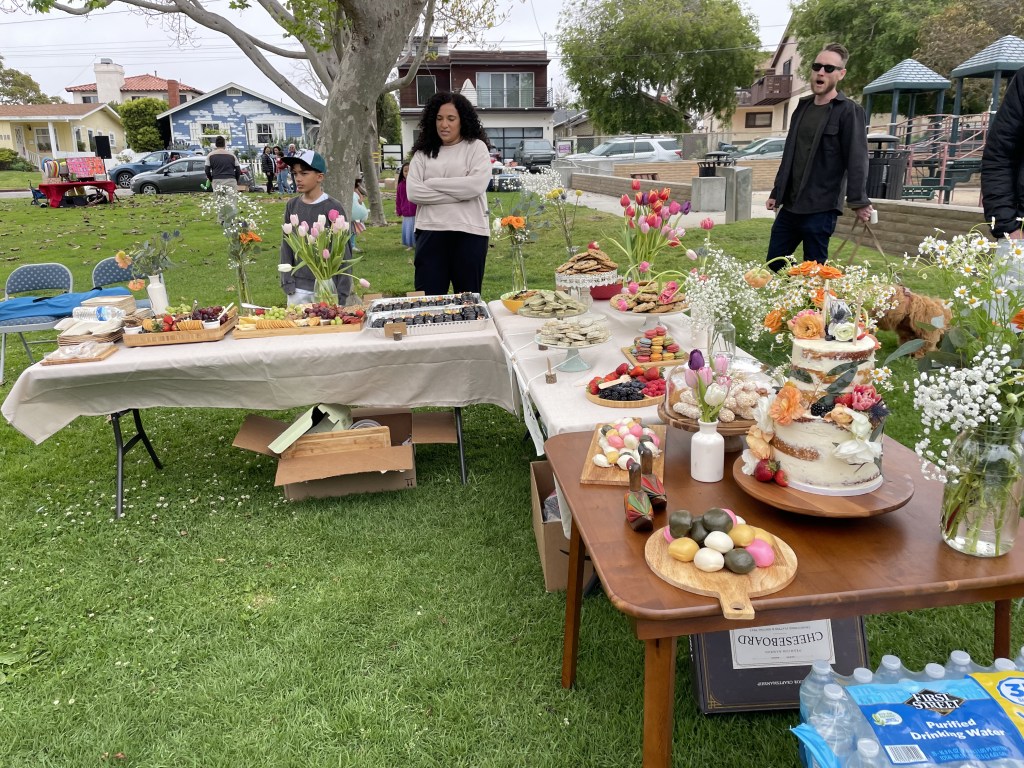
For Tov’s dol (first birthday in Korean), I began preparing weeks ahead. I bought a 25-pound bag of flour and lots and lots of butter. I made multiple batches of three kinds of cookie dough and froze them. I ordered a dozen Amazon packages full of cake-making and party supplies that I’ll probably not use again. I looked up countless recipes looking for the best cake recipe, and tested them out so I can find the best lemon olive oil cake recipe. I watched dozens of YouTube videos on how to make a naked tiered cake.

It wasn’t just me. My parents spent thousands of dollars to fly out for his dol, and so did my father-in-law. My mother made a huge pot of japchae while my father tried in vain to put Tov down for a nap. My mother and I spent took much time trying to arrange flowers I had bought at Trader Joes that didn’t really work well together. The day off, David and my father-in-law hauled boxes and boxes of stuff to the park to set up for the party. David’s uncle and aunt and cousins all helped me assemble everything together while I barked orders and ran around like a stupid chicken all stressed and frazzled because Tov had been crying nonstop and everything was still in boxes when we had 15 minutes until the party starts.

To be honest, I did not have all that much fun. I wasn’t able to hang out with anyone very much because I had to hold Tov most of the time, which also meant I wasn’t able to eat much of the food I had prepared, either. I was cold and tired and over-touched and over-stimulated.

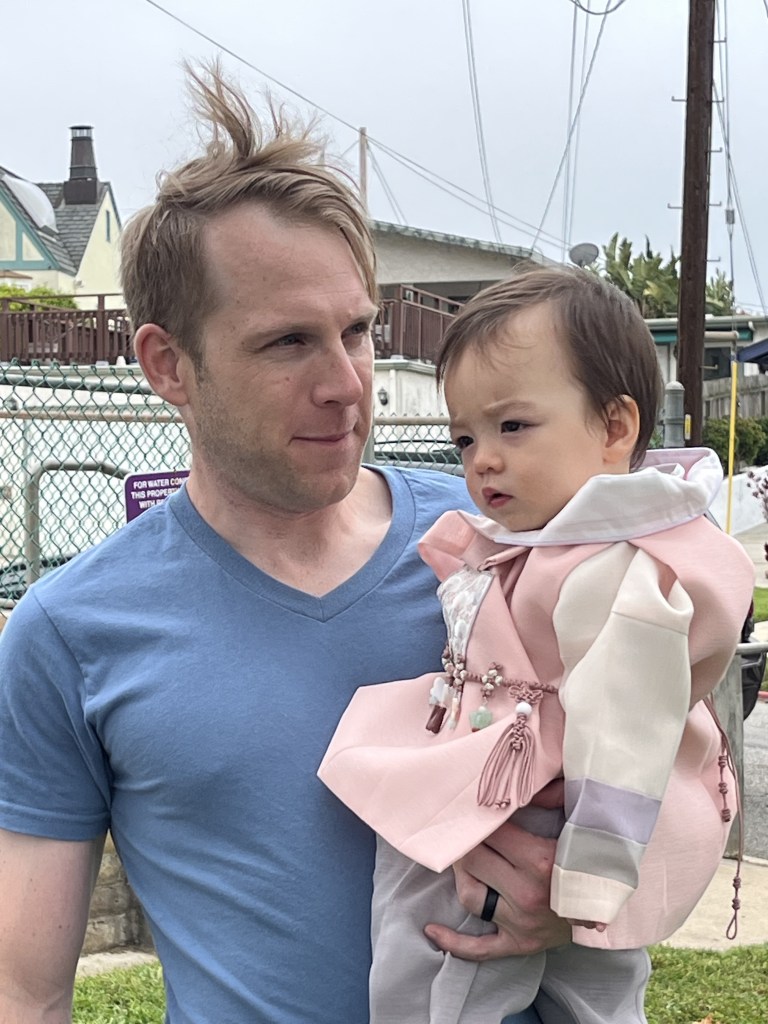
All this backbreaking work, for a one-year-old boy who couldn’t give a crap, who didn’t want to wear his traditional Korean hanbok, who cried and fussed because he missed his nap, and eventually passed out on David’s shoulder.

Oh, the things we suffer through for a child. Oh, the things a child suffers through for us adults.

But there was one redeeming thing to this whole affair: Except for Tov, we all willingly did it. People willingly sacrificed several hours of their Saturday afternoon to drive a far way down to us. Parents and grandparents willingly gave up time and money and energy to gift Tov a special celebration that he’ll not remember, but will hopefully bless him in immeasurable, invisible ways because it is a reflection of our love for him and each other.

Another redeeming factor: For his doljabi, Tov picked a globe! He shall be a globe-trotter! I was thrilled, though David was a bit sad he didn’t even give the baseball a glance. I cannot wait to take Tov around the world and let him see and experience the peoples and cultures I meet as a journalist.

Happy birthday, Tov. Even if you don’t remember the details of your dol, remember this: Even at that age, you had the power to bring together all these people to celebrate and bless you. That power is love. You still have it. You’ll always have it.

Little giant disrupters

Tov is nine months old.

In the last several months, he’s found his hands and his feet. Instead of laying helpless and limp on the bed, he has learned to grab things, hit things, thump his foot on the floor. He’s also found his voice, and instead of simply crying when hungry, he has learned to yell, exclaim, babble, growl.

What all this means is that Tov has become very very loud. There was a time when we could wheel him in a stroller into church or a restaurant, and he’ll sit quietly in the stroller next to us, either drifting asleep or sucking on his pacifier. There really wasn’t much else he could do. Now he’s wiggling and flailing to get out of his stroller so he can explore the world. He wants to commando-crawl from corner to corner, and touch shiny and dangerous things. He wants to put everything in his mouth, including dirt and soiled diapers. He wants to smack his open palms on the floor, clang objects on tables, and exclaim “Aaaaah! AaaaaAAH!” at the bangs and booms he’s making. He wants to screech– not because he’s hungry or poopy or tired, but just for the sake of screeching, because listen to me, mama, did you know I have a voice?

Our little son is a 16-pound creature who makes as much noise as a boom box– doesn’t matter if we’re at a prayer meeting, or a Bible study, or a dinner party. There is no shushing him. (Those amazing baby shushers? They only worked for the first two months, if that.) Pacifiers are no longer self-soothers to suck quietly, but projectiles to fling across the room, or hit the nearest person with it.

We cannot take him anywhere without apologizing for the constant disruption. Those self-care mommy IG accounts often preach that mamas don’t need to apologize for our baby’s noises. But I do apologize, because there is no other honest way to say it: My son, my adorable son whom I love so much I could stare at his little head for hours, is a tiny-sized massive disrupter.

Back in my childless days, these disruptions would annoy the heck out of me. They disturbed my peace, my space, my concentration and comfort. One time when I was an intern at a church, a parent brought their infant into the church office. The parent put the infant down for a nap in a room and must have been busy at a meeting, because the moment the child woke up, he wailed and wailed.

“Waaaaaah! WAAAAAAAHHHH!” went the little disrupter, and the high-pitched screeches raked like a witch’s fingernails on my eardrums and gave me a splitting headache. I would have rather listened to Blink-182 blasting full volume on a boom box, because at least I could turn that off. There is no “off” button for a human baby.

Finally, a friend who has a grown-up son hurried over to pick the baby up and calm him down.

“Poor baby,” she sighed. “He was in distress.”

“I don’t understand why babies cry so much,” I complained. “I don’t think they’re in distress. They just want attention.”

My friend raised her eyebrows and looked at another friend who was with us. “Oh dear,” she said. “When Sophia has her own baby, we’ve got to run over, because she’s gonna need a lot of help.”

Well, I’m never going to have a baby, so that solves the problem, I thought to myself.

Joke’s on me. Now I’m the parent dragging her kid around and causing disruptions. Now it’s my kid wailing in distress in the middle of a Sunday service, or breaking dishes in restaurants. Now I’m the harried-faced, apologetic parent, while others stare or glare at us. It isn’t just my life that’s been disrupted– everywhere I go, my family was disrupting other people’s lives, and for the sake of everyone’s convenience, it was just so much easier to stay home and be antisocial.

Except we need community. Parents of babies especially need community, at a time when our world constricts and squishes into a vortex of baby talk, diapers, and feedings, when all our energy and love is poured out out out out out and we just need someone outside of us to pour an ounce back into us. That’s been our prayer topic as a family for this year: We need community. Not a “see you on Sunday after church for 20 minutes” kind of community, but fellow brothers and sisters in Christ in the neighborhood with whom we can regularly and intentionally practice our faith together, people with whom we meet up so often that they know what’s happened in our lives yesterday, instead of two months ago. Because our church is a little further out, we haven’t been able to find that kind of neighborhood community yet.

So recently we decided to join another church’s community group, which meets every Wednesday night at a coffee shop owned by a church couple. Even on a weeknight during traffic hours, the group is only about a 15-minutes drive away. The one pitfall is, the group meets between 6 and 8 pm. Tov’s bedtime is between 7 and 8 pm.

This Wednesday, we wheeled Tov in his carseat-stroller into the coffee shop, and almost immediately he was wiggling to get out of the stroller. We took turns carrying and bouncing him around. We gave him things to distract him. I took him to the corner so he can crawl on a rug.

There was no silencing him. He took a plastic communion cup and repeatedly smacked it loudly on the tabletop. Smack. Smack, smack, smack! He punctuated the smacks with a happy yelp: “Aaah! Grrrrr! Aaaaah!” When I took him aside so he can crawl in the corner, he bolted out of the rug, slid under people’s chairs, and tried to lick their shoes. I gave him toys, but they were wooden and the floor was concrete. He banged them on the hard floor– bang, bang, bang! And when I took those toys away, he squealed, then smacked the floor with his hands instead. Smack, smack, smack! I let him crawl for a while again, and he thumped his foot on the floor– thump, thump, thump! All the while exclaiming, “Aaaah! Aaaaah!”

By 7:30, those “aaah”s were no longer happy exclamations, but angry screams. He was overtired and hyperactive– refusing the bottle, refusing to be held, twisting his body and flailing all limbs and scrunching his face into exhausted, enraged howls. Time to go home.

“I’m so sorry,” I said.

“Sorry, sorry,” David said.

We quickly strapped the yowling Tov into his stroller and hurried out.

The coffee shop co-founder, one of the leaders of the community group, rushed out with us. “I just want you guys to know, it’s totally OK. You all are always welcome here,” he said. “I have three boys. We understand. We all understand. Don’t ever feel like you can’t be here.”

“Thank you,” I said, incredibly moved, but I couldn’t help adding, “I’m so sorry.”

Two things can be true at once: My son is disruptive; he will distract and inconvenience people. And! There is also space for him, for us.

We’ve been craving community because we needed someone to pour into us during times when we feel like we’ve been poured out empty. And one of the biggest way people pour into us is to scoot an inch aside and make room for our noisy family, and to reassure us, “It’s OK. You are welcome here. We understand.”

It’s a grace that I never once extended to others when I was childless and single, and perhaps that’s why I have trouble allowing that grace to myself. I feel like I don’t deserve this grace, because I couldn’t give it to others when they needed it. And you know what? I don’t deserve it. Yet people give it to me anyway. So I’ll receive it, a little shamefacedly, that undeserved grace that is the glue that holds together a community made up of people who need and give it.