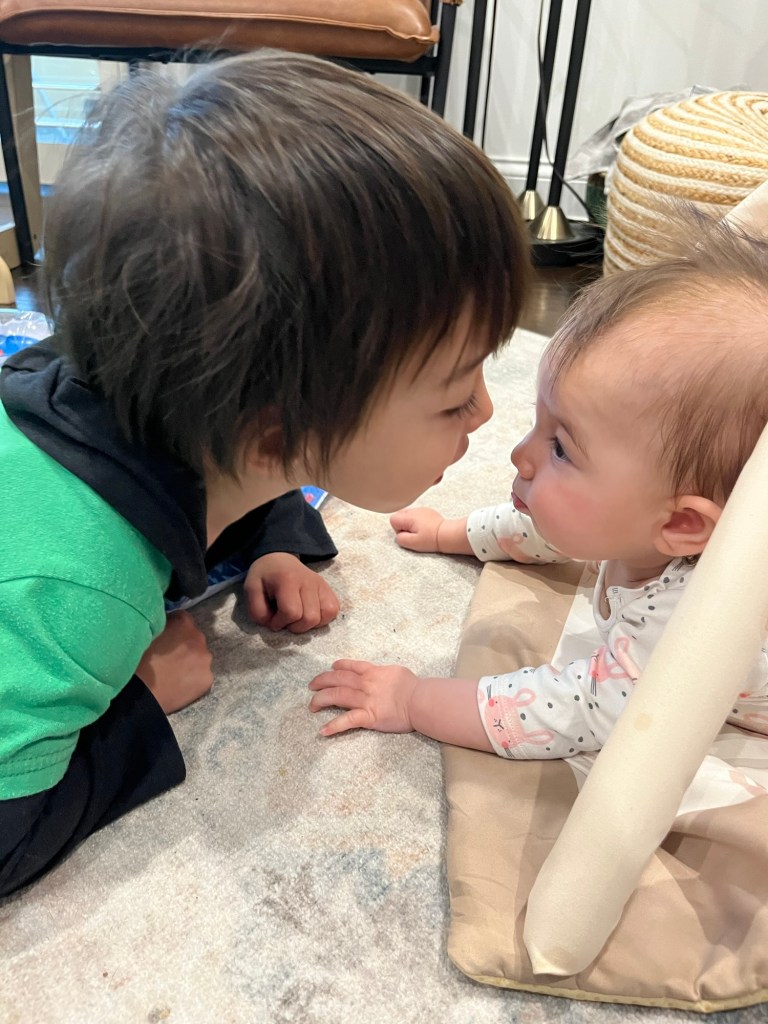
These are the best days of my life

Woori has been going through a sleep regression the past three weeks or so, exacerbated by teething. Like clockwork, at about 12:30 am, she wakes up screaming. And from then on, she wakes up every hour or two hours.

In the past month, she also stopped napping in her bassinet. She doesn’t even last 5 minutes before screaming and flailing so hard she’s breathless and hyperventilating.

All that to say, I am a walking zombie. I wake up in the morning groggy, with that deep-in-the-brain ache because my brain has barely been able to shut off all night. My body and hormones are off, because I’m night-sweating again, waking in a soaked T-shirt. I’m almost falling asleep as I drive Tov to school. Often, I pass out half-dead with lurid dreams while holding Woori in the nursing chair. (Somehow, I still have energy to read novels late at night, but that’s the kind of nonsensical superpower parents have when we are liberated after putting the kids to bed.)

It’s been hard, but honestly I don’t really have the mental and physical energy to even think about how it’s hard. I just go on, putting one foot before the other, day by day, dragging my weary body through the mire of parenthood.

There have been moments of lucidity though. I remember one morning, as I heard Tov having a tantrum with David in his room, and Woori starting to fuss in bed with me (we co-sleep now— it just keeps everyone sane), and felt the bunched-up clammy sheets under me, and raked my hand through my damp, disgusting postpartum hair, probably pulling out 237 strands of hair that I don’t have to lose, all of a sudden, this thought came to me: “These are the best days of my life.”

It’s cathartic to complain about parenthood, especially those early childhood years, when everything is a struggle, from shoving a sweatshirt over a screaming, snotty toddler’s head, to driving stressed because the baby’s shrieking like a banshee in her car seat and there’s nothing you can do about it. Complaining about the hard moments of parenthood is viral content on social media— I enjoy them; I enjoy commiserating and sharing them with my fellow moms and dads. It brings much-needed comic relief to a period that feels so long and consuming.

But still. These will be the best moments in our life.

When I was young, I could not wait to grow up. I wanted to be independent, to earn my own money, choose what I want to eat, where I want to go, without asking my parents for permission.

Meanwhile, my childhood best friend dreaded growing up. “I want to stay a child forever,” she told me. She liked her cocoon of innocence and lack of responsibilities, liked the assurance that someone bigger and wiser is taking care of her.

“You’re stupid,” I told her, with all the eloquence of a 9-year-old. “Or crazy. Why would anyone ever want to stay a child?”

She gazed with longing into the past. I gazed with impatience into the future.

And I’ve lived like that since. I’ve always been impatient for what’s next, what’s new. When we immigrated to the United States, I eagerly kissed everything and everyone in Singapore goodbye. Next! In high school, my actions and thoughts were all set towards preparing myself for college. Next! Once in college, I couldn’t wait to graduate and be done with school forever, and kickstart my career. Next! Then once I got a job, I was never content in my career. I wanted to work in someplace more prestigious, and lived in constant frustration of feeling stuck in my job, watching with envy when my peers seemed to hop on to shinier opportunities. Next. Next. Next!

What’s next? What’s new? Is this it? To what end I was working towards, I did not know. What was the achievement that would finally satisfy me, to make me relax and say, “This is it,” what was the accomplishment that would allow me to start enjoying what I have, I do not know. I was just perpetually restless, rootless, reaching out and out.

And now. As a parent, as a mother of a 2.5-year-old and a 5-month-old, I seem to do both, looking both forward and backward. I look at old pictures of Tov and my heart aches. Sometimes he looks up at me a certain way and I lose my breath; I’m so shocked at how boyish, how non-toddler his expression is. My boy is growing up before my very eyes, and I am still caught off guard by how fast.

Even as I hold Woori, who blessedly still fits in my arms and stays where I put her, I am already mourning, looking into to the near future when she’s 2 like Tov and Tov is almost 5, and I feel nostalgic for the very period I’m currently in.

Parents have talked about the importance of “soaking in” every moment, but I feel like every moment, even as I’m living right in it, keeps slipping through my fingers like water. Rather than soaking, the moments seem to flow out like a stream, and all I have are pictures and reels on my iPhone as memories that are memories because they are already in the past.

Yet at the same time, I’m still planning my future, wondering what’s next. When are my kids going to be independent? When can I start having my time back, my body back? When can I restart my career? When I can have my mind and creativity back? When can I start writing again? And because motherhood makes you insane, I also wonder: When can we have a third baby?

Perhaps the present moments keep slipping me by because I keep looking back to the past and out into the future, but rarely stay still to enjoy the present. Honestly, I don’t know how. I haven’t practiced that enough to suddenly do it now.

Which brings me to that morning when I woke up feeling that heaviness of trying to swim upstream, facing the new day with exhaustion, and that seemingly random thought came to me— that these are the best days of my life. I was startled by how strongly this sentence entered my mind, so I took it as a conviction from the Lord, and I thought of Ecclesiastes: “Hevel, hevel, all under the sun is hevel.

Working hard on a career is hevel, or meaningless, or vanity. Marriage is hevel. Raising kids is hevel. All in life is hevel, unpredictable and fleeting, impossible to grasp and control. So I was right: It is hard to “stay in the moment” because time keeps moving, tick tick ticking along even as we practice meditation to “be still.”

But there’s still joy found in the hevel, Ecclesiastes tells us: “Light is sweet, and it is pleasing for the eyes to see the sun. Indeed, if someone lives many years, let him rejoice in them all, and let him remember the days of darkness, since they will be many.”

I love how realistic and grounded Ecclesiastes is, at once exhorting us to enjoy what we have while also acknowledging that life feels futile and hard. Yes, we are all drawing one day closer to death every day. We all die, including powerful filthy-rich smart-alec jerks like Elon Musk and saints like Mother Teresa. Death is the ultimate equalizer; as terrible as it is, it is fair.

Accept the hevel, accept that time is passing us by, accept that a lot of things that mean so much to us will not mean much after we’re gone. Enjoy our remaining youth while we can. Work hard while we can. Enjoy our bread while we can, and enjoy the sun when it’s out.

And always remember: “Fear God and keep his commands, because this is all humanity. For God will bring every act to judgment, every hidden thing, whether good or evil.”

“Judgement” sounds so ominous, but not when the judge is God, who is perfect in every way. This perfect God sees it all. He sees me nursing Woori at 4 am. He sees me packing Tov’s lunch in the morning before my first cup of coffee. He sees me holding back my temper when Tov is having a tantrum. My kids will not remember all these little acts of service, and if I’m banking on my husband or society to acknowledge everything I do, I’ll become bitter and petty. But God does. He sees what I do, and He also sees right into my heart as I do these daily domestic duties.

As I slide into the early stage of middle age, as the rosiness of youth wilts, as I gain hard-lived experience and knowledge with every fine line and wrinkle, I want to remind myself that I’m living the best days of my life.

One day I’ll look back and miss these days when I can still carry Woori on one hip, when I can cuddle and smother Tov in kisses while he giggles, and hopefully, hopefully, by then I would have gained enough wisdom and contentment to be able to miss the past yet also wake up every morning declaring, “Today is the best days of my life.”
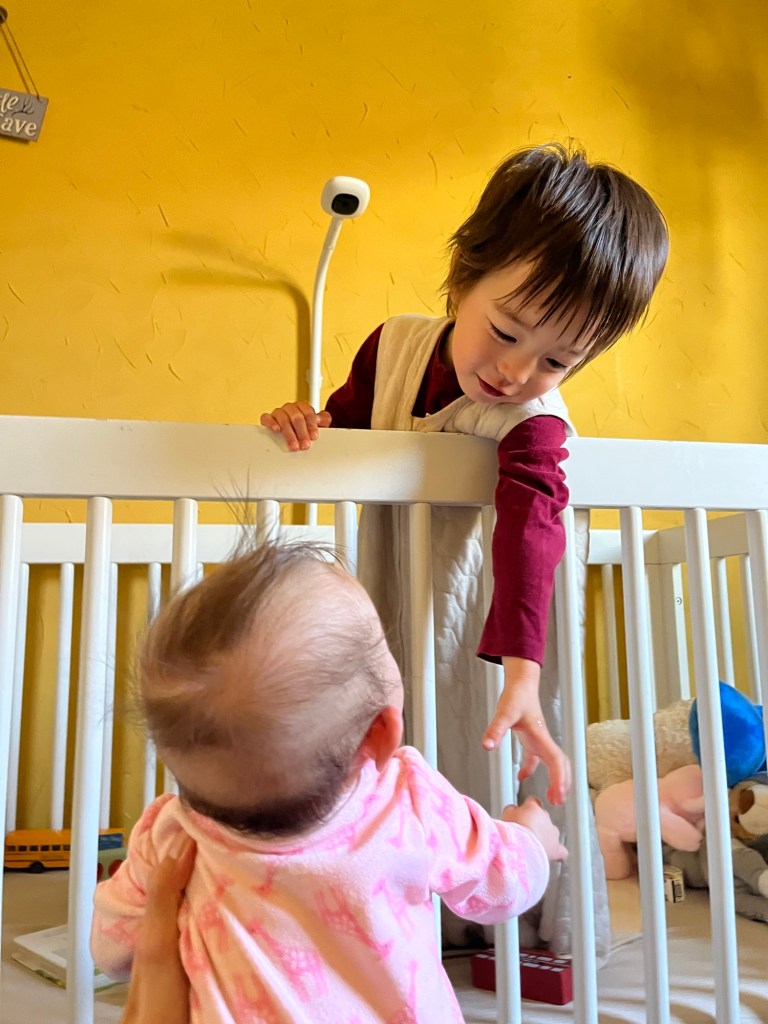
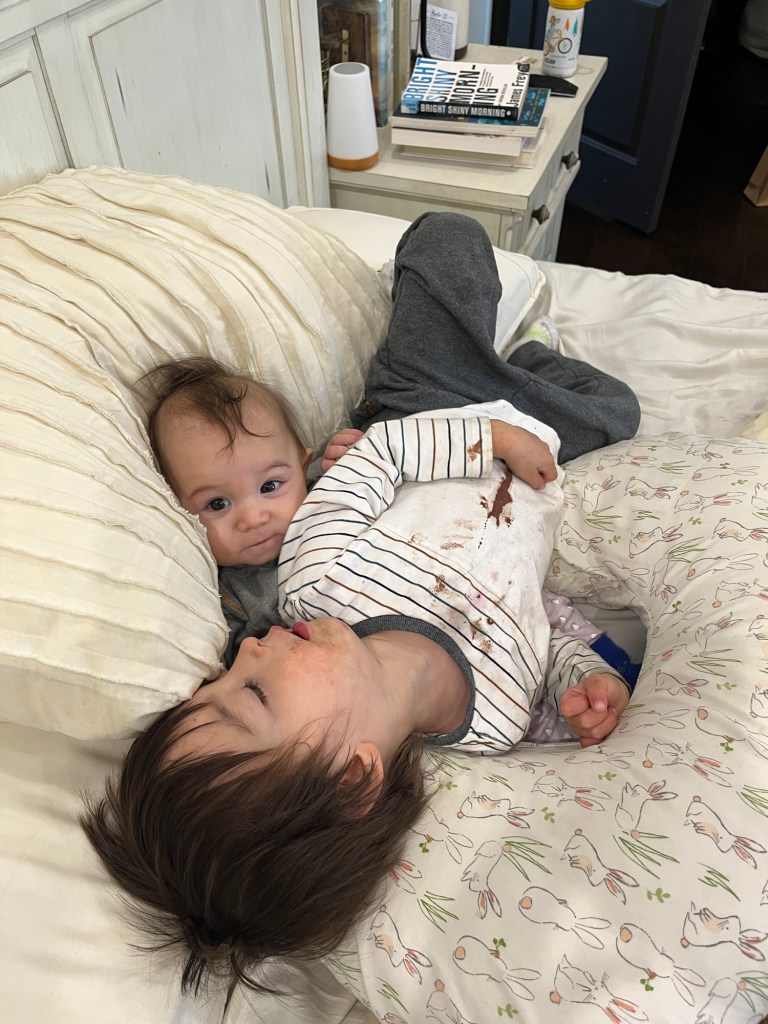
Tov is definitely jealous

I tried really hard to not let Tov feel like he’s lost a mother when Woori was born.

The first time he met Woori at the hospital, I made sure she was in the bassinet, not in my arms. I held him and cuddled him and gave him lots of attention. I still bake with him as much as he wants. When I’m nursing Woori and he’s around, I am pushing toy cars on the arms of the nursing chair with him, singing songs with him, reading him books. I leave Woori in the car when I drop him off and pick him up at school, so that he has my full attention and I’m not hip-hugging him goodbye or hello.

But things have changed. I don’t put him to bed as much anymore; David does that. I don’t greet him when he first wakes up; David does that. I don’t give him baths; David does that. I’m not the one pushing his wagon when we go on walks; David does that.

Having two young kids under 3 is kind of like being single parents in the same household, each assigned to one kid. Honestly, it’s helped assuage some of the resentment I’ve had towards David about unequal parental duties, but at the cost of losing undivided time with Tov. When I am taking care of Tov, it’s almost always with Woori sitting on my lap, or me shuttling from one kid’s urgent need to the other’s.

So as much as I’ve tried, Tov is sensing the loss. He’s overall a very affectionate, sweet big brother— he loves kissing and hugging Woori, even though half the time he’s either squishing or head-butting or chokeslamming her, all in the name of brotherly affection. For the first several months, he didn’t show signs of jealousy. He would forget about her, then obsess over her, then run off to his own thing again— all the normal classic toddler narcissism, in which he has little emotional and mental capacity to consider anyone else but himself. But never jealousy.

And then. It’s starting.

Woori is now five months, and around the mid-four month mark, Tov all of a sudden started hitting her— not unintentionally in the spirit of fun, but willfully, deliberately, spitefully. I can see the shift by the expression in his face. It’s not hee hee look what I’m doing! but I’ll show you! He’s not giggling but serious— his lips pursed, his eyes hard, his brows snapped close with intent.

And there’s no guile or sneakiness about it, either. He doesn’t do it behind our backs but when we are watching. As if to make a point.

One morning, I was trying to nurse Woori to sleep when I saw him stomping into the room, his palm up straight and hard like a paddle. He comes stomp stomp stomping with a purpose over to us, and while I’m watching, while I’m telling him to step away, raised that palm up and smacked Woori over the head. Not once, but again and again, smack smack smack! I fruitlessly told him to stop it, trying to lift Woori out of the way, until by the third smack I had to physically push him, and he fell back on his bottom.

“I told you to STOP!” I yelled at him, and he stared up at me in amazement. Then he lifted his chin up to the sky like a wolf and howled. Fat globes of tears ran down his cheeks as he sobbed with sorrow, and I felt both sad and tickled at his theatric, but also very real and sincerely felt, emotions.

By then Woori was also wailing, startled awake from having had her head slapped in the middle of a drowsy feed. I shushed her as fast as I can, then put her down and picked up Tov and comforted the other heartbroken kid. She quieted down quickly, but Tov needed a longer cuddle. He didn’t need words from me about not to hit his sister— he hears that all the time— he just needed a hug that gave him both my arms and both my eyes.

Oh, how he sobbed. Like he had lost his mother, though he doesn’t understand that, doesn’t understand how and why he feels this way, cannot articulate it to me or to himself. It is a tough age to suddenly become a big brother, to share your parents with someone smaller and needier than you are, even though you are still very small and needy yourself.

I, too, was a big sister, though now at 37, I can’t remember how I felt when my parents brought home a newborn baby brother. I must have had big feelings then too, confusing and terrible feelings, but none of those feelings have left a mark on me 35 years later, so I know Tov will be fine, but I also know that right now, all these changes is a freaking big deal to him.

So I try. I try not to get mad at him when he mistreats his sister. I try not to have big reactions, which I suspect is what he wants— attention, any kind of attention, even the bad ones. I teach him to shake Woori’s hand instead of punching her, to cycle her legs instead of kicking her, and he seems to enjoy that. Now whenever he hits her, I look at him and he amends his behavior by shaking her hand, looking up at me for approval.

Still, I know he’s jealous. When I give Woori anything, Tov snatches it away. I give her a rattler; he wants it. I give her a teething toy; he wants it. I give her a wooden bus; he drops everything and rushes over to grab it out of her hands. I give her a ladle, then a spoon, then a Tupperware lid; he snatches them one by one away until he’s amassed a hill of items that he doesn’t care for other than the fact that he doesn’t want his sister to have it.

Poor Woori. Right now she’s defenseless, and doesn’t know even to protest when her oppa rudely wrestles her toys away from her little fingers. But one day she’s gonna fight back. Like the time when Tov rolled over her and her hands closed over his thick tufts of hair and pulled hard, eliciting yelps of pain from her brother.

Did I tell Woori to stop it? No, no I didn’t. Because Tov kind of deserved it, and he needs to know his jealous bouts have consequences.

Tov, you gotta watch out. Woori’s not gonna take this lying down for much longer.

How I feel 4 months postpartum as a stay-at-home mother

It’s been almost four months since I’ve had Woori.

Many people, after reading my essay for Christianity Today on transitioning from a working mother to a stay-at-home mother, have asked me how I’m doing now that I’ve crossed that transition.

I reply, “Don’t know. Ask me in a few more months.”

It’s a hard question to answer because honestly, I’m rarely thinking about how I feel. I’m just clucking about like a crazy hen, pecking at this, chasing chicks, fluttering and puttering and scuttling. My eyes only see what’s right before me in the dirt, at hen-height. The day passes by so fast I can barely tell a Wednesday from a Saturday. I could have sworn I just folded a pile of laundry, and behold, here’s a mountain of laundry waiting to be folded again!

So I haven’t really had the chance to sit down and process my thoughts and feelings, but it really isn’t just about lack of time, either.

I’ve gotten dumb. I’ve gotten really, really dumb. When I expelled all my postpartum blood, I seem to also have flushed out most of my IQ. I forget friends’ names. I forget to respond to texts. I forget where I placed an item right after I’ve placed it. I lose my phone all the time. I can’t finish a thought. Words don’t come to me as I’m speaking, so my sentences are jumbled and chopped. When David wants to talk to me about news and politics, I have absolutely no mental or emotional capacity to respond other than to mutter, “Oh yeah?”

So yeah. How do I feel about being a stay-at-home mother? Maybe the most accurate description is: Dumb AF.

But it’s also confusing. Because in those moments when I am more aware of my thoughts and feelings, they don’t make coherent sense.

At times, as I hold Woori and feel her warm little head resting on my shoulder, or kiss Tov as he giggles with such wild joy, I feel such deep contentment, like my life is perfect the way it is. And then other times, I’m deeply discontent, and the smallest thing annoys me— the permanent clutter, the hands constantly grabbing at me, the noises, the very breathing of my husband. (Is it too much to ask our spouses to stop breathing for just half an hour?)

At times, I’m simply so filled with gratitude for the blessings God has given me that tears spring to my eyes, and I want to leap and sing like Maria in Sound of Music. Other times, I’m in inexplicable rage mode, wanting to kick walls, throw things, scream.

At times, I love the familiar, comforting drudgery of motherhood— feel relieved, even, that I don’t have to go back to work. Other times, I feel pinches of panic and anxiety— is this it? Am I stuck in this merry-go-round of domestic hell? Dropping kids off, picking them up, cooking and cleaning, wiping butts and wringing your explodes mustard-colored poop off onesies? What if I never make something of myself? Am I ever going to write a book?

At times, I tear up seeing how big Tov is now, and how quickly Woori is growing, and whisper to them, “Oh, stop growing so fast,” and I wish I can freeze time and capture them tiny forever in a snow globe. Other times, I’m impatient for the next stage, impatient for them to be more independent and self-sufficient, so I don’t have to help dress them or bathe them and I can have my life back again.

That’s the paradox of parenthood: I feel the extremes of both ends on the emotional spectrum, often within the same day. I’m standing pulled and stretched in that tension of contradictory feelings, which spike and dip wildly like a monsoon season. And from what I’m hearing from other parents, everything I’m feeling is normal. Laughing with joy one minute and then internally screaming with frustration the next? Quite normal. Wait till your kids are teenagers, they say.

So. At four months postpartum, how do I feel? Like a mother, I suppose.