Married with a newborn, Part II

It’s interesting how we form a lot of our “truth.”

We like to think that we form thoughts and opinions based on facts, evidence, logic. Rather, it’s the opposite: We have a thought, and then we look for facts and evidences to reason that thought into “truth.”

I had such a thought one day. I thought, “I have a terrible husband.” And from then on, the evidences all fell swiftly and neatly into a report on why David is a terrible husband.

That is a very dangerous thought, because no spouse is perfect. We’re living with an imperfect human being, sharing so many intimate, unfiltered moments that a person’s every flaw pops out of the surface like pubescent pimples. And when you look at your spouse and decide that he is x or y or z, every incident– past and present and imagined future– reinforce that he is indeed x or y or z. Any evidence that points otherwise is ignored, dismissed, and reasoned away.

My thought– that David is a terrible husband– raked up old conflicts long resolved that date back to our dating days. They came back alive and groaning like a resurrected mummy. And once that thought clutched my mind, it held on with a death grip, killing all the joy and grace in my heart.

Obviously, there are genuinely terrible spouses out there. This is not the case here. David has always supported me and my career. He consistently provides for the family. He has never once raised his voice at me. He does all the cleaning in the house. He is a great father to Tov. He even takes better care of the cat.

But that’s how deceitful our thoughts can be. One morning, I woke up feeling grateful for my husband. I kissed him good morning and blessed him with all my heart. Then by evening, I was tallying up all the ways he had disappointed me. My eye sharpened, and my heart narrowed. All within the span of 12 hours.

What changed? Besides for being physically and mentally drained, I listened to my own thoughts, and only my own. It doesn’t mean that thinking is bad– I’m talking about the kind of self-focused, self-listening, self-advocating, self-accusing, self-reinforcing thoughts that dwell in my mind and heart and spirit, leaving no room for anyone else’s voice but my own. And I know myself. I can be selfish, mean, contradictory, exacting, ruthless, graceless, impatient, toxic– everything that the fruits of the Spirit are not.

That evening, on our usual evening walk, I lingered several steps behind my husband because I was crying, and I didn’t want him to see my tears– not out of consideration for him, but if I’m brutally frank, it was because I was content to just stew in my own thoughts. They were familiar, even comforting. Bringing him into my self-conversation would have added inconvenient and uncomfortable nuances to the picture.

It just so happened that that morning, I had begun reading a book called “Risen Motherhood” by Emily Jensen and Laura Wifler for a book club. I had recently joined this book club with other mothers from my church and just finished reading the first chapter, which ended with the book’s main point: “This book is for every mom who is asking, ‘Does the gospel matter to motherhood?’ Oh friend, the gospel changes everything.”

The gospel changes everything. I thought about that paragraph that evening. I remember thinking, as I walked behind my husband, wiping sour tears from my cheeks, “OK then. How does the gospel change this?”

Preach the gospel to yourself, the book says: “…we hope you’ll be encouraged and that you’ll gain a greater ability to see God in your own life through gospel lenses.”

All right then. Sounds good. Let’s try seeing this situation through gospel lenses. Well, let’s see…I am a sinner. Ha. I know that. I also know for certain that my husband is a sinner. We are all wretched creatures, I know, I know, OK, next.

Jesus died on the cross for my sins. Well, Jesus, thank you, that is wonderful, I am grateful, truly. But now what? How does his death more than 2,000 years ago change what I’m feeling right now?

The world is broken, but God redeems. Again. Wonderful, but what am I supposed to do about that now, as as a new mother and wife, when I can’t stop the tears from falling and it’s freaking embarrassing that I’m crying, when I feel unappreciated, ugly and old, tired as hell, and uncared for? Do I just wait around for God to magically redeem this broken situation? Do I count to three and hope for joy to magically infuse my heart?

This isn’t working. My heart is still as hard as popsicles. How? If the gospel changes everything, how does it change this specific situation in my life?

I should have read on. The second chapter of “Risen Motherhood” is titled, “What is the gospel?” And I have to admit, I rolled my eyes. I grew up in a preacher’s family. As a kid I attended church services three to four times a week. I’ve heard the gospel till I bleed in the ears. I don’t need yet another retelling of what the gospel is. I felt like I was reading a book explaining the alphabet to me.

But as I read that chapter the next day, I realized I had left out something: I have an enemy. He is a real being, and the Bible describes him as “a murderer from the beginning” who has “no truth in him,” “a father of lies.” (John 8:44)

I don’t know how that slipped my mind, but it jolted me. The fact that I have an enemy who’s a liar and a thief became so real to me. Then it clicked: There is someone who’s actively trying to destroy my marriage. There is someone who’s whispering falsehoods in my ear, and then sitting back watching and cackling while I take his lead and continue the work of self-destruction. There is someone who viciously hates me, because I am loved by God whom he hates, because I share the glory of God that he covets. This someone tells me that the gospel is irrelevant and boring; he blasts white noise in my head: blah blah blah, I know it all already.

But do I, really? Is the gospel a continuous reality for me? Why do I always forget? Why do I go through life with the gospel as a blur in the background, like coffeeshop music? Because in my worst moments, in the deepest, darkest caves of my thoughts, if the gospel doesn’t shine there, then is it true?

If the gospel is true, then I need to wake up and protect my marriage. And if the gospel is true, then when I’m hearing the lie that my husband is a terrible spouse, I can remember exactly who planted that lie in my head, and I fight back with victory, because Christ crushed that enemy’s head on the cross. If the gospel is true, then I need to pray– really pray, not just by myself, but with my husband, for my husband, for us.

David and I are both very independent beings. We even do our own laundry– which is fine, but we carry our independence into our spiritual walk too, which is not fine. Other than meal times, we rarely pray together. I guess I think of those picture-perfect Christian influencer couples kneeling and praying while holding hands (somehow they’re always young, blonde, and beautiful), and it feels so inauthentic, cheesy, performative. But since Tov’s birth, I’m feeling the urgent need for us to practice the habit of praying together for the sake of our household, for the sake of keeping the gospel active and true in our life.

Since then, David and I have talked more about our needs and expectations. He suggested doing a devotional together every evening during dinner. We’ve been doing that (not always consistently, because such is life) for about three weeks now. At times we get distracted, especially when Tov is being extra fussy, but that’s OK. There is grace for all of that. This is a season of grace. And thank God, the grace is all His.

Married with a newborn: Part I

David and I had our first conflict as parents when Tov was about 10 days old.

We thought we were ready for conflict. While I was pregnant with Tov, we heard a lot of advice and warnings from other parents: You’re going to be exhausted and frazzled. You’re going to lose your temper with your spouse. You’re going to resent him/her. You’re going to argue. So over-communicate, prioritize your spouse, go on date nights.

David and I talked about this before Tov was born. Let’s always have grace with each other, we promised: We’re going to help one another. We’re going to communicate. It’s all about teamwork. We got this, partner!

I wish life works out exactly as our promises. I wish I have more grace than my best intentions. But even if I’m the most even-tempered, sweetest person in the world, I still won’t have enough grace during those unexpected, out-of-control, aggravating, I-hit-my-limit moments that unleash the worst parts of me.

No, the grace manufactured out of my own willpower is never enough. I need the pure, limitless, naturally-flowing grace from a source who’s perfect, someone who has so much abundant grace that He willingly sacrificed Himself for sinners who rejected Him. I need Jesus.

If you’re a long-time Christian, how familiar does that sound? I knew that. I know that. This is basic Gospel 101 that my parents and church have hammered into me since I was a young girl. And yet…why, during the times when I need this gospel truth most, why does it suddenly seem so unnatural, foreign, and irrelevant?

****

It was dinner time. David and I were having takeout for dinner: pad see ew and green curry. David, as always, needed something sweet to finish off the meal, and he remembered there was a half-eaten Milk Bar corn cookie in the fridge. The cookie was tucked way back in the fridge, so he had to wiggle his arm in…and in the process, knocked over the plastic bottle filled with breastmilk. The bottle tumbled onto the floor, hitting at just such an angle that the lid popped off, splashing its content across the kitchen.

“Argh, damn it!” David exclaimed.

“What is it?” I asked. I was still finishing my curry and hadn’t seen what had happened.

“I spilled your milk,” David said, sighing and ripping out some kitchen paper towels to wipe up the mess.

“WHAT!” I shouted. “All of it?”

He shrugged.

And then I lost it. “I HATE YOU!” I screamed.

David stared at me. “You hate me? Excuse me?”

We stared at each other for a couple seconds.

He wrung his hands. “I’m trying!”

For some reason, that irritated me even more. I felt like David was making the spilled milk all about him, and by then I was sick of hearing him talk about how exhausted he is. What about me? I’m the one who gave birth! So I silently watched David clean up the mess in burning-cold silence, my rage frothing. Then I said, my tone prickly with irritation, “Why couldn’t you have been more careful?”

David didn’t say anything, but he made a motion of pulling his hair in frustration, which further pissed me off.

I should explain myself. Often, men accuse women of flying off the handle for no reason. But such an incident never happens in isolation. That milk David spilled? It was only about 2 measly ounces– but it was 2 ounces that I had spent the past 16 hours collecting. That included an hour’s session of power pumping at a godawful time in the morning until my nipples were swollen and sore, only to collect a thumb’s worth of measly milk. Each nursing and pumping session was discouraging and defeating. Meanwhile, we were in the midst of a terrible formula shortage, and Tov was still below his birth weight.

So I was worried about Tov’s lack of weight gain, frustrated about my slow milk supply, incredibly tired from lack of sleep, and somewhat resentful of my sudden downfall from a free, independent woman to a walking, bleeding cow– all udders and leaking fluids and foggy brain, my days and nights filled with nothing but the mundane, mind-numbing tasks of keeping a newborn child alive. I missed my freedom, just the taken-for-granted joy of being able to brew a cup of coffee and drink it hot without being interrupted by a crying baby. I missed the freedom of reading late into the night and going to bed whenever I want, the basic freedom of functioning as an independent, well-rested, well-fed human being.

Then I looked at my husband, and his life didn’t seem to have changed that much. He’s still working; he took only two days off while I was at the hospital. He’s still going on two walks a day. He’s still working out every morning. He still eats three meals and three snacks a day, and is able to sleep through the night. In my mind, my husband got to keep his routine, while mine has been shredded like confetti. And before I realized it, resentment coiled around my heart.

So that 2 ounces of milk? I wasn’t crying over spilled milk. I was mad because I knew how much toil and loss went behind collecting that milk, which my husband spilled while reaching for a damn corn cookie– and he shrugged. And in that instant, I reached for the worst interpretation of that shrug: It wasn’t so much that I didn’t think he cared about the work I’ve put in– I decided he just didn’t even care to know about it. I was suddenly struck with an indignation that he never once asked, “And how are you doing?” So at that moment, the first sentence that shot out of my mouth was an explosive “I hate you.”

Did I really hate him? No. But in the thick of the moment, with so many unprocessed thoughts and emotions swirling through my mind, the first gush out was like projectile vomit– a chunky, sour, undigested mess. I just wanted to say something that slapped my husband in the face, something shocking and sticky and rude, to make him notice me.

You can tell there’s a conflict in our house not by loud volumes, but silence. We did not speak much for the rest of the night. David ate his cookie and went on his long evening walk. I fed Tov and changed his diaper. When David returned, I silently handed Tov to him and retreated into the dark corner of our bedroom. The next morning, things returned to “normal.” We didn’t talk about what happened the previous night. I didn’t explain why I reacted the way I did, and David didn’t tell me how my outburst made him feel. I watched Tov all day. David worked all day.

Having a newborn child changes your marriage. Because of the baby’s sleep pattern, we were no longer sharing the same bed. At times, I felt like we were more roommates than married couple. Nothing was really “wrong” with our marriage– but I could feel the first tugs of strain. I was easily irritated and short with my husband, especially when I felt my expectations and needs were not being met, yet I couldn’t and didn’t articulate what those needs are, because everything was just so new and unfamiliar.

Grief also changes marriage. David lost a mother. I lost a mother-in-law. That’s not even remotely the same grief. Life remains relatively the same for me, and other events– starting a new job, the birth of my son– took precedence. But for David, his life had cracked apart, and he was still holding onto those shattered pieces, unsure of what to do with them, cutting himself every time he tries to glue them back together. For him, every event– especially the birth of his son– reminds him of his mother. For example, Mother’s Day– my first Mother’s Day as a mother, his first Mother’s Day without his mother– made him sad, so we didn’t even acknowledge it.

Grief is a lonely road– nobody really understands this grief of losing a mother until they experience it themselves. People swarm around the grieving person for a week after the tragedy with casseroles and prayers and flowers, but one week, two week, one month later, everybody moves on with their busy lives, whereas the grieving one observes life through frosted glass. But as a wife, I too sometimes felt lonely. We were experiencing the greatest experience of our life as new parents together, but I couldn’t quite feel the togetherness in it, because while I wanted to cry tears of pure joy, David cried tears of loss, and my selfish, tired heart wanted a respite from all those heavy emotions, a break from nursing both a newborn baby and a husband’s broken heart.

At first, I felt guilty for feeling and thinking that way. I should be more understanding, more empathetic, more self-giving, I preached to myself. But then a voice interjected, “But why? You’ve done enough! Isn’t marriage a two-way covenant? What about your needs? Shouldn’t your needs be met, too? Who takes care of you?” So I cast the guilt aside, and instead took on the cross of a justified martyr. I swung between guilt and self-justification. Neither felt nice, but both felt right.

It was reasonable and natural to feel the way I did. I was “right” that a wife needs care, attention, and appreciation from her husband. I was also “right” to recognize that during some seasons, one partner might need more tender care than the other, and this was a season for me to practice self-sacrifice and selflessness. Everything I felt and thought were logical, understandable. But the problem was, it was too logical. My mind was a courtroom, and I was the defendant, the attorney, the prosecutor, the judge, and the jury. There is no room for grace in the courtroom.

I accused my husband of making things all about him. But I too made it all about me– and that much focus on self does not leave room for the Spirit to grow fruits– love, joy, peace, patience, kindness, generosity, faithfulness, gentleness, and self-control– all the qualities I desperately need for a thriving marriage.

I needed grace. I needed the gospel, a gospel not just stuck in my head as concepts but living and breathing truths in my daily life.

Continued in Part II

Grandparents come to visit

My parents flew from Virginia to Los Angeles to meet Tov in late May.

Anyone who knows me knows I’m an extremely independent person. I think I wear my independence like an envelope– it’s how I present and package myself. I like being independent, and I like being known as independent. So I assumed a lot of things about what postpartum will be like for me– I assumed I wouldn’t want any visitors at the hospital, no visitors at home, no advice or gifts or meals, just everyone, please leave me alone to figure this parenting thing out on my own. That included my parents: I assumed I wouldn’t really need them that much.

I assumed wrong. The day we got discharged, as a hospital escort wheeled me out to the parking lot, she exclaimed, “You guys just seem so chill! Most of the other parents I’ve escorted always look so terrified and anxious. But you guys don’t look anxious at all!”

That wasn’t true. There were plenty to be anxious about; we just didn’t show it, because everything had happened so fast, so soon, that we were suffering from whiplash and had no mental space to even feel anxiety. Right before we were discharged, the pediatrician told us Tov showed concerningly elevated levels of jaundice, and recommended we take him to the ER the next morning for another blood test. That day, Tov was so drugged out from his circumcision that he could barely sip 10 ml of milk, even though it had been more than four hours since his last feeding, and the lactation consultant had told me he really should be drinking at least 40 ml every two to three hours. The kid was so tiny at less than 5 lbs, fresh out of the NICU, looking a little orangey-yellow in the face, and he was coming home alone with clueless parents who didn’t even know how to buckle him into the car seat, how to burp or swaddle him. I wanted to borrow a couple nurses and take them home with me, because I had questions about questions I didn’t know. When we got home and parked the car in the garage, David and I looked at Tov and then at each other: OK. What now?

That was when I really, really wanted my abba and omma. It wasn’t even about asking them for help with the baby. I just wanted their presence, to feel safe and secure at a time when I suddenly had to provide safety and security to a fragile child of my own.

My parents arrived late at night on a Monday, while Tov was sleeping soundly. David picked them up at the airport and brought them home to meet Tov. Concerned about bringing germs and viruses, parents had said they would keep their N-95 masks on and just look at the baby in the crib. But once they saw Tov sleeping, at times puckering his lips and wrinkling his little forehead, they simply couldn’t help themselves– they gasped; they laughed in wonder; their hands naturally reached out to stroke his cheeks, his hair, his little bundled body.

And I didn’t care at all. I wanted them to touch my son, to embrace and kiss him, because I wanted Tov to receive all the love I’ve always received from my parents from birth till now. Because Tov needs his grandparents’ love. And because a mother also needs her mother.

The next morning, my parents came to our house with three huge boxes full of ingredients they had bought from the Korean market. They bought so much stuff that my fridge could barely stay shut.

Only parents would eagerly fly across the country to physically labor in their grown-up children’s house. I may be almost 35, but in my parents’ eyes, I need as much care and nurturing as Tov. As soon as they walked into the house, my mother was already tying an apron around her waist. Every day, all day she pottered around the kitchen, soaking and stir-frying seaweed for seaweed soup, marinating sesame seed leaves and cucumbers for kimchi, brewing dates for date tea, stewing pork ribs with spices for bak kut teh– all “warm” foods that’s supposed to help me recover postpartum. My father helped mince onions and garlic, vacuumed the whole house, watered and pruned all the plants in the house. Every evening before dinner, he prepared a devotion and prayed earnestly for 15 minutes while the food my mother prepared turned cold.

My parents came to our home with hearts full of love and arms full of blessings. And yes, they also came with fistfuls of unsolicited advice. Like all Asian parents, they were obsessed with avoiding anything cold.

“Aigo! Aren’t your feet cold?” omma exclaimed when she saw my bare feet.

“I just showered and didn’t have time to put on socks,” I said.

“Aigo!” abba exclaimed when he saw my feet: “You should put on some socks!”

“I will, soon!”

A few minutes later, omma: “Ommoh, it’s so chilly in this house! Hurry. Better put on some socks!” (It was 72 degrees inside.)

A minute later, abba: “Are you going to put on socks?”

Me: “Oh my God! I already said I will!”

This obsession with keeping the body warm went on the entire time they were with us. Just as they worried about my cold feet, they worried about Tov being cold. They closed the window when we opened it. They closed it again when we opened it again. Any time there was a slight breeze wafting into the house, they slammed the windows shut. They insisted on wrapping Tov in a blanket, even though we told them he easily overheats. They snuck an extra blanket over him when we weren’t looking. They exclaimed, “Aigo, I think he’s cold!” every time Tov sneezed, or grunted, or wailed, or fidgeted. My mother herself wore two layers of pants and woolly socks all day. And they both completely freaked out when they found out we fed Tov breastmilk straight from the fridge.

“Shocking!” abba muttered, wrapping his arms extra-tight around his grandson as though to protect him from any future cold beverages: “Unthinkable! We could never imagine ever feeding a baby cold milk!”

I expected all this to happen. I expected myself to get annoyed, and I did. Yet I also enjoyed every moment with them, because even their unsolicited advice and nagging were, in a way, loud proclamations of their love.

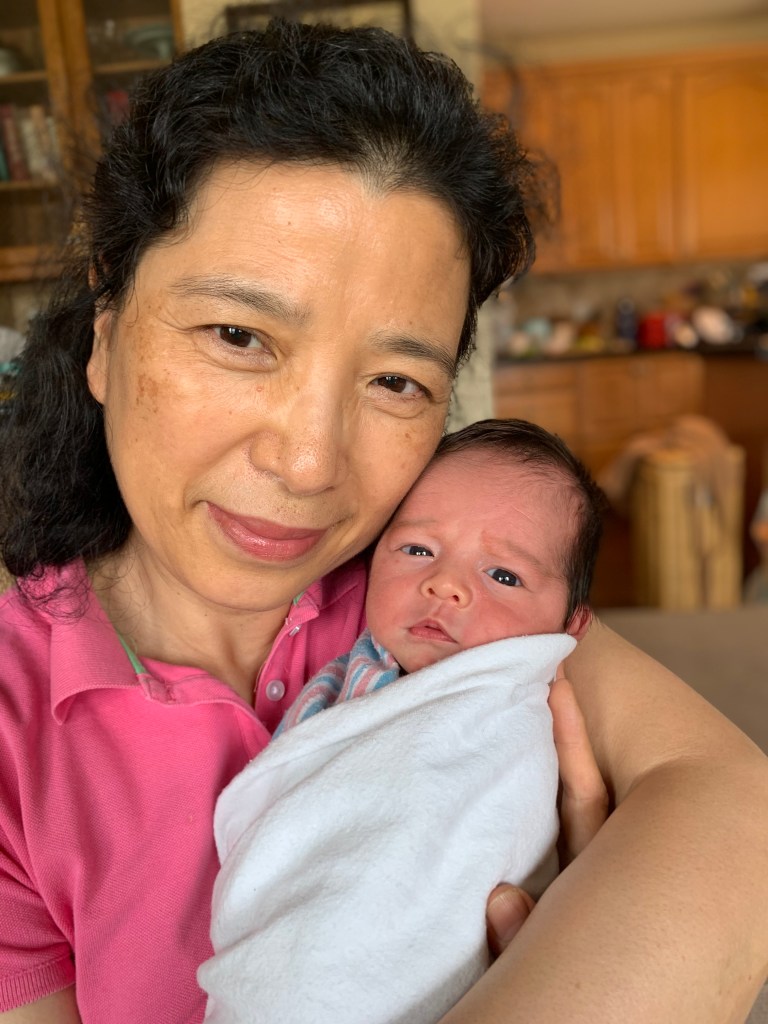
Abba left earlier on Saturday to preach on Sunday, while omma stayed an extra week with us. Every single day, any time he could, abba held Tov in his arms. When Tov made a noise in his crib, abba would zoom right over and scoop him up. He’d plop Tov (bundled in extra blankets, of course) on his round belly and just stare at him for hours while munching on glutinous corn on a chopstick, praying silently, or sometimes dozing off himself. Tov never napped as well as he did in his grandpa’s arms. He just melted right into his grandpa’s warm embrace, sleeping without stirring for three hours.

My omma, too, loved watching Tov. When the boy was especially fussy during the evenings, omma would prop him on her lap and sing to him– fun, silly Korean lullabies about fat papa bears and playful mountain rabbits, and the classic “Jesus loves me” hymn. Sometimes, she sang her own prayers for Tov in Korean and Mandarin to the tune of “Jesus loves me.” As she sang, “God, raise this child to be like his name, that he would enjoy your tov, and be tov and blessing to all!” Tov stopped fussing and just stared at his grandma with wide, bright eyes.

Oh, how full my heart was during those moments! Tov felt like the biggest gift I could give my parents– the joy of holding and loving the child of their child, the fresh marvel and joy of being grandparents. How powerful is this parental love, that it keeps flowing down from generation to generation without losing its purity and radiance. I want Tov to soak up all his grandparents’ love, all the way to his marrows. I want my parents’ prayers for Tov to move the hearts of every angel in heaven to keep and protect him from evil and brokenness. I want Tov to remember the scent and warmth from his grandparents, even if he won’t yet remember their faces and snuggles and coos. Few other things warm a mother’s heart like seeing her child be loved by others.

The day I dropped omma off at the airport, I felt a deep loss. David too said he felt weirdly sad saying goodbye to my parents. It wasn’t just about the convenience of having two extra pair of hands in the house. It was the security and comfort of having our own parents with us, like the coziness of a weighted blanket on a cold winter night, because every parent needs their parents, whether they’re five weeks old or 50. While taking care of my child, I– this proud, stubbornly independent, grown-ass woman– ached to also be cared for by my own parents, to once again be somebody else’s baby.

When we become parents, we see our own parents with new eyes. While my parents were here, abba and I talked about the way my brother and I were raised. I have my own minor grievances about the way I was raised, and I shared some of the instances when I felt my parents had wronged me, or misunderstood me.

Before Tov, some of those grievances still felt a little sore. But I was surprised to discover that the rawness of those childhood memories had faded away. Instead, new healthy skin had formed over that wound– the skin of empathy and compassion for my parents who were once in the same position as me: clueless, fumbling, clumsy, and fallen, but doing the best they can with the best love I could ever receive from a flawed human here on earth. Nobody loved me as fiercely and brokenly as my parents– and nobody loved me as well as they did.

My parents were raised very differently in a very different culture, and that generational and cultural gap will always be there between us, but this new unity of parenthood has unfolded a bridge between our two worlds.

Tov is five weeks old today. He’s chubbier and slowly growing out of his hospital blanket. His needs are more urgent, at least from the way he expresses it. At times, when his needs are not immediately met– (really, because this boy cannot speak! He just scrunches his face and wails! How is a mother to know if he can’t speak his mind. Speak, boy, speak!)– he gets particularly agitated, his hands clenched into little golf ball-sized fists, his legs kicking, his face all wrinkly and red.

It doesn’t matter to him that I’m holding him in my arms, showering him with kisses, showing him in every way possible that I love him. It doesn’t matter to him that I’m exhausted, that I haven’t had more than two hours of uninterrupted sleep for five weeks, that I lost the thing that was most important to me– my freedom– to him. He doesn’t appreciate this love, not yet– he just takes and takes as though receiving love is the most natural and expected thing in the world. Right now, he’s still very young, but one day, I’ll disappoint him even more. I’ll snap at him, dismiss his feelings, misunderstand him, force things on him– all the things parents do when they’re busy or selfish or tired or anxious, or simply loving their kids as best as they can with all their shortcomings.

Perhaps, one clear indication of maturity is when the child can look at all the mistakes of her parents, and respond with compassion and empathy. I hope one day Tov will do that for me– and if I’m lucky, I won’t have to wait till he has a child of his own.