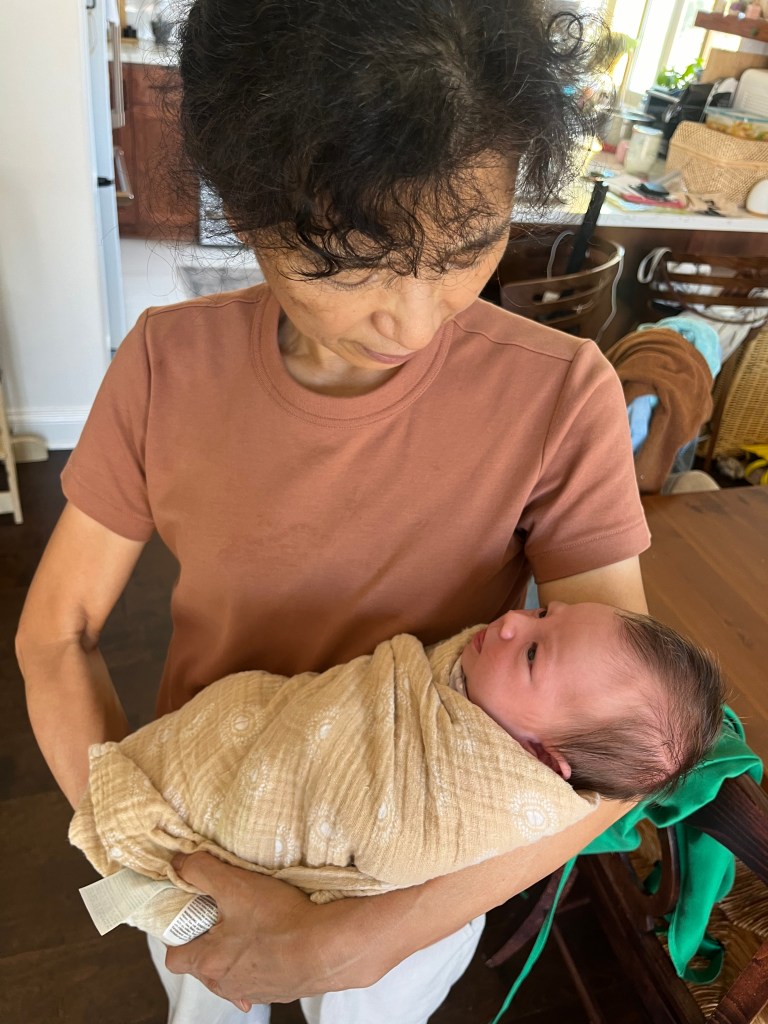

How nursing with Woori is going (It’s not)

I would love to follow up my last post with a post about how I’ve become calm and collected, gentle and lowly like Jesus, but no. I have been experiencing major mom rage, and a lot of that has to do with how nursing is going with Woori.

Probably because at this stage of infancy, all I ever do is feed this baby. All day long. No sooner have I finished nursing, bottle-feeding, then pumping, do I have to start the process all over again.

Woori is 5 weeks today. Which means we’ve been stuck in this hell cycle of triple feeding for five weeks. I would go five more weeks if there were signs that she’s improving, that one day I can exclusively breastfeed her without worrying if she got enough, worrying about pumping, worrying about my milk supply.

But then I go to a lactation support group, weigh her after a 45-minute nursing session, and find out she had sucked only 1 ounce.

Forty-five minutes, and we get 1 measly freaking ounce. I guess that’s better than 8 ml (0.27 ounce), which was what she ingested the first time I joined the lactation support group. But still. I want my 45 minutes back!!!

“She’s…at least getting better,” the lactation consultant Mary said pityingly. She asked me how much I’m pumping.

Two to 5 ounces, I said, depending on time of day.

“So it’s not your milk supply,” she said. “How many times do you pump a day?”

Eight, I told her. Almost every feeding session.

“Well, I’m worried about you. That’s not sustainable,” Mary said.

Nope, it is not.

Mary suggested going to an occupational therapist. But for some reason, the thought of going to another appointment with a specialist that might not work, that might be another waste of time, money, and hope, felt overwhelming to me.

“I just worry about you,” Mary repeated. “What you’re doing is not sustainable.”

I fought to blink away tears. Up till then, I’d been pretty stoic about this triple feeding process. I complained some, but it was a routine I did, day by day, without thinking too much about it. But it was wearing me down. And when I came to this lactation support group, I had had hope that Woori was finally nursing much better. So to see that number— 1 ounce— felt crushing. I wanted to throw myself on the floor and weep.

“Let’s try again,” Mary suggested.

So I went back to the nursing pillow, and tried to rub Woori awake, but she was drowsy from all the calories she spent nursing without getting much calories in return. We stripped her down. We turned a fan on her to keep her awake. She squirmed and pushed but I kept her plastered on me.

Thirty-five minutes later, we weighed her again. She had just under another ounce of milk.

Two hours, 2 ounces. A baby at her age needs about 20-24 ounces a day. That’s 20 to 24 hours of nursing I have to do to get her what she needs, if I were to exclusively breastfeed.

Unsustainable, indeed.

Two evenings ago, I lost it.

We had just finished eating dinner, and as always, David wanted to go for a walk. That’s been our daily routine since we met, but since we’ve had Woori, more often than not, David has been going out for a walk with Tov while I stay home with Woori, nursing and pumping.

This evening, I really wanted to go for a walk too. I had been cooped up at home all day. I had not been able to get my regular workouts in that week because Woori’s naps have shortened to barely half an hour, and when she’s up, she wants to be held. And then of course there’s her feeding schedule.

But come 6:30 pm, I was still stuck in the chair nursing Woori. I had passed out, so I couldn’t tell if Woori had even been sucking or simply suckling.

David stuck his head into the room. “Are we going?”

I opened my bleary eyes. “I don’t think I can go,” I said. I still needed to pump, and it was getting late, and our walks are usually almost an hour long.

So David got ready to go for a walk with Tov without us.

We were alone at home. Again. Man, I really wanted to go out for a walk.

By then I had maybe been nursing for a good 45 minutes. Surely she’s gotten something out of this, I thought.

But no. As I lifted Woori up and walked around the house, she began sucking on her fingers— cues that she’s hungry.

I groaned— a deep, guttural burst of livid frustration. How. HOW! How is she STILL freaking hungry?! Did my milk ducts dry up? What the heck have we been doing for the past 45 minutes?!

In a whoosh, I felt rage boiling out of me like fresh hot lava. I felt resentment that David got to keep all his routine— a 90-minute workout every morning, walks every afternoons and evenings, hot coffees, work and conversations with adults— while I was chained to this never -ending cycle of feeding a baby who had a piss-poor suction. I could feel the hours we spent trying to nurse flattening my butt into a Swedish pancake, all my hard-earned muscles softening like butter. I felt fat. I felt unproductive. I felt utterly demoralized and discouraged and deflated.

I burst into angry tears. And then, because tears were not enough, I picked up the first thing I saw— a big-ass plastic dump truck filled with blocks that a very kind friend had gifted Tov that day— and hurled it across the room. Red and yellow blocks scattered across the floor. That was still not enough, so I kicked his plastic fire truck across the room, too, and it somersaulted in the air and skidded next to the other giant truck.

I calmed down a little then. Or rather, guilt and shame tampered my rage. I felt bad that Tov’s toys had to bear the brunt of my lack of self-control. I checked on them and was relieved they weren’t broken.

Then I warmed up 4 ounces of pumped breastmilk and bottle-fed Woori. Sure enough, she gulped that thing down as though I haven’t just spent the last three-quarters of an hour trying to feed her. I could have cried again.

At that moment, I remembered what a woman had told me after helping watch Woori for an hour: “She’s so easy! All she does is sleep and eat and poop!”

I knew she meant it as a compliment or something. But when I heard it, I felt triggered and irritated. I thought, Of course she’s easy, after you’ve golfed all day and shopped at a farmer’s market and all you do is hold her for an hour in the evening. Of course she’s easy, when that bottle you’ve fed her was squeezed from someone else’s dairy farm. Of course she’s easy, when you get to hand her off so you can go home and sleep when you like, for however long you’d like.

I knew I wasn’t being fair. But I wasn’t in a mood to feel gracious and rational. I felt like my struggles were belittled. And then, on the flip side, I belittled myself: What are you whining about? Why is this so hard? It’s so easy. Just suck it up.

I dried my tears and gulped down my frustrations and picked up Woori and spoke to her gently. Something will have to change, and we’ll figure it out together.

Later, while I was bathing Woori, I heard David and Tov return from their walk. Tov stomped up the stairs to greet his new truck. “Argh! Oh nooo!” I heard him exclaim to see his dump truck turned upside down and all the blocks skittered across the room. I felt guilty, but also tickled at his dramatic reaction. I heard him gather all his blocks again and put them where they belong into the dump truck.

He pushed that truck into the bathroom where I was bathing Woori, and he greeted cheerfully, “Hi!” He had no idea the tantrum I had thrown just 20 minutes before. I pulled him close and kissed his cheeks, penance for throwing his toys, though he had no idea what I had done. If only all the moments of my mom rage could be as easily remedied as picking up plastic blocks.

An hour later, I was back in my nursing chair with Woori, restarting the process again.

Of course, all this could end if I stopped being stubborn and just gave up on breastfeeding. I’m keeping this cycle going because at the end of the day, I still have the privilege of choice. I told myself I’ll keep on going for as long as I can, and maybe that breaking point is coming.

I hired a personal lactation consultant who lives nearby to come visit me. It’ll be the fourth lactation consultant I’ve seen. She’ll visit me next week, and maybe it’ll help, maybe it won’t.

But I need a new plan. Tov’s toys don’t deserve my mom rage.

Gentle & Lowly as a Viper

I have a necklace that I’ve not taken off since I got it two Christmases ago. It’s a thin gold chain with a circle pendant that says “Gentle & Lowly” and has two heart-shaped tags with David and Tov’s initials on it.

I chose to engrave “Gentle & Lowly” on my pendant in reference to Dane Ortlund’s book Gentle and Lowly: The Heart of Christ for Sinners and Sufferers, which draws from Jesus’s own description of himself as “gentle and lowly in heart” in Matthew 11 to point out the essence of God’s heart for His people. It was written for, in Ortlund’s own words, “the discouraged, the frustrated, the weary, the disenchanted, the cynical, the empty. Those running on fumes. Those whose Christian lives feel like constantly running up a descending escalator. Those of us who find ourselves thinking: ‘How could I mess up that bad– again?'”

Reading Ortlund’s book made me look at Matthew 11:29, a familiar verse– “take my yoke upon you and learn from me, for I am gentle and lowly in heart, and you will find rest for your souls”— in fresh eyes. Ortlund points out that of the four gospels, this is the only instance in which Jesus describes his own heart— and if that’s the case, we ought to pay attention: Jesus, the Son of God, King of Kings, describes himself as gentle and lowly in heart. His orientation towards us is that of mercy, love, compassion, self-sacrifice. He hates sin, to the point of dying on the cross because of it, but his heart towards the penitent is open, wide, and forgiving. That has profound implications on our relationship with God, and our relationship with others.

I was moved by the heart of Jesus. His gentleness and lowliness taught me what it means to be “Christlike,” to be “the aroma of Christ to God among those who are being saved and among those who are perishing, to one a fragrance from death to death, to the other a fragrance from life to life.” (2 Corinthians 2:15-17)

If the Jesus who lives inside me through his spirit is gentle and lowly, then I too want to be gentle and lowly. I too want that to be the key descriptor of my heart and posture.

There’s just one problem. I’m about as gentle and lowly as a viper. Anyone who knows me would never think to use “gentle” or “lowly” to describe me. In fact, it’s the people who are closest to me who have been bitten most by my viper moments.

Just a week ago, while my parents were visiting us to meet Woori, I had another viper moment. It was the hottest week of the year, but that’s not what turned me into a viper. I actually cannot always explain why I get so snappish and irritable sometimes. I’d like to blame the sleep deprivation, or postpartum hormones. I’d like to blame my frustration with the lack of improvement in nursing Woori. I’d like to blame the increasing meltdowns from Tov, who have been crying and screaming so often his voice is now as hoarse as a chronic smoker’s. But I cannot. Sometimes, I’m just a bitch for no reason.

David had just clambered up mid-afternoon to get a snack, and he asked me what was in the mixing bowl sitting on the kitchen counter.

“Bread,” I said.

He made a face. “Can we not use the oven today? It’s too hot. I don’t want the AC running all day.”

I ignored him.

“Sophia? Sophia?”

I felt a hot flash of irritation. The dough was already rising, and I was so sick of hearing David complaining about the weather. “Whatever,” I snapped. “Just shut up.” Then I walked away.

My mother, who was present at the time, observed the whole interaction. She went up to David later and told him, “Sometimes, she can really stab a dagger into your heart. She does that to me too.”

I only know because David told me later, while I was nursing Woori. “You really need to watch the way you talk,” he said. It’s like a whiplash, he told me. One moment I’m fine and happy, and the next moment— whoosh! The viper strikes.

I felt like such a fraud. I call myself a Christian, yet there’s very little Christlikeness in me. I am a mother who’s thinking and talking about raising my children in the faith, yet my faith does not primarily shape the way I think, speak, and act.

Gentle and lowly I am not. I am not gentle and lowly with my husband when he annoys me or does things that make me feel misunderstood or unappreciated. I am not gentle and lowly with Tov when he is being particularly whiny and screamy, and my nerves are all frayed from over-stimulation.

All the more ironic that I wear that engraved in my necklace 24/7, and also all the more reason why I should wear it constantly as a reminder. During these moments though, long after I had already struck my head out and sunk my fangs into my prey’s heart, I wear that pendant like a scarlet letter, an ugly red brand of shame and regret.

I feel stuck in this cycle of striking and remorsing. I of all people know best that I need to watch the way I talk, to be slow to speak and slow to anger. The consequences of my speech and action get more and more serious as I age. With my parents, I know they’ll always love and accept me, no matter how poisonous my fangs are. With David, I know there’s a limit before the toxins reach the bloodstreams of our marriage. And as for my children, I am terrified of scarring them for life.

And yet. There are those viper moments, when my fangs rear up before my brain even recognizes what I’m doing. If Jesus’s essence is gentleness and lowliness, my essence seems to be sharpness and haughtiness. It is what spills out of me the instant I’m poked and punctured. It’s hard for me to even ask David for forgiveness then, or pray, when I’d rather tuck my head into a hole and hide, or worse, root around the dirt looking for justifications for my behavior.

There was a time when I wanted to go to seminary to study theology. I read Wayne Grudem’s Systemic Theology for fun. I loved gathering knowledge and understanding, like picking fruits into a basket, and debating things like predestination and complementarianism. I am by nature a nerd and love learning new things, but all that knowledge also puffed me up, deceiving me into mistaking education for sanctification. The fruits of knowledge I gathered in my basket, hoarded but unused, rotted into brown, putrid mush. What’s the use of learning about the fruits of the Spirit— gentleness and self-control in particular— when I don’t manifest them in my own life? So much of my theology has become like my necklace— it’s there, and I’ve gotten so used to it being there, that I no longer put any consciousness into why it’s there, what it’s for. It’s become little more than a pretty decoration, like the wedding ring of an adulterer.

These days, Woori likes to grab at my necklace. She’s still too young to intentionally grasp at objects, but she can wrap her tiny fingers around the chain and tug at it with a firm grip. I’ll have to untangle her fingers, gently removing each finger, careful not to hurt her delicate pink skin. And that’s how I remembered: Oh yeah. The necklace. Gentle & Lowly. With the initials of the two people with whom I’m the least gentle and lowly.

It’s not so much that I’ve forgotten to be gentle and lowly. It’s that I’ve forgotten Jesus, forgotten his heart for me, forgotten to fall in love with his heart over and over again.

Last Sunday, I sat in the church’s nursing room with Woori and listened to a sermon about the historical reliability of the gospels. It was more a lecture than a sermon, the nerdy kind I love, with lots of historical facts and intellectual stimulation. It was an engaging sermon, but I was half-distracted. I listened while struggling to nurse Woori, getting frustrated and discouraged by her lack of improvement, and then fumbling hot and bothered underneath a nursing cover trying to pump as discreetly as I could, silently cursing the men present in the nursing room.

The sermon ended, and worship started. The worship band sang “King of Kings” by Hillsong, a 5-year-old song I’ve heard and sang many times. In fact, I remember grousing internally, Ugh, another Hillsong song. I want old hymns! They’re so much richer and deeper than these contemporary Christian music.

They started singing:

In the darkness we were waiting
Without hope, without light
‘Til from Heaven You came running
There was mercy in Your eyes…

And then the chorus:

Praise the Father, praise the Son
Praise the Spirit, three in one
God of glory, Majesty
Praise forever to the King of Kings

I don’t know why. But I started weeping.

It wasn’t the beautiful melody. It wasn’t just the lyrics. It was just, at that moment, so spiritually parched, I felt the first drop of a light rain, and man, it felt so sweet. So sweet it broke me.

It was the power of worship. Praise the Father. Praise the Son. Praise the Spirit, three in one. Praise forever the King of Kings. A simple praise. A simple reminder of the majesty and glory of God. And I remembered, then, how awesome, how incredibly freeing it is, to simply lift my head up and worship Him, not just for what He’s done, but who He is.

Even when I chose the engraving for the necklace, I was more fixated with what I must become. When I failed, I berated myself, excused myself, hid myself. If I counted all the ways I failed as a wife and a mother and a daughter and a human being, I would get too overwhelmed to do anything about it. I can’t will my heart to change. I need a whole new heart. I need the heart of Jesus.

There is a time to study the Bible like a theologian, to analyze verse by verse with commentaries and highlighters. I don’t have that time right now. Much of my day is spent nursing Woori round the clock, pumping while trying to keep her from fussing and crying, dealing with Tov’s tantrums and antics, cooking and cleaning and oh God, endless loads of laundry stained with pee and poop and breastmilk, a domestic potpourri of sourness, pungency, and sticky sweetness.

But then in the midst of my hurry Woori grabs my necklace, and I think not of what I’m not, but who Jesus is.

This is a time to just think about Jesus, and fall in love with his heart, and worship him, because we become what we worship, and the one I worship is gentle and lowly.

Our Woori, My Woori

Before we had Tov, before I even realized I wanted a child, I had a name for my firstborn.

I got the idea for Tov’s name while reading A Church Called Tov by Laura Barringer and Scot McKnight. I learned what the Hebrew word “Tov” meant then, and I fell in love with it, thinking, “If I had a child, I’d name him or her Tov.” And then I rolled my eyes– yeah, right, like I’d ever become a mother.

Just like Tov, I had a name for my secondborn before she was conceived.

At the time, I was working on a reported piece for Christianity Today about the modern-day challenges of finding community, and it quickly became more a personal essay because the piece was born out of my own frustrations and desire for community. In that essay, I was frank about my shortcomings and the mistakes I made that made community more challenging, and one thing became clear to me: I’m incredibly individualistic.

I’ve always been a very independent person; even as a kid I couldn’t wait to grow up, leave my parents’ house, and forge my own path. Since young, I’ve always been drawn to the western culture and celebration of individualism. It just felt right and natural to me, to emphasize self-autonomy, self-reliance, self-identity. I looked down on the Asian concept of collectivism, dismissing it as unenlightened, suffocating, and oppressive.

Over the last few years, as I study the Bible more and understand more about the nature of God, I’ve come to realize how some characteristics and consequences of individualism are actually unbiblical and toxic. God Himself is Three in One, and through perfect unity and community He created humankind, saying, “Let us make man in our image, after our likeness.” God didn’t call us into an individual relationship with Him; we are called into the Body of Christ to worship and fellowship together in community.

When Jesus Christ came to earth in flesh, he dwelt in a collectivist society, and one of the first things he did when his ministry started was to build a community. He then called us to build the Church– again, community. When he taught us to pray, he didn’t teach us to call out “My Father,” but “Our Father.”

The early churches met and broke bread together every day, sharing their possessions and wealth. The immediate work of the Pentecost was to break down the barriers between languages and cultures, and later creating unity between Gentiles and Jews under one Body and one Spirit. So much of the Spirit’s work is about reaching out to others, reconciling people, and loving people well. The fruits of the Spirit all have to do with our relationship with others.

If God Himself is communal, existing in community and encouraging community, then I need to change the way I think about myself in relation to others, and the change the way I view and participate in community.

That’s how I came to really appreciate the Korean word “woori” (우리), and how unique and pervasive it is in the Korean culture. In direct translation, woori means “we” or “our” or “us,” but the word contains a much deeper Korean concept of self and others. It evokes a sense of community, unity, oneness. Korean culture values community over the individual, expressed through the way Koreans frequently use “our” rather than “my.” That’s “our house,” for instance, or “our husband,” or “our school.”

I really took notice of the Korean concept of “woori” after Tov was born, when my parents would ask, “How’s woori Tov?” “Let us see woori Tov!” “Aigo, why is woori Tov so handsome? Must have grandpa’s eyes!”

Despite becoming so westernized in my thinking, I also realized how Korean I still am, when I felt a twinge after I heard my husband refer to Tov as “my son” rather than “our son.” I felt like I got cut off from the picture. On the other hand, even when David wasn’t around, I referred to Tov as “our son.” That just felt innately right to me.

That Korean use of “woori” might feel jarring for people from a more individualistic mindset. My friend, who just gave birth to a beautiful daughter, recently told me that she had to correct her mother when she cooed at her granddaughter, “There’s my J!” “No,” my friend told her mother firmly. “She’s not your J. She’s not your daughter. She’s my daughter. Mine.” I understood where my friend is coming from. She has a history with her mother, and she’s setting boundaries early. It’s what modern-day therapists and psychologists advise, too: Set boundaries with people for self-care and happy relationships. Only you get to decide what is acceptable and not, what’s your limit. Communicate that clearly to others, especially family, the source of your deepest triggers.

Meanwhile, the word “boundary” as used in this context doesn’t even exist in the Korean language. They literally have to use the English word “boundary.” Koreans might say “don’t cross the line,” but I believe that statement is a modern saying that didn’t become mainstream in Korean society until recently.

I actually think there’s something beautiful and right about my parents calling my children “woori.” It reminds me my children are not my own, that they’re part of a rich and long heritage, that they belong to not just a biological nuclear family but a more timeless, expansive family. I love my children dearly, but my and my husband’s love for them is not the only love that will shape, edify, and enrich them.

And that’s why, about a year ago, as I revised my thoughts on individualism, as I prayed for community, as I took notice of the obstacles I put up between me and a vibrant community, I thought, “If I have a second child, I think I’ll name him or her Woori.”

Several months later, I found out I was pregnant. And on August 19, 2024, I held our daughter in my arms and wrote on her birth certificate, “Woori Grace Lee-Herrmann.”

For all my philosophizing of Woori’s name, the practice of living it out is much harder and messier. I may recognize the good in my Korean heritage’s communal culture to the point of naming my daughter Woori, but there are still aspects of it that make me instinctively recoil and hesitate. Just like there are aspects of the individualistic society that are unbiblical and unhealthy, there are parts about the collectivist society that’s also unhealthy and twisted, and I still struggle to judge what is right and biblical, and what is not.

I am, by nature, still a very individualistic person. I live in an individualistic society steeped in individualistic culture. My Instagram feed is full of expert parenting advice on setting boundaries with your parents and in-laws, on how to raise kids with good self-esteem, a strong sense of self-identity, and a bold voice to express one’s rights and needs– all good things, great things. But some of those things are foreign to my very Korean parents, and we butt heads over our two very different cultural contexts.

If you have an Asian parent, you’ve probably gotten your fair load of unsolicited advice. My parents frequently tell me how to parent our children, which I oftentimes receive as passive-aggressive criticism.

“You have to make sure you wash his hands properly,” my mother would say after Tov developed strep throat, as though we let Tov roll around and sleep in dirt. When we FaceTimed during dinner, she would let out little shrieks as Tov dug into his pasta with his hands, sauce dribbling down his forearms. “Wipe his arms! Wash his hands!”

When she saw a photo of our nanny showing Tov a picture on her iPhone, she immediately texted to remind us not to give any screen time to our child.

When she saw how easily distracted Tov is, she hinted at the possibility of ADHD and exhorted me to train him to focus on one task at a time, even though he was still barely a toddler.

She compared Tov’s speech development with my niece’s, sent videos instructing me how to teach a delayed child to speak, and suggested I send him to a speech therapist.

She reminded me over and over again that a baby needs to sleep in complete silence and darkness. She complained about the loud washing machine downstairs, the loud noises outside, the loud work meetings in David’s office, and other auditory disruptions that will certainly stunt my children’s brain development, disregulate their emotional stability and perhaps that’s why Tov’s so delayed in speech and so unfocused?

Each time this happened, grenades popped off inside me. “Aish, Omma, just stop nagging!” I would snap at her, and my father would jump to her defense. “No parent nags less than we do!” he snapped back. “You don’t know how good you have it.” And then he preached about the Bible commanding us to honor our parents. “Let us live according to the Bible,” he said. “Blessed are those who let their parents nag.”

“Pretty sure that’s not in the Bible.”

“Oh, woe is our generation,” my father lamented. “We are the most pitiful generation ever. When we were young, we could not say a word back to our elders. We had to respect and tiptoe around them. Then we have children, and times have changed. Our children now disrespect us, and we have to tiptoe around our children. We served those above us and now we serve those below us, and nobody serves us!”

“So you want me to tiptoe around you, kowtowing and saying ‘yes, yes’ to everything you say?” I retorted back.

My father shook his head, as though shaking his head at the entire spoiled, entitled, and disrespectful generation to which I belong. “Truly, the end times are coming. Culture is changing too fast. So let’s just do as the Bible says. Honor your parents.”

“Honoring your parents doesn’t mean we just have to keep quiet when you’re vexing us,” I said, getting more and more heated. “The Bible also says, do not vex your children.”

Here’s the thing: I really, really like the concept behind “woori.” I really appreciate the values of community, unity, and sacrificing self for the common good. It’s so ideologically charming and pleasing, like the idea of sipping tea in an old English cottage with a thatched roof– until you realize those quaint, pretty roofs can be annoying to maintain, vulnerable to fungal attacks, fire, and bug infestation.

I like my parents calling my children “woori” until the actual practices of it grate against all my individualistic impulses and preferences. I don’t like people telling me what to do, even if it comes in the form of harmless advice and suggestions that I can always choose not to follow. I love it community when my parents help watch Tov so David and I can go on a date, or when they say nice things about them, but I get triggered when my mother worries over Tov or Woori, or mutters the mildest hint of criticism, and I get even more triggered when my father starts preaching at me with Bible verses. I like the “woori” concept only when it benefits me and requires little effort or sacrifice from me: You can love my kids, but from a distance, saying only positive things, and God forbid you care enough to suggest what you think might be best for them. That’s the opposite of what “woori” is.

I don’t intend to obey everything my parents say. I’m an adult, and they raised me to be independent and mature, capable of making my own decisions. But at the very least, I can listen to their unsolicited advice and their preaching without getting snappish, even if they annoy me, and be genuinely thankful that someone else cares so much about my children to worry and nag about the details of their upbringing, things that most people don’t even bother thinking about because our children are not “woori” children.

Woori’s name was a gift from me to her– a prayer, a blessing, and a benediction that she would never lack community, that she will seek and find and form a community wherever she goes, breaking and sharing bread with all kinds of family.

But Woori’s name is also a prayer and a blessing for me, too, as Tov’s name has been for me. Both our children’s names embody an important, essential characteristic of God. In my pursuit to know God more, to meet him the way Moses did– speaking to him face to face, “as a man speaks to his friend” (Exodus 33:11)– I see the image of God in my own children, even as they reflect my image: Woori Tov, and woori Woori.